DIY amateur radio
Suggestions, construction proposals, circuit diagrams
The history of amateur radio began as early as the period before 1920. One used self-built equipment, as commercially available devices did not exist at that time. The shortwaves were left to the amateurs for their experiments, since no commercial significance was attributed to them. With simple transmitters and receivers for Morse telegraphy, increasingly distant radio contacts were achieved, which quite soon even reached across the Atlantic.
Already during the 1950s, the trend increasingly shifted towards commercially available receivers, and the importance of voice communication grew steadily. Consequently, there was much experimentation with various modulation methods. From around the late 1960s onward, the majority of amateur radio stations were also equipped with commercially available transmitters, which were increasingly capable of single-sideband modulation. The introduction of license class C in Germany, which permitted radio operation exclusively above 144 MHz, led to a renewed surge in home-built radios from 1967 into the 1970s, until many commercially VHF devices became available for purchase.
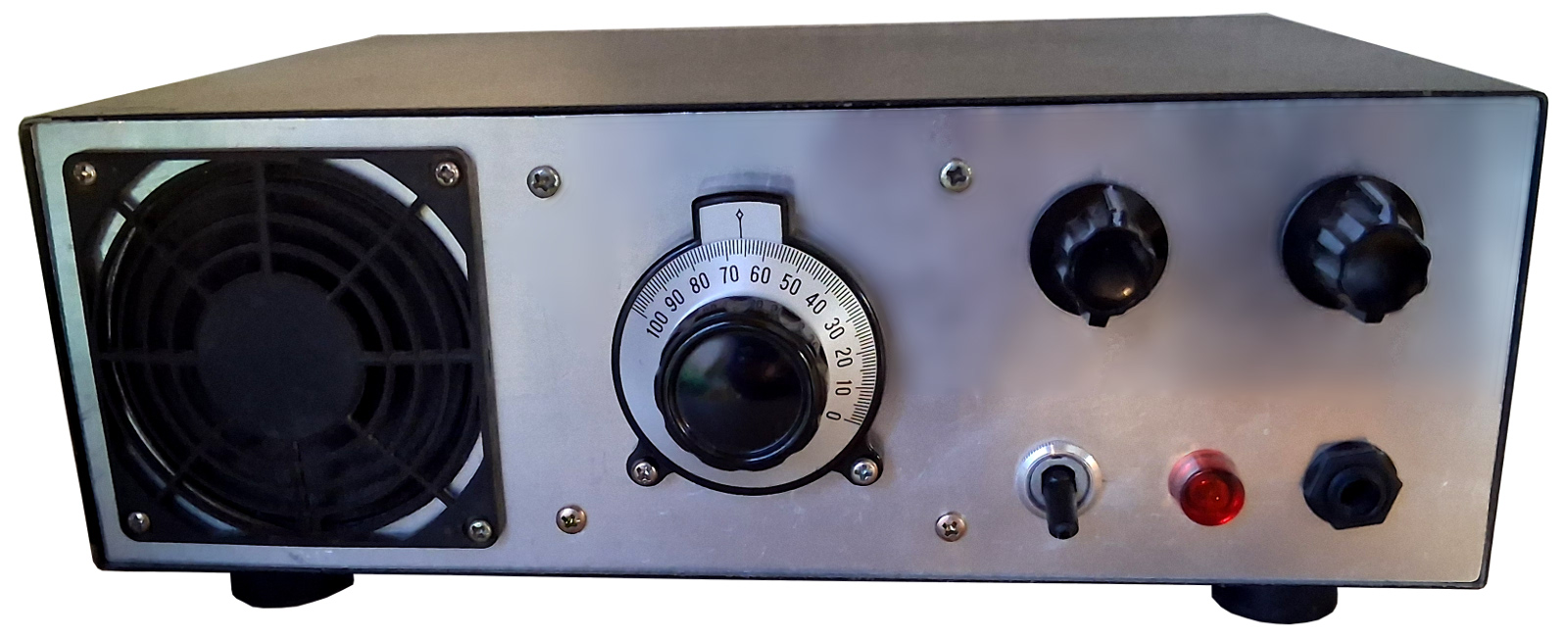
My personal main interest in amateur radio has always been, and remains, operating radio equipment that is not only self-built but, where possible, largely self-designed. This doesn't require a huge investment of money. With careful planning, surprisingly simple radios can be constructed not only for telegraphy operation but also for amplitude, frequency, or single-sideband modulation! I don't intend to provide step-by-step instructions here, but rather to offer suggestions and encourage experimentation with classic circuits!
73 de DL4CS, Claus Schmidt
DIY receiver for amateur radio newcomer
Those interested in amateur radio used to begin by listening to radio communications on the amateur bands. However, for various reasons, this wasn't so easy. The shortwave range of most radio receivers started at around 5 MHz. This meant that the 80-meter band, very popular with many amateurs at the time, couldn't be received at all... read more
The construction of simple shortwave amateur radio stations
After passing the amateur radio license exam, radio operators typically began with a simple, home-built transmitter. This was added to an existing receiver, which had previously only been used for listening on the amateur bands. The station thus assembled was initially usually only suitable for telegraphy operation... read more
DIY devices for single-sideband modulation
During the 1960s, single-sideband modulation (SSB) became increasingly prevalent for shortwave voice communication. By the mid-1970s, amplitude modulation (AM) was rarely used by amateur radio stations on the shortwave bands. Initially, the phase shifting method was popular for single sideband modulating transmitters because it didn't require an expensive crystal filter... read more
Experiments with amplitude modulation in the 10m band
The oldest modulation method for transmitting audio signals (e.g., speech or music) is amplitude modulation (AM). Its efficiency depends heavily on the concepts used at both the transmitter and receiver, offering technically minded amateurs a wide field for experimentation. For example, old AM CB radios can be modified for the 10-meter band with minimal effort... read more
Transmitter and receiver circuits for the 2m band
Not only among amateur radio operators did a particular interest in ultra-shortwave radio technology, considered state-of-the-art at the time, develop at the beginning of the second half of the 20th century. This led to the construction of many simple, home-built devices in which a VHF oscillator, used as a transmitter, functioned as a superregenerative receiver with over-regeneration during reception... read more
Amateur radio bands from 160m to 70cm
160m-Band: 1810 - 2000 kHz (MW)80m-Band: 3500 - 3800 kHz (KW)
60m-Band: 5351,5 - 5366,5 kHz (KW)
40m-Band: 7000 - 7100 kHz (KW)
40m-Band: 7100 - 7200 kHz (KW)
30m-Band: 10100 - 10150 kHz (KW)
20m-Band: 14000 - 14350 kHz (KW)
17m-Band: 18068 - 18168 kHz (KW)
15m-Band: 21000 - 21450 kHz (KW)
12m-Band: 24890 - 24990 kHz (KW)
10m-Band: 28000 - 29700 kHz (KW)
6m-Band: 50080 - 52000 kHz (VHF)
4m-Band: 70150 - 70210 kHz (VHF)
2m-Band: 144 - 146 MHz (VHF)
70cm-Band: 430 - 440 MHz (UHF)
Areas highlighted in bold are those that were already
open to amateur radio in Germany before 1979.
Further circuits and articles on amateur radio technology:
- A Two-tone roger beep for amateur or CB radio stations
- Audio amplifiers for radio receivers and two-way radios
- Calibratable S-meter with LED bar display
- Interference signal reduction with Selectoject, noise blanker and DNL
- Retrofitting existing AM receivers for narrowband FM reception
- Arrangements for increasing the modulation strength
- Greater ranges with amplitude modulation: The HAPUG-Modulation
- How general coverage receivers with a Wadley loop work
- This is how frequency generation works with a PLL-Synthesizer
- VHF range calculation using radio and antenna data
- Glossary: Technical terms and abbreviations used (still only in German)