What's going on here?
What's CB radio doing on the website of a licensed amateur radio operator? Quite simply: CB radio is a radio application for everyone. Why shouldn't that interest an amateur radio operator? Racing drivers, with their interest in automotive technology, certainly don't ignore the fact that many people drive ordinary cars. And many amateur radio operators gained their first radio experience through CB radio. Furthermore, the history of CB radio is very interesting, especially from a technical perspective. CB radios can be modified for amateur frequencies and can serve as parts donors for DIY projects. Studying them can also provide interesting inspiration for one's own designs. Reason enough to publish something about CB radio here!

USA: Birthplace of CB radio
After the end of World War II, there was a great international interest in the civilian applications of radio technology and electronics. Many who had served as soldiers had come into contact with so-called transceivers. These radio systems, primarily designed for portable use and therefore relatively compact, combined the transmitter and receiver in a single device... read more
Cheap walkie-talkies from the Far East
With the increasing use of transistors in radio and wireless technology, walkie-talkies became more widespread. Such one-handed devices, containing the complete transceiver including batteries, antenna, speaker, and microphone, had already been in use by the American military for some time... read more
The beginnings of CB radio in Germany
In Germany after World War II, during the division into four occupation zones, there was initially no legal framework for amateur radio. Despite the threat of punishment, stations in some areas resumed radio operation using simple equipment, typically consisting of a basic feedback receiver and a single-stage transmitter, employing self-invented call signs... read more
Allowed: Mobile Units, Home Stations, and "Handy-Talkies"
With the release of 12 CB radio channels in 1975, the use of three types of radio equipment was permitted for everyone: units for vehicle installation, portable units, and station units. A prerequisite for legal operation was that the equipment used had to be tested by the telecommunications authority and, in connection with this, receive a test number mechanically stamped into the housing... read more
Prohibited: "Export" radios and afterburners
Since the advent of 27 MHz radios in Germany, devices whose use was prohibited domestically have also been available on the market. Initially, dealers always added the disclaimer "for export only" to such offers and advertisements. In reality, these devices, which were mostly manufactured in Japan and thus actually imports, were rarely re-exported... read more
Stories that went down on CB radio back in the day...
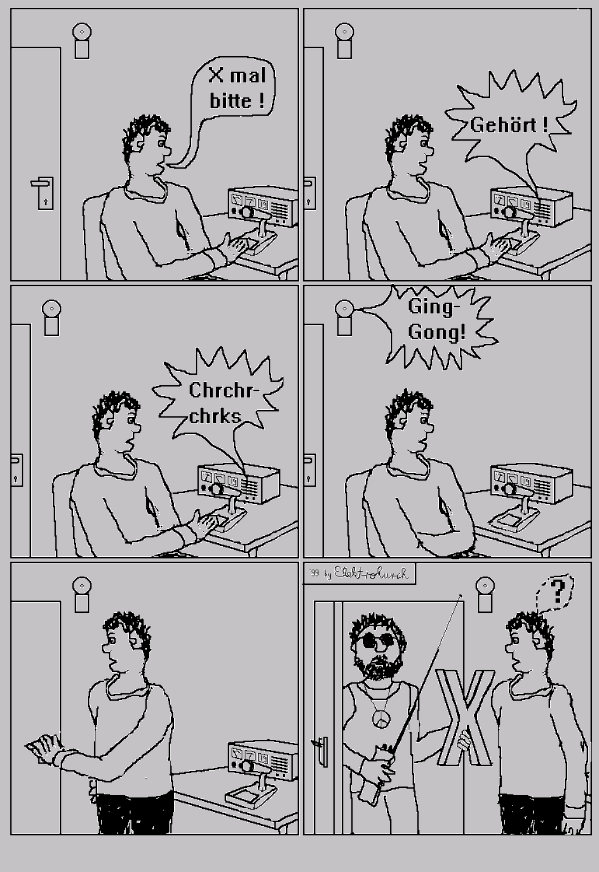
In Germany, instead of the international 'break,' CB operators widely used the letter 'X' (pronounced 'ix') to cut into a conversation—a habit that can still be heard occasionally today. It originated from the Q-code 'QRX,' which was mistakenly adopted as a request to join, even though it officially means 'standby.' Since the full code was often too long for the brief pauses between transmissions, it simply got shortened to 'X'.