The beginnings of CB radio in Germany
In Germany after World War II, during the division into four occupation zones, there was initially no legal framework for amateur radio. Despite the threat of punishment, stations in some areas resumed radio operation using simple equipment, typically consisting of a basic feedback receiver and a single-stage transmitter, employing self-invented call signs. Communication was conducted exclusively in telegraphy, i.e., via Morse code. Many soldiers in Germany had also become familiar with portable and easy-to-use transceivers for voice communication. Towards the end of the war, the German Wehrmacht was equipped with large numbers of so-called "small radio transceivers." The "d" model, also known as the Dorette, was particularly widespread for the frequency range of 32 to 38 MHz. While these transceivers were somewhat more complex in design than the American BC222, they also used a direct-wave receiver with superregeneration, which acted as an oscillator during transmission. Thus, the same resonant circuit determined the operating frequency for both receiving and transmitting.
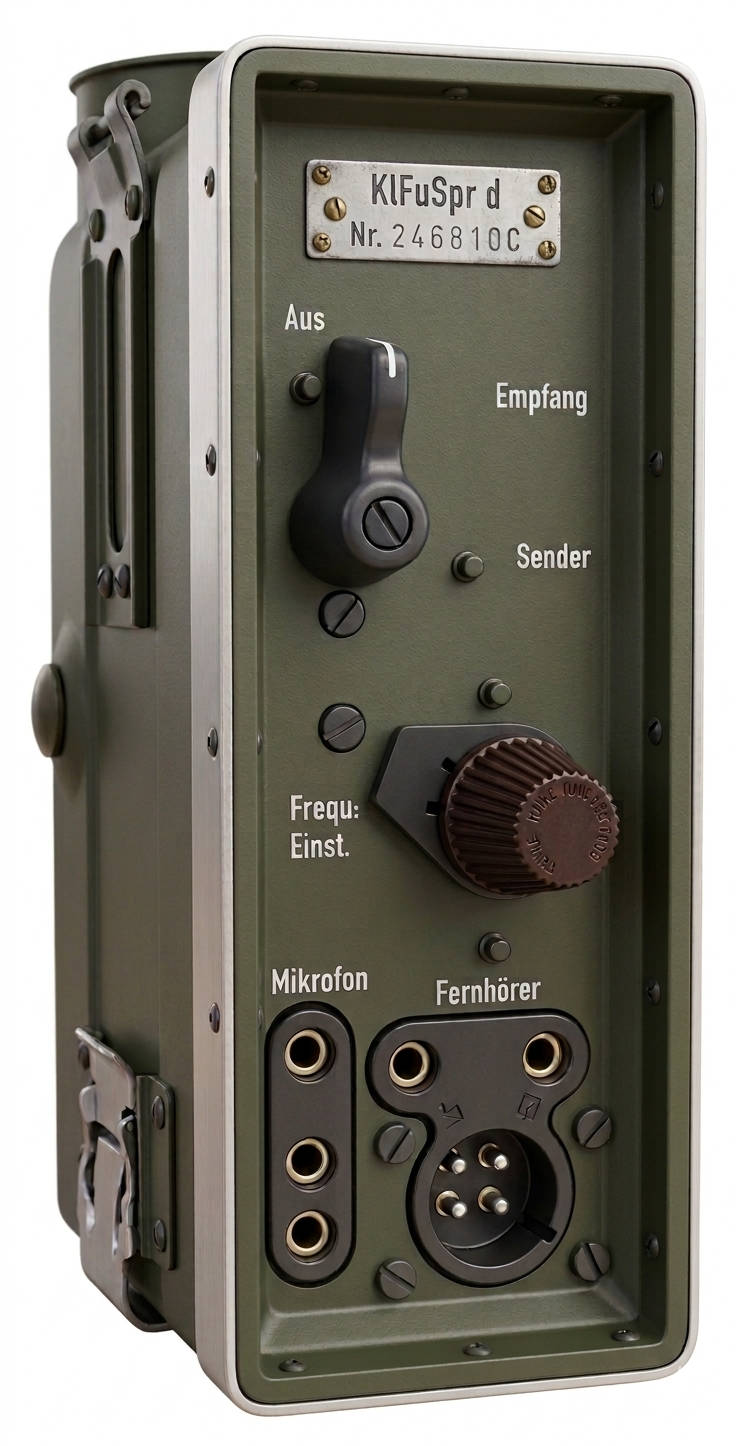
In the late 1940s, following the legalization of amateur radio in Germany, many radio enthusiasts joined the amateur radio movement. Some focused on building simple transceivers, for which numerous construction manuals were published. These were generally simpler in their circuitry, like the Dorette, and were more closely based on the BC222 design. After the war, large quantities of decommissioned military equipment, including the Dorette, were soon available through radio retailers. In addition to building their own transceivers, amateur radio operators frequently modified such devices for operation on the amateur bands. In principle, it was sufficient to adapt the transceivers to the amateur band. By spreading the frequency using parallel capacitors, the frequency range could be reduced to the 10-meter band.
During the economic boom of the 1950s, a great deal of interest developed in model making as a hobby and the possibility of remotely controlling these self-built models by radio. Remote control systems and circuits for transmitters and receivers were therefore published in abundance in the trade press and literature. The most common construction plans were for systems operating in the 27 MHz band. The 13.56 MHz frequency, which was also allocated at the time, required an excessively complex antenna. In the 70 cm band, which was also permitted for model remote control at that time, the technical requirements for the transmitter and receiver were significantly higher. Because the 27 MHz band is quite close to the 10-meter amateur band, some people had the idea of illegally using the published transmitter and receiver circuits for voice transmissions. Furthermore, the desire for private wireless communication options, where not every participant needed a license, grew increasingly louder. From around the end of the 1950s, therefore, the operation of illegal two-way radio systems in the 27 MHz band in Germany became increasingly common. For this purpose, home-built devices based on construction manuals for the 10-meter band were used, as well as repurposed remote-control circuits or modified military equipment, such as the 'Dorette' small portable radio transceiver.
With the increasing prevalence of semiconductor technology, Japanese manufacturers attempted to conquer markets worldwide with their transistorized two-way radios. Such devices were increasingly offered in Germany as well. Initially, these were primarily portable two-way radios that could be operated with one hand, had a built-in antenna and battery compartment, and allowed the user to speak directly into the transmitter when the transmit button was pressed. The term "walkie-talkie" soon became established for such handheld radios. Simpler models had a superregenerative receiver and a single-stage transmitter. They were often equipped with only four transistors. Slightly better models had a simple superheterodyne receiver and a two-stage transmitter and usually operated with seven to nine transistors in total. More sophisticated models used 12 transistors or more and featured switchable channels, a built-in squelch, connections for an external power supply, and a vehicle or base station antenna. All such devices were offered either in amateur versions for the 10-meter band or as devices for the 27 MHz band. The 10-meter radios were usually crystal-equipped for operation at 28.500 MHz when delivered. For multi-channel radios, the necessary crystals had to be ordered separately to use additional channels. Simple radios for the 27 MHz range initially often operated on the ISM frequency of 27.12 MHz, which was also approved for model radio control. The intended use of this frequency range was (and still is) for high-frequency devices for industrial, medical, and scientific purposes, such as medical irradiation equipment or laser welding systems. ISM stands for the corresponding English terms Industrial, Scientific, and Medical. Since the ISM frequency only had a relatively large frequency tolerance of ± 0.006% for 27 MHz, voice channels on frequencies between 26.96 and 27.28 MHz were considered for two-way radio applications in this range, taking into account the bandwidth of an AM signal.

In 1959, the so-called FTZ number was introduced in Germany and became mandatory for two-way radio equipment from 1960 onwards. FTZ was the abbreviation for the Federal Office for Radio Technology (Fermeldetechnisches Zentralamt). An FTZ number was only issued after testing by this authority and had to be clearly displayed on the radio equipment by the manufacturer. This testing focused primarily on compliance with technical specifications, such as transmission power, operating frequencies, and, in particular, the suppression of unwanted spurious emissions. Initially, for example, VHF two-way radios used for taxi or business radio received such FTZ numbers, which began with the letter E. In the spring of 1963, FTZ numbers beginning with the letter K were also introduced for so-called "low-power two-way radios for the frequency range of 26,960 to 27,280 kHz." This legalized the use of radio equipment for the 27 MHz band in Germany. However, the use of these devices was subject to certain conditions. First and foremost, a permit had to be obtained from the postal service, and the application had to be adequately justified. A crucial criterion for issuing permits was that the public telephone network was unsuitable for the intended use. Depending on the intended use of the radio equipment, permits were granted for one of the channel groups I to V introduced for this purpose.
Group I
Intended for bodies with security tasks (e.g. police, fire brigade, customs, German Red Cross, Federal Agency for Technical Relief, German Life Saving Association):
Channel 1: 26.965 MHz (also today on CB radio channel 1)
Channel 2: 26.975 MHz (also today on CB radio channel 2)
Channel 3: 26.985 MHz (also today on CB radio channel 3)
Channel 4: 26.995 MHz (later no longer permitted for CB radio)
Channel 5: 27.005 MHz (today's CB channel 4)
Channel 6: 27.015 MHz (today's CB channel 5, was only added in the early 1970s)
Channel 7: 27.025 MHz (today's CB channel 6, was only added in the early 1970s)
Channel 8: 27.035 MHz (today's CB channel 7, was only added in the early 1970s)
Group II
intended for authorities and associations that have tasks to perform in the public interest (e.g., utility companies in the gas, water or electricity sectors, surveying offices, municipal or city administrations):
Channel 9: 27.045 MHz (later no longer permitted for CB radio, was only added in the early 1970s)
Channel 10: 27.055 MHz (today's CB channel 8)
Channel 11: 27.065 MHz (today's CB channel 9)
Channel 12: 27.075 MHz (today's CB channel 10)
Channel 13: 27.085 MHz (today's CB channel 11)
Group III
intended for internal use in industrial companies, freight forwarding companies, and civil engineering companies (e.g., for communication on construction sites):
Channel 14: 27.155 MHz (today's CB channel 16)
Channel 15: 27.165 MHz (today's CB channel 17)
Channel 16: 27.175 MHz (today's CB channel 18)
Channel 17: 27.185 MHz (today's CB channel 19)
Channel 18: 27.195 MHz (later no longer permitted for CB radio, was only added in the early 1970s)
Group IV
intended for use by sports clubs or for purposes that promote sports, as well as for economic purposes in trade and commerce:
Channel 19: 27.205 MHz (today's CB channel 20, was only added in the early 1970s)
Channel 21: 27.225 MHz (today's CB channel 22)
Channel 22: 27.235 MHz (today's CB channel 24)
Channel 23: 27.245 MHz (today's CB channel 25)
Channel 24: 27.255 MHz (today's CB channel 23)
Channel 25: 27.265 MHz (today's CB channel 26)
Channel 26: 27.275 MHz (today's CB channel 27)
Group V
Intended for applications where frequency groups I to IV are not suitable:
Kanal 20: 27.215 MHz (today's CB channel 21)

In practice, the use of 27 MHz radios by private individuals was severely restricted under these regulations. Only those who could present a compelling case for their application or possessed a business license had a chance of obtaining a permit for frequency groups IV or V. The use of frequencies in groups I and II was completely prohibited for private purposes. Company owners and employees often used radios approved for business purposes on frequency group III not only for business purposes, and sometimes even exclusively for private use, although this was not the intended use. Group V permits were granted, among other things, in medical or nursing contexts. Most radios approved during this period were handheld devices. Devices eligible for approval with an FTZ number invariably used crystal-controlled superheterodyne receivers. Initially, simple single-channel devices without squelch were very common, but these were soon superseded by devices with two or three switchable channels and adjustable squelch. These devices usually also had a connection for an external antenna, allowing for significantly greater ranges in conjunction with their higher transmission power. At the same time, the market share of vehicle radios, which typically had six switchable channels, increased. Operating such devices in a stationary position with a AC net power supply was prohibited, with a few exceptions.
Group IV played a particularly important role in the development of CB radio for everyone. Here, even owners of small businesses had a chance of obtaining a radio license. To secure such a license, some businesses even invented imaginative proposals for new services, which were never actually implemented. The sporting sector could also be interpreted very broadly as a justification for obtaining radio licenses. Provided the reasoning was strong enough, these could even be secured for use in soapbox races or the minor private rallies once a bit disparagingly known as 'coffee tours'. Within the context of more or less serious motorsports, clubs sprang up throughout Germany whose statutes listed free breakdown assistance for motorists as one of their objectives. They attracted a large number of members, whose primary goal was to obtain a license to operate a 27 MHz radio. Licenses for such use were also granted for operation on the frequencies of Group IV. With the rapid increase in radio licenses, a "chat radio" system developed on these six channels, designated A, B, C, D, E, and F, with a growing number of participants. Members across different clubs were given the same call signs, followed by a sequential number (e.g., "Edelweiss 67" or "Panther 31"), which were then entered into their license certificates. Due to the large number of participants, it became virtually impossible for the authorities to verify, simply by monitoring the frequencies, whether all participants actually possessed a license, as call signs were often "lent" to friends.

Although radio operations on the frequencies of Group IV got somewhat out of control, it turned out that no one suffered any serious harm. Voices within the german postal authority, then responsible for radio matters, and in political circles grew louder, advocating for open radio access for everyone, modeled on the American CB radio system. However, the resistance was immense, and opponents prophesied the imminent downfall of Western civilization if spies and terrorists were now able to use this technology unhindered. The regulations for 27 MHz radios had just been adapted to the increasing demand and technological advancements when, on July 1, 1975 – surprisingly even to many insiders – twelve channels in the 27 MHz band were opened for general use. Care was taken in selecting the frequencies to ensure that the channels of Groups III to V remained unaffected, allowing users of those channels to continue using their equipment as before. Only Groups I and II lost channels to the new public access radio system, including some that had only recently been introduced. The four channels remaining for Group I at the lower end of the band were now sufficient, as there was hardly any demand for them anyway. The Criminal Investigation Department (CID) still occasionally used 27 MHz handheld radios for crime scene investigation, but gradually the police, as well as smaller volunteer fire departments and emergency services like the German Life Saving Association (DLRG), replaced their remaining 27 MHz devices with FM radios for the public safety channels in the 2-meter and 4-meter bands. Handheld radios were now available for these bands as well, and these were of much higher quality than the previously used radios. Consequently, there were now almost no users left for Group II either.
27 MHz channels released to everyone in Germany on July 1, 1975:
Channel 5: 27.015 MHz
Channel 6: 27.025 MHz
Channel 7: 27.035 MHz
Channel 9: 27.065 MHz
Channel 10: 27.075 MHz
Channel 11: 27.085 MHz
Channel 13: 27.115 MHz
Channel 14: 27.125 MHz
Channel 15: 27.135 MHz
Channels 27.105 to 27.135 MHz were particularly unattractive in densely populated areas, especially during the day, as they were close to the ISM frequency of 27.12 MHz. Consequently, interference from industrial, medical, and scientific frequency users was often strongest in these channels, rendering them unusable for commercial two-way radio operators anyway. Some manufacturers used the channel designations A to L for their devices equipped with 12 switchable channels. At the same time, many devices with six or fewer channels were still in use. On other twelve-channel devices, such as the first series of the DNT Meteor 5000 base station shown at the beginning, the channel selector was labeled with the numbers 1 to 12, even though the frequencies now approved for public use in Germany were the international CB channels 4 to 15. These channel designations only gradually became established, a process aided by devices originally developed for the US market where the channel selector was labeled with the international channel designations 1 to 23. In such devices, adapted for German regulations, channels 1 to 3 and 16 to 23 could not be selected due to a mechanical lock; furthermore, the necessary crystals were missing. Consequently, only channels 4 to 15 could be selected using the channel selector.
What was new was that mains-powered devices for stationary use were now also permitted. The RF output power of these devices, which FTZ numbers beginning with the letters KF, was limited to 0.5 watts. To prevent competition with the wired telephone network, radio operation from fixed station to fixed station was prohibited – a regulation that was hardly observed in practice. Furthermore, these devices had to be registered with the German Federal Post Office. The respective owner then received a registered call sign, which had to be used during radio operation. With certain limitations, the wishes of the license holders were taken into account when assigning the call sign. A rather high monthly fee of DM 15 had to be paid to the German Federal Post Office for these so-called home stations. The operation of vehicle and handheld radios, whose FTZ numbers began with the sequence PR27 and ended with /M or /P for mobile or portable, was, however, free of charge, and their owners were not registered. These devices were subject to a general permit for movable, low-power two-way radios operating in the frequency range 26960–27280 kHz, bearing an FTZ serial test number in the letter series "PR27...". The most important regulations for operating these devices could be found in the document, which had to be carried at all times during operation. The term CB radio did not appear in it. It was officially introduced in Germany for so-called "everyones radio" only many years later.
Circuit diagrams of typical car radios from the early days of CB radio in Germany
- 6/8-channel mobile transceiver Sommerkamp TS-750 with individual crystals
- 12-channel mobile CB transceiver Kaiser KA-9012L with dual-conversion receiver and individual crystals
- 12-channel mobile CB transceiver N-Transceiver 527 with dual-conversion receiver (mixing synthesis)


