Cheap walkie-talkies from the Far East

With the increasing use of transistors in radio and wireless technology, walkie-talkies became more widespread. Such one-handed devices, containing the complete transceiver including batteries, antenna, speaker, and microphone, had already been in use by the American military for some time, most notably the BC-611 shortwave AM radio ("the Fat Telephone") since 1942, and the PRC-6, often called the "Banana," since 1950, which operated in the lower FM frequency range. However, because these devices still used vacuum tubes, they were complex in design and required expensive, specialized batteries. Such devices were unsuitable for cheap mass production. Furthermore, despite their relatively large size and considerable weight, the range of these radios was rather limited at transmission powers of 360 or 250 mW. The main reason for the BC-611's limitations was that it operated in the lower shortwave range at frequencies around 4 MHz, for which its telescopic antenna, despite its considerable length, was simply too short. While the PRC-6 was superior, its use of broadband frequency modulation resulted in a significantly unfavorable signal-to-noise ratio for such low transmission powers.
For the 27 MHz frequencies used in CB radio, transistors suitable for the transmitter section of radios became available at acceptable prices from around the mid-1960s. Transmit powers of several hundred milliwatts were thus achievable. Consequently, various American manufacturers quickly produced fully transistorized handheld CB radios. These typically contained a two-stage transmitter and a full-fledged superheterodyne receiver. Double superheterodyne receivers were not uncommon in such handheld radios. While these devices were not exactly cheap, considering their size and weight, their receivers, designed with a bandwidth suitable for a 10 kHz channel spacing, offered quite respectable ranges.
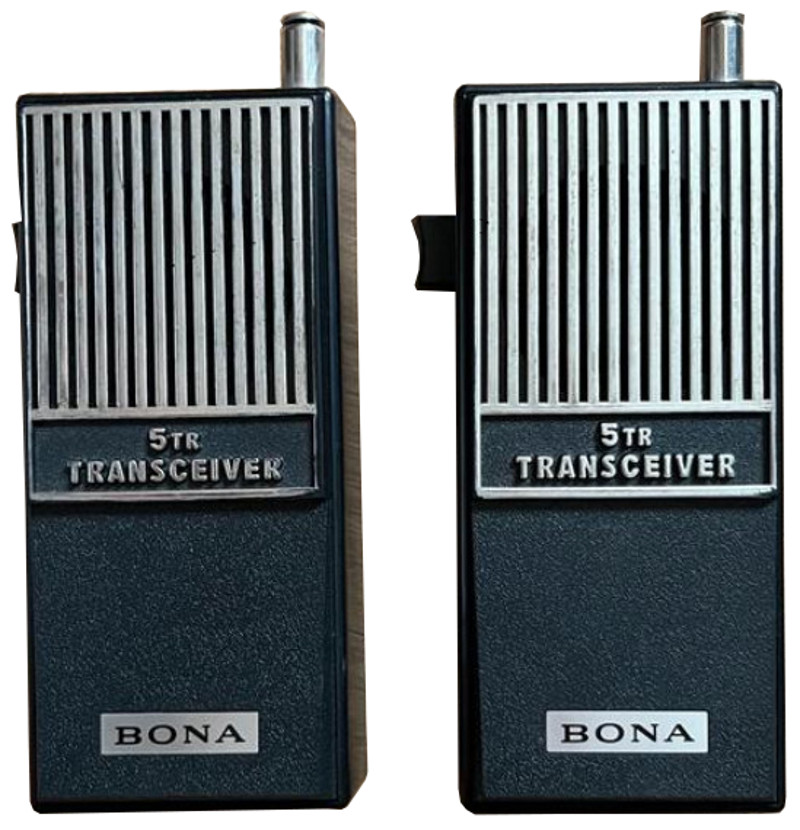
Soon, very simple and inexpensive handheld radios appeared, first in the USA and shortly thereafter in many other countries. These were often sold through retail chains, mail-order companies, or even gas station shops. Manufactured in Japan, these devices revived the by then-outdated transceiver concept, which used a superregenerative receiver. The novelty, however, lay in the fact that these devices were now built with transistors, often indicated by the inscription "Solid State" on the device. The number of transistors in the circuit was often stated in the external labeling. However, this was often misleading, for example, by using defective transistors that were then simply employed as diodes. Many such devices were built with a total of four transistors, although only three were actually needed: the audio output stage, used as a modulator during transmission, consisted of two transistors connected in parallel. This allowed for the use of two slightly lower-powered transistors. By stating that it contained four transistors, the impression could be given that such a device was of somewhat higher quality than a 3-transistor device.


The ranges achievable with such simple devices are naturally limited. Outdoors, distances of a few hundred meters can be bridged at most with a clear line of sight, while indoors, radio contact with immediately adjacent rooms is often impossible. Because superregenerative receivers emit considerable interference in the form of noise to the antenna, such devices were never approved by the relevant authorities in Germany when radio operation in the 27 MHz band became commonplace. Nevertheless, devices of this type, now manufactured in Taiwan (R.O.C.), suddenly reappeared in large quantities in Germany in the 1990s. As the circuit diagram of such a device shows, it transmits on the frequency of 49.86 MHz. However, there were also versions that operated with a 27.125 MHz crystal. To this day, such devices, in new guises, can still be found in various supposed special offers or as promotional gifts or merchandise. Now manufactured in China, they usually even bear a CE marking, although it's doubtful they meet the necessary product standards or requirements. In direct performance comparisons, these newer devices often perform significantly worse than comparable devices from the 1960s. For all these reasons, I can only advise against using them.
