Simple circuit for generating a two-tone roger-beep
In radio communications, it is not always easy to tell if the distant station has finished speaking. This is particularly true in cases of high interference levels or when operating through a repeater, where the S-meter reading does not indicate whether the partner has released the PTT button. With the advent of transistor technology during the 1960s, circuits for generating automatic microphone handover tones soon became popular among the amateur radio community. The popularity of such devices was likely bolstered by the live broadcasts of American spaceflights on radio and television—particularly the Apollo moon missions. At the beginning and end of transmissions from the ground station, one could often hear the so-called "Quindar tones" (2,525 Hz and 2,475 Hz, each lasting 250 milliseconds), though these served a different purpose. They were used to switch the networked ground transmitters on and off, ensuring constant contact with the astronauts regardless of the Earth's rotation. Tones of a similar sound gave amateur radio transmissions a particularly professional touch. Over time, the term "Roger Beep" became established for devices that generate these tones automatically. While many modern CB and amateur radio sets include such a feature as standard—activated via a switch or menu—a corresponding circuit that can be connected to almost any transceiver (including older models) and easily adapted to individual preferences can be built with little effort.
The Roger Beep circuit presented here is well-suited for beginners in amateur radio and electronics, as it requires only a few, very robust components. Nevertheless, it features a special characteristic: it transmits two different tones in succession. This is achieved using a simple tone generator built with just a single transistor, visible on the left side of the schematic. It is a feedback-based low-frequency amplifier stage. Due to the RC network in the feedback loop, the feedback condition is met for exactly one frequency. As a result, an almost sinusoidal tone is produced. By using high-quality, temperature-stable capacitors for the three 4.7nF components, high pitch stability can be achieved. In any case, the stability is significantly better than that of an astable multivibrator, such as those often built with the NE555 for these purposes – especially since the operating voltage here is stabilized with a Zener diode. The frequencies of the two consecutive tones can be adjusted using the 47kΩ trim potentiometers. The 10kΩ trimmer is used to set the audio level to ensure the radio's modulation input is not overdriven. Almost any silicon NPN transistor is suitable, for example, the widely known BC547.
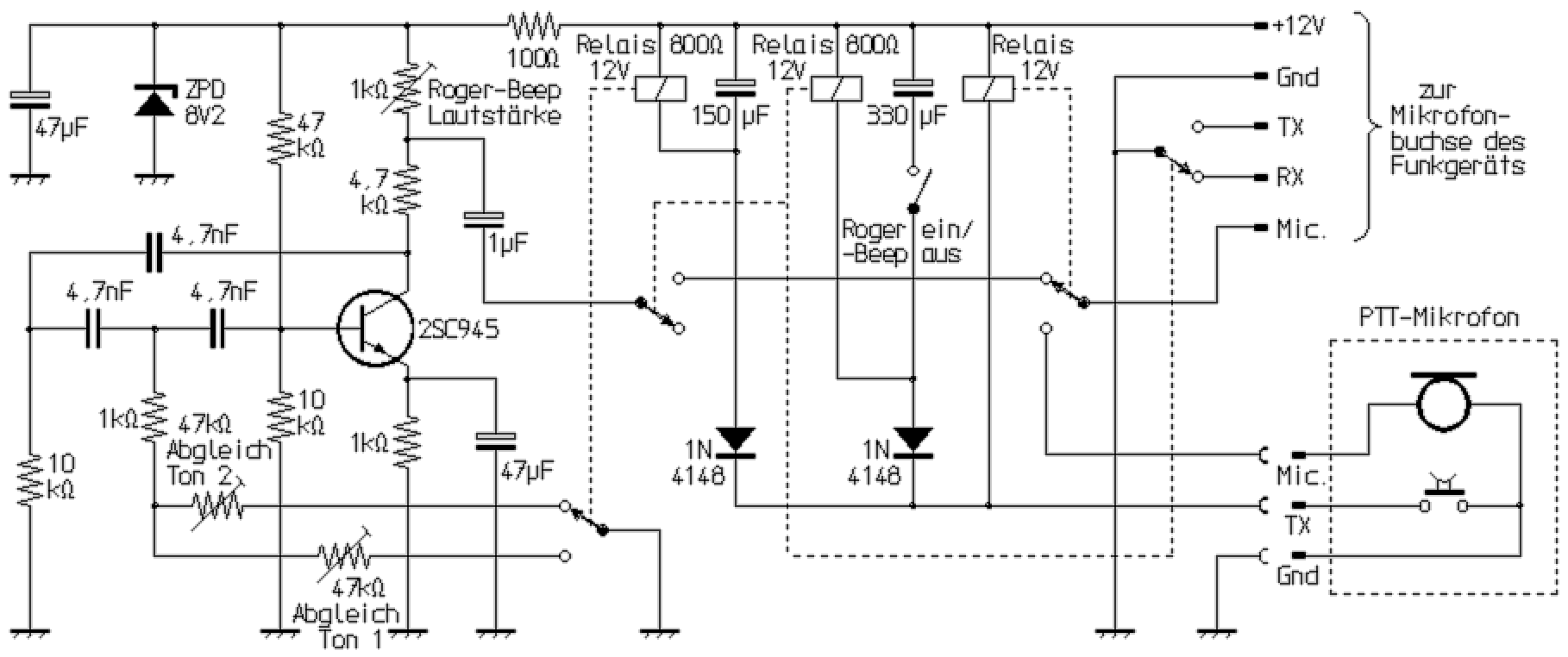
For the timing of the tones, a simple solution without transistors or ICs was preferred. When the PTT button is pressed, both relays engage. Since electrolytic capacitors are connected in parallel to their excitation coils and they are connected via diodes to the microphone's PTT button, both relays release with a delay. The different values of the electrolytic capacitors cause the right relay to remain engaged for about twice as long as the left one. Therefore, the 330µF capacitor determines the total length of the Roger Beep, while the 150µF capacitor determines when the tone switches. You can adjust the duration of the tones to your liking by using different values. The circuit can also be adapted to other relays, as not only the capacitor values but also the coil resistances affect the release delay. The contacts of the right relay are connected to the microphone jack just as the microphone's PTT button would normally be connected without this additional circuit.
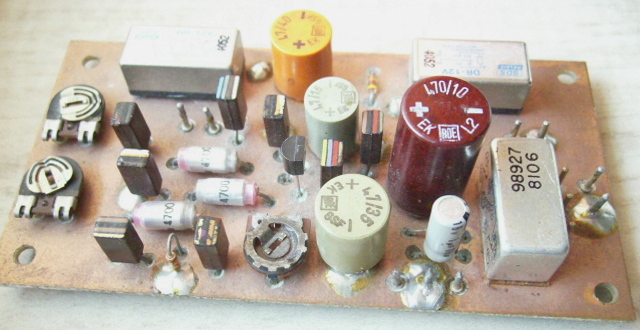
I built the circuit on a piece of single-sided copper-clad board. The copper surface on the top side acts as a ground plane, to which all component connections leading to the circuit's common ground are soldered. For all other wire leads, small holes were drilled through the board. To prevent short circuits, the holes on the copper side were slightly countersunk using a larger drill bit. On the underside, all other connections are wired in a conventional manner using thin tinned copper wire. This construction method eliminates the need for etching a PCB and allows for easier subsequent modifications. Furthermore, it is exceptionally well-suited for high-frequency circuits up into the VHF range and beyond. Even though this is only an AF (audio frequency) circuit, this build style prevents issues caused by RF interference from the connected radio.