Homebrew devices for single-sideband modulation
During the 1960s, single-sideband modulation (SSB) became increasingly prevalent for shortwave voice communication. By the mid-1970s, amplitude modulation (AM) was rarely used by amateur radio stations on the shortwave bands. Initially, the phase shifting method was popular for single sideband modulating transmitters because it didn't require an expensive crystal filter. Although the method can theoretically be used for receivers as well, it didn't gain widespread acceptance there at the time. Up until the 1970s, shortwave radio operation with separate transmitters and receivers was common. Superheterodyne receivers were typically used for single sideband operation. High-quality, commercially manufactured receivers were often double or even triple superheterodyne designs. The received frequency was thus converted two or three times to different intermediate frequencies using mixer stages before the signal was demodulated. A product detector with a beat frequency oscillator (BFO) was used for the demodulation of single-sideband signals. The frequency of the BFO could be set to either the upper or lower edge of the BFO passband, depending on the sideband being received. The use of separate transmitters and receivers necessitated tuning the transmitter to the set receive frequency. This required the ability to make the suppressed carrier of the transmitter audible at the receiver, allowing it to be adjusted to zero beat frequency. This enabled operators to respond to calling stations on the correct frequency. The desire for greater ease of use, coupled with the increasing availability of inexpensive crystal filters and suitable crystals for their construction, led to the growing popularity of the transceiver concept. In this concept, the oscillators and filters were used for both the transmitter and receiver in a single unit. This design eliminated the need for tuning; operators could now respond directly on the set receive frequency.
Using the phase shifting method single-sideband tube transmitter
In a single-sideband transmitter using the phase method, signal processing is not fixed to a specific frequency determined by the single-sideband filter, as is the case with the filter method. Therefore, auxiliary devices, so-called single-sideband adapters, were initially popular; these could be connected downstream of a transmitter suitable for telegraphy. Single-sideband modulation and carrier suppression were thus performed directly at the transmit frequency. The driving transmitter used for this purpose had to meet particularly high frequency stability requirements, and the signal also had to be as hum-free as possible. High output power was not necessary at this point. Because the amplification of a single-sideband signal must always be linear, a transmitter power amplifier is required after the modulator anyway. A small output stage with a transmit power of approximately 5 to 10 watts was therefore usually already included in such auxiliary devices. Due to the greater efficiency of single-sideband modulation, in this way roughly the same performance could be achieved as with an amplitude-modulated transmitter with approximately 50 to 100 watts of carrier power. With a further downstream linear amplifier, which operated with transmitter tubes of the latter power class, a significant increase in range was then possible with single-sideband modulation.
Based on a construction proposal for a single-sideband adapter of the type described, namely the "Adapt-O-Citer" by W6QLV, a complete transmitter was designed, the circuit diagram of which is presented here. This transmitter can be operated with a crystal or with an external variable frequency oscillator (VFO), which can be connected to the designated socket in place of the crystal. To achieve good frequency stability, it is recommended to operate the externally connected oscillator at half the transmit frequency. The circuit arrangement of the crystal oscillator can then be used as a frequency doubler. The best results with this transmitter are achieved at lower frequencies, for example, in the 80-meter band. In principle, however, the circuit is also well suited for frequencies up to about 30 MHz. With the simple quartz oscillator shown, operating in the so-called Pierce configuration, unwanted frequency modulation can occur at higher frequencies without a buffer stage or stabilization of the anode voltage, despite quartz control, resulting in distorted modulation. This problem does not occur with an externally connected oscillator. In the 80-meter band, the circuit shown can achieve a high-frequency output power of approximately 10 watts at signal peaks. Without retuning the coils in the single-sideband modulator, operation is limited to a band segment approximately 100 kHz wide.
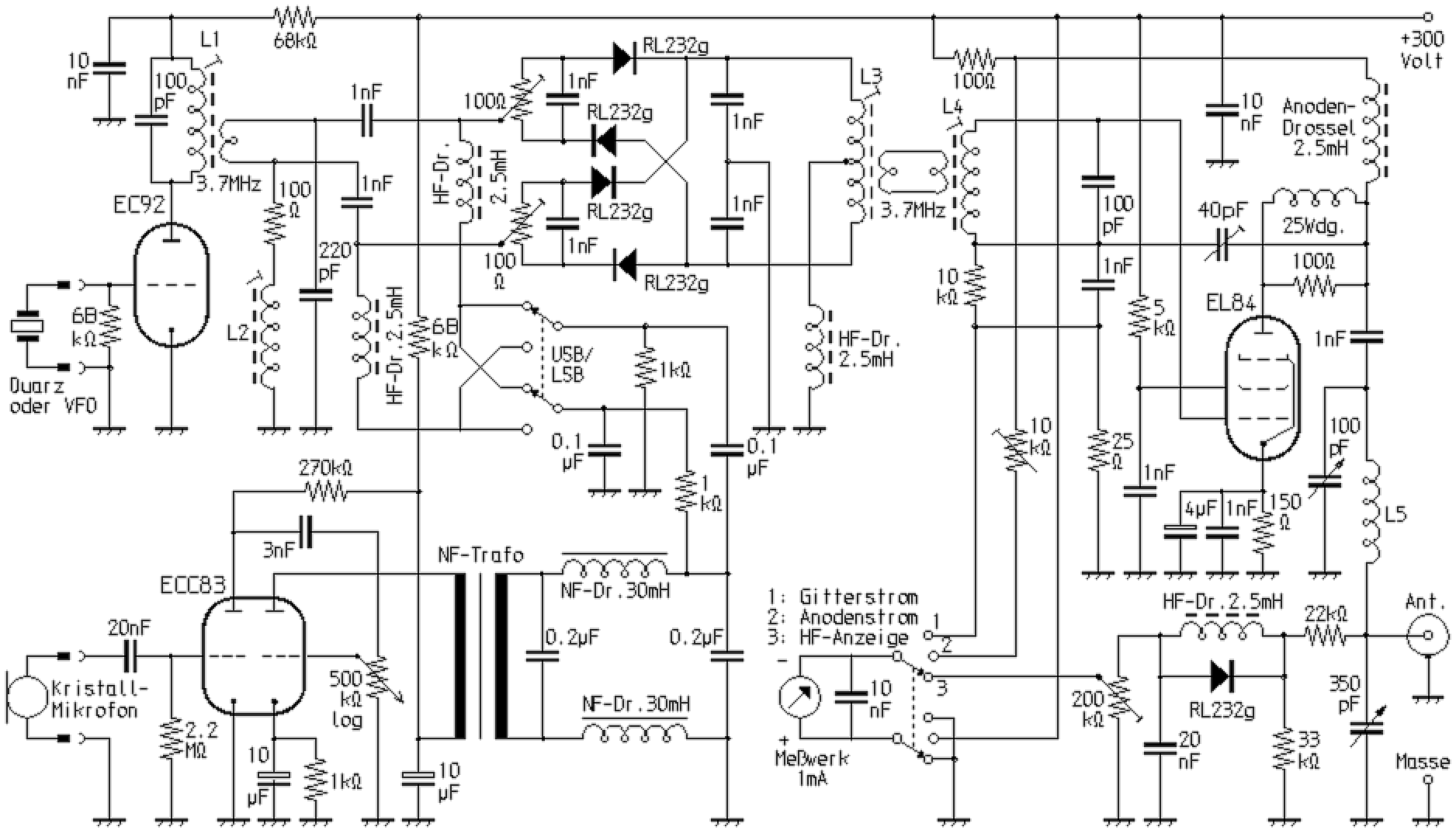
As my experiments showed, the suppression of the unwanted sideband with this simple circuit was quite small. The achievable value of approximately 25 dB, due to the very basic audio phase shifter, does not apply to all modulation frequencies; in fact, it only applies to one. Transmissions with a suppressed carrier, where both sidebands are emitted at full intensity—that is, when no sideband suppression occurs at all—are often quite distorted when received. This is always the case when the receiver offers no way to filter out one of the two sidebands. In such cases, interfering intermodulation occurs at the difference frequency, which results from the difference between the transmit and receive frequencies. These disturbances even occur when the difference is below the audibility threshold of approximately 16 Hz. In this case, they manifest as vibrating volume fluctuations. These problems are particularly noticeable with regenerative receivers operating in oscillation mode. The same applies to direct-conversion receivers. Even with the comparatively small sideband suppression of this transmitter, clearer reception is possible with such receivers.
With a narrowband receiver where the beat frequency oscillator is tuned to the correct edge of the receiver's passband curve, such problems simply don't occur. A transmitter with missing or insufficient sideband suppression then uselessly occupies the frequency range of the unused sideband. If a selective receiver is intentionally tuned to the wrong sideband, the desired signal, with a sideband suppression of 25 dB, is roughly the same order of magnitude as the splatter interference inevitably caused by the output stage intermodulation. It is therefore clearly audible whether the receiver is tuned to the correct sideband; reception is significantly clearer in that area. The major advantage of single-sideband modulation, namely its greater efficiency, is fully realized with this circuit, despite the relatively low sideband suppression. With proper modulator tuning, the power consumption of the transmitter's output stage drops considerably, while the desired signal on the desired sideband becomes somewhat stronger. This is hardly surprising, since a sideband suppression of just 6 dB would theoretically mean that the unwanted sideband is only transmitted with a quarter of the power. The energy saved there benefits the desired signal on the desired sideband.
For experiments with this circuit, here the coil data for the 80m band:
L1, L4, L5: 36 turns, coupling winding 7 turns
L2: 15 turns
L3: 18 turns with center tap, coupling winding 7 turns
each copper enamel wire 0,3 mm on shielded 8 mm coil bodies with screw core
Transistorized single-sideband phase transmitter for the 80m band
Based on the tube-based single-sideband transmitter, gradually was developed a version that operates entirely with transistors. While this increased the circuit complexity, it simplified the power supply and reduced the material requirements for the power supply unit. Furthermore, this design enabled portable battery operation. First, the crystal oscillator was replaced with a transistorized version and, in the process, a buffer stage was added. Of course, a tunable, variable-frequency oscillator can also be used instead of the crystal oscillator. However, due to the narrowband input and output circuitry of the exciter, the frequency variation must not be too large. Relative to the transmit frequency, a maximum of only a few percent, or again around 100 kHz, is possible. If a free-running oscillator without crystal control is connected via the 150pF capacitor instead of the crystal oscillator, another buffer stage should be added to ensure good frequency stability. An emitter follower, i.e., a transistor stage operated in common-collector configuration, is well-suited for this application. The arrangement of the two diode-based balance modulators of the tube transmitter was largely retained. However, a transistorized high-frequency amplifier stage was added at its output. This provides sufficient output voltage to connect a transistorized linear power amplifier, which is driven at low impedance via a capacitive voltage divider.
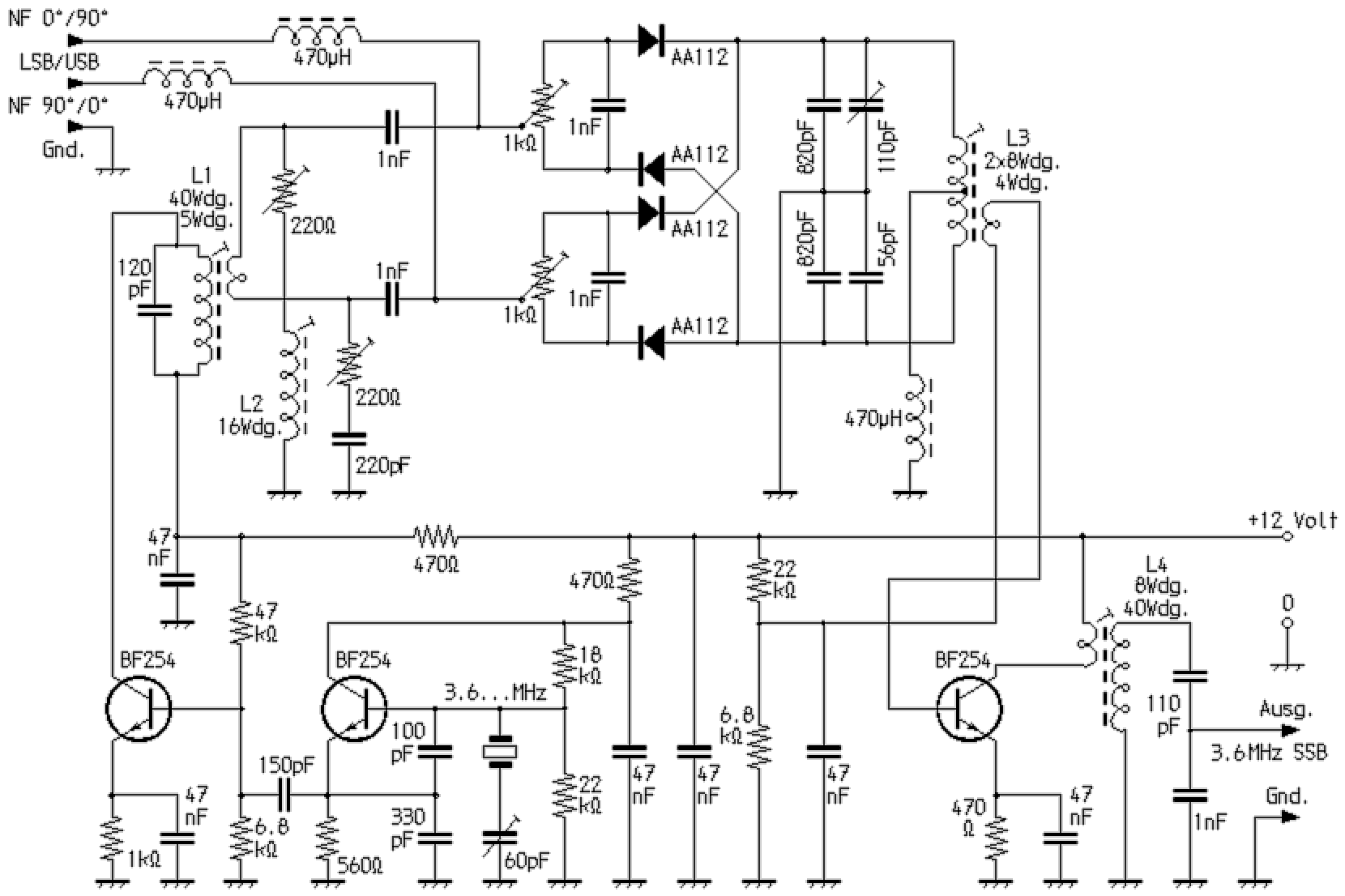
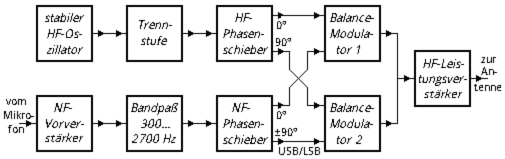
When generating a single-sideband signal using the phase method, both the audio signal and the high-frequency signal are phase-shifted by 90 degrees. This poses little problem for the high-frequency signal and can, in the simplest case, be achieved with an inductor and a capacitor. With a suitable termination impedance, these allow for a phase shift of 45 degrees in different directions, resulting in a total phase difference of 90 degrees. However, this is considerably more difficult with the audio modulation signal, as it covers a wider spectrum, for example, 300 to 3000 Hertz, meaning the lowest and highest frequencies are in a ratio of approximately 1:10. As mentioned earlier regarding the tube transmitter, maximum sideband suppression is only achievable at a single modulation frequency. This is because the phase difference is achieved using only two simple combinations of a capacitor and a resistor, known as RC circuits. One of these shifts the phase by -45°, the other by +45°, but only at the frequency where the capacitive reactance of the capacitor has the same value as the resistance of the RC network. At other frequencies, a different phase angle results. When generating single-sideband signals using the phase method, the audio signal and the high-frequency signal are each phase-shifted by 90 degrees relative to each other, fed to two balance modulators, and then added. On one sideband, the phase difference is then 180 degrees, meaning there is an out-of-phase effect, and the signals cancel each other out. The more precisely the 90-degree phase difference is maintained and the more accurately the signals have the same level, the better the sideband suppression. Switching between the sidebands (USB/LSB) can be achieved by swapping the high-frequency or audio signals, although the latter is recommended.
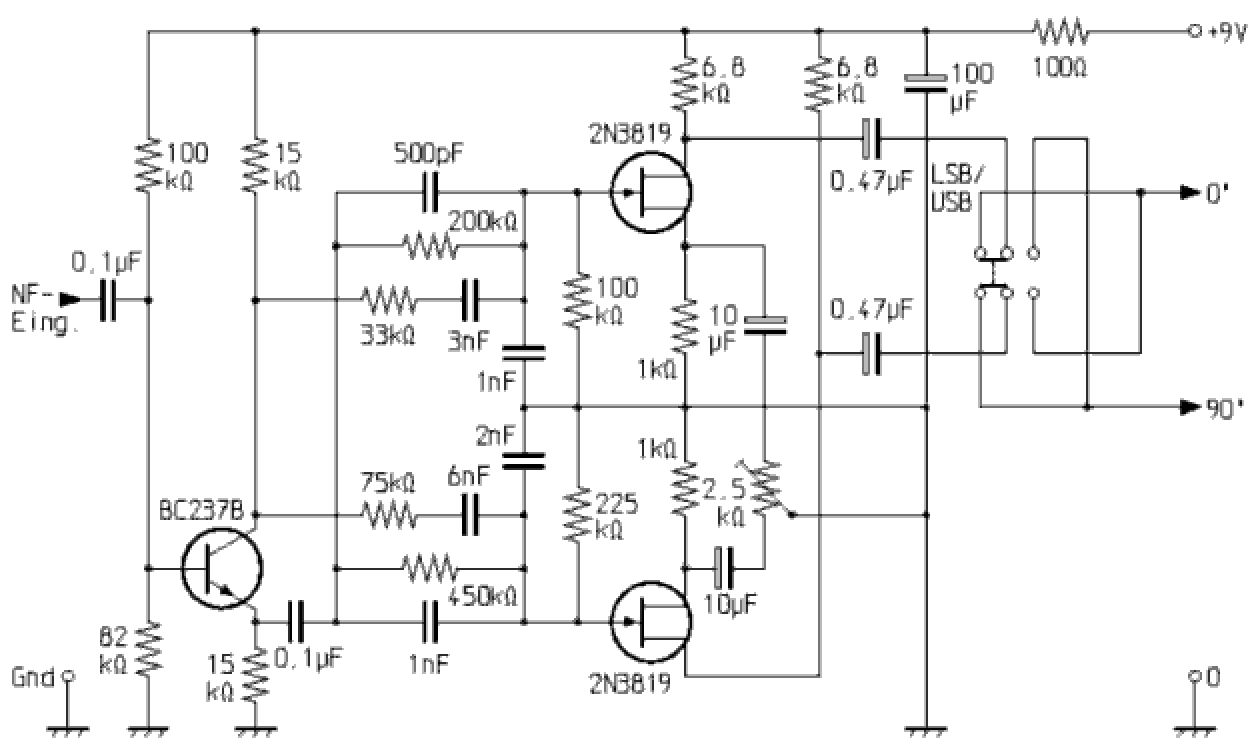
To enable improved sideband suppression, the transistorized single-sideband transmitter now features an enhanced phase-shifting circuit for the audio signal. This circuit is based on the principle of two so-called all-pass filters, which have little to no impact on the signal level and only introduce a frequency-dependent phase shift in the range between 0 and 180 degrees. For it the signal is first split into two signals with a 180° phase shift in a frequency-independent phase inverter stage. These two signals feed a frequency-dependent phase-shifting network. Due to the different dimensions of the all-pass filters for the two outputs, the phase shift in the relevant frequency range lies somewhere between 0 and 90 degrees for one output and somewhere between 90 and 180 degrees for the other. The phase difference between the two outputs follows a horizontal S-curve around the 90-degree line, exhibiting exactly 90 degrees at three points and otherwise closely approximating this value in the speech frequency range. The two output signals of the phasing network are each fed to an amplifier stage with a field-effect transistor. These transistors have a particularly high input impedance and therefore only minimally affect the operation of the phasing network. The 2.5 kΩ trimmer, which is wired similarly to a balance control in a stereo amplifier, adjusts the two signals to tWhen generating a single-sideband signal using the phase method, both the audio signal and the high-frequency signal are phase-shifted by 90 degrees. This poses little problem for the high-frequency signal and can, in the simplest case, be achieved with an inductor and a capacitor. With a suitable termination impedance, these allow for a phase shift of 45 degrees in different directions, resulting in a total phase difference of 90 degrees. However, this is considerably more difficult with the audio modulation signal, as it covers a wider spectrum, for example, 300 to 3000 Hertz, meaning the lowest and highest frequencies are in a ratio of approximately 1:10. As mentioned earlier regarding the tube transmitter, maximum sideband suppression is only achievable at a single modulation frequency. This is because the phase difference is achieved using only two simple combinations of a capacitor and a resistor, known as RC circuits. One of these shifts the phase by -45°, the other by +45°, but only at the frequency where the capacitive reactance of the capacitor has the same value as the resistance of the RC network. At other frequencies, a different phase angle results. When generating single-sideband signals using the phase method, the audio signal and the high-frequency signal are each phase-shifted by 90 degrees relative to each other, fed to two balance modulators, and then added. On one sideband, the phase difference is then 180 degrees, meaning there is an out-of-phase effect, and the signals cancel each other out. The more precisely the 90-degree phase difference is maintained and the more accurately the signals have the same level, the better the sideband suppression. Switching between the sidebands (USB/LSB) can be achieved by swapping the high-frequency or audio signals, although the latter is recommended.he same level as precisely as possible. For optimal results, the resistors and capacitors used in the phasing network must have an accuracy of at least 1%. If such tightly toleranced components are not available, they must be measured and selected accordingly. Sufficient temperature stability must also be ensured. If necessary, suitable values can also be achieved by connecting two or more components in parallel or in series. Incidentally, the principle of the phase method can still be found today in radio equipment with digital signal processing (DSP) as a software implementation. Here it is called the In-Phase-And-Quadrature (I&Q) method. A phase shift of 90 degrees, which is almost constant in the audio spectrum, no longer presents such difficulties here.
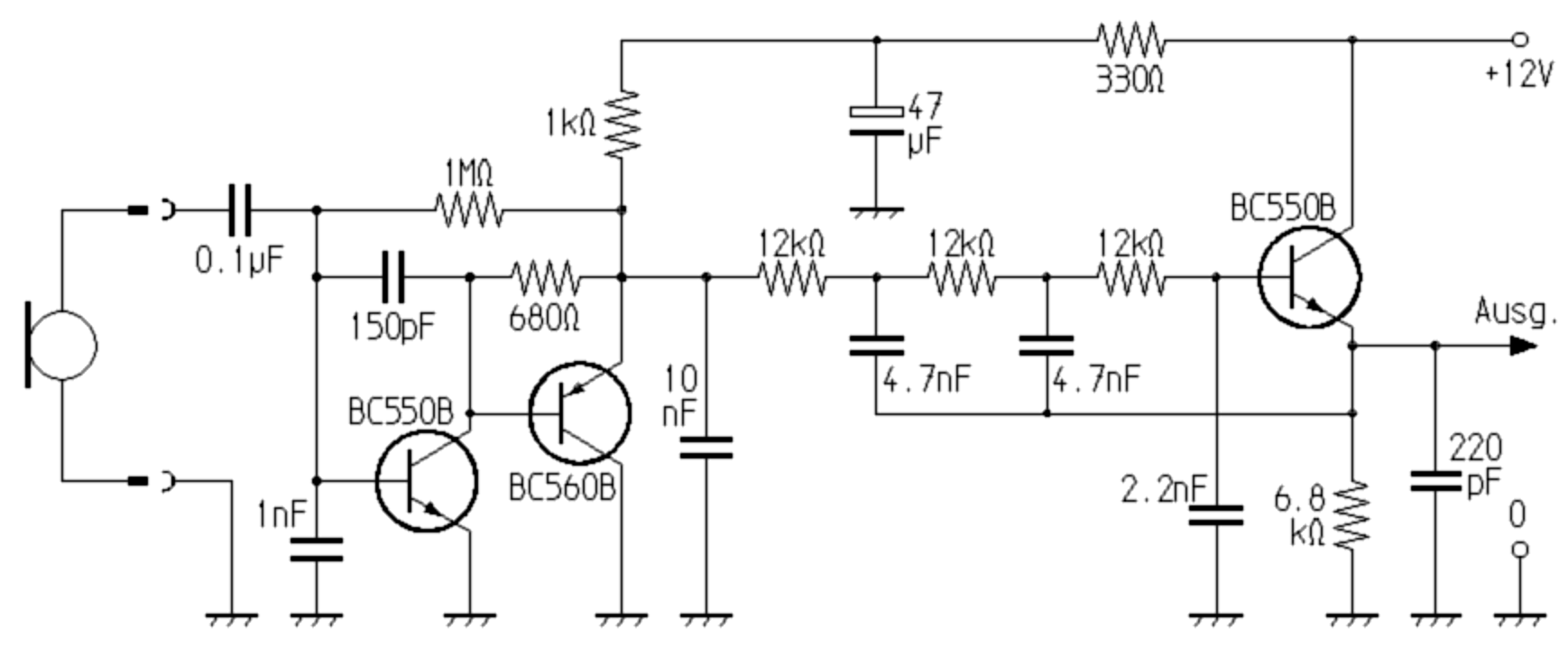
To adequately drive the phase-shift circuit shown with a dynamic microphone, a preamplifier is required. Unless using an outdated carbon microphone, the input sensitivity of the audio phase shifter is insufficient for direct microphone connection. For a sufficiently narrow transmission signal, the preamplifier must be designed to transmit only the speech frequency range of approximately 300 to 3000 Hertz. For a transmitter operating using the phase shift method, this is particularly important at higher modulation frequencies, as otherwise the transmission signal would become too broadband. Transmitters using the filter method suppress frequencies outside the desired spectrum already using the single-sideband filter. The preamplifier circuit shown provides sufficient gain for dynamic microphones while simultaneously limiting the transmission range as desired. The microphone capsules formerly used in telephones were initially carbon microphones that transmitted only the speech frequency range and provided a high output voltage. When using such that with this no preamplifier would be required. However, like electret condenser microphones, they require a bias voltage supplied from the positive lead via a resistor (e.g., 1 kΩ). Due to their significant noise—and, with increasing age, sometimes other weirder interference—their use is not recommended. Instead, the telephone microphone capsules with built-in amplifier electronics that emerged in the 1970s can be used with good results. They also require a bias voltage supplied via a resistor and are therefore connected in the same way as carbon microphones. This eliminates the need for the preamplifier shown.
Frequency-variable transistor oscillators for single-sideband devices
The single-sideband transmitters presented here operated with quartz-controlled oscillators. As mentioned, they can also be operated with other oscillators. However, the high demands of single-sideband devices cannot be easily met without quartz control. Even a frequency deviation of 100 Hertz leads to significant modulation distortion, as the pitch is shifted up or down by the same amount across the entire spectrum. Larger deviations therefore quickly render transmitted speech signals completely unintelligible. If one does not want to be limited to the transmission frequency determined by a quartz crystal, an oscillator is needed with which correspondingly stable frequencies can be set. To meet the requirements for single-sideband devices, such a variable frequency oscillator (VFO) must first and foremost be mechanically constructed stable. Otherwise, even the slightest vibrations can lead to unacceptable frequency changes. The utmost care is therefore required in the construction of the coil and the capacitors of the tuning circuit. Furthermore, it must be taken into account that the values of many components—especially the capacitance values of capacitors—are temperature-dependent. The internal capacitances of transistors also change with temperature and, without countermeasures, will lead to frequency changes. All of this can be compensated to a certain extent by using capacitors with opposing temperature responses. Another, but more complex, option is to keep the ambient temperature constant using technical means, for example, with a heat source and a thermostat. In addition, the oscillator's supply voltage should be electronically stabilized.
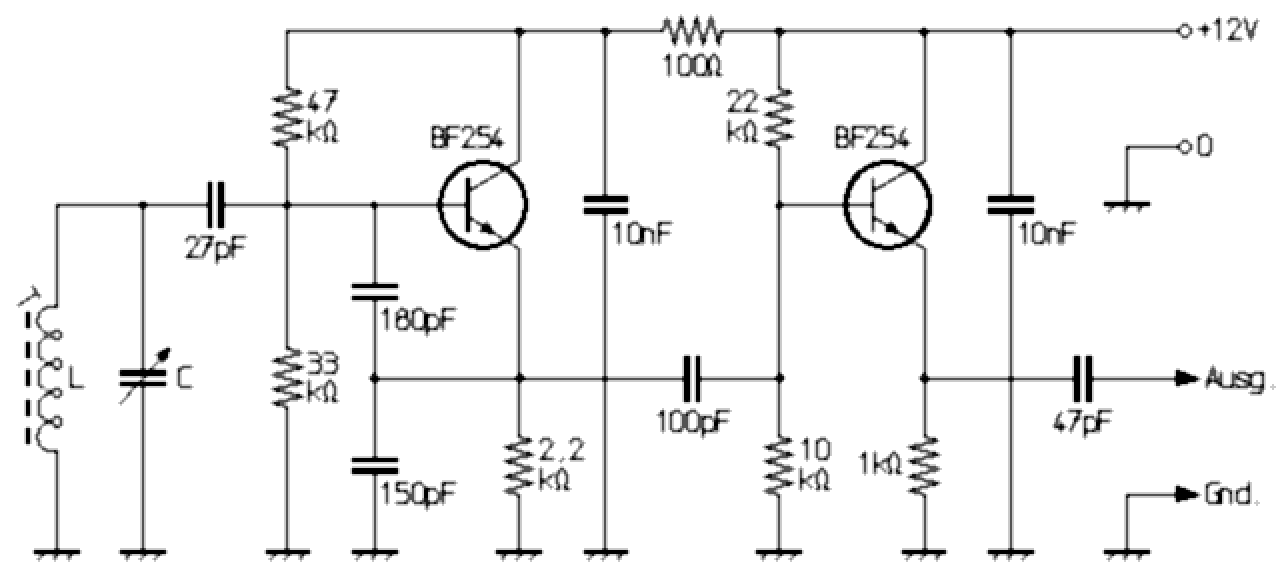
The Seiler oscillator shown is a well-suited oscillator circuit for single-sideband transmitters. Its simple construction makes it popular for homebrew projects, and it was also frequently used in commercially manufactured amateur radio equipment in the past. Because the resonant circuit is coupled to the rest of the circuit with a relatively small capacitance, while simultaneously having relatively large capacitances in parallel with the diode junctions of the oscillator transistor, the internal transistor capacitances have a minimal influence on the generated frequency. A buffer stage is connected after the actual oscillator circuit, minimizing the influence of the circuit connected at the output on the oscillation frequency. This circuit can therefore be used in place of the crystal oscillator in the described transistorized single-sideband transmitter, provided the supply voltage is sufficiently stabilized.
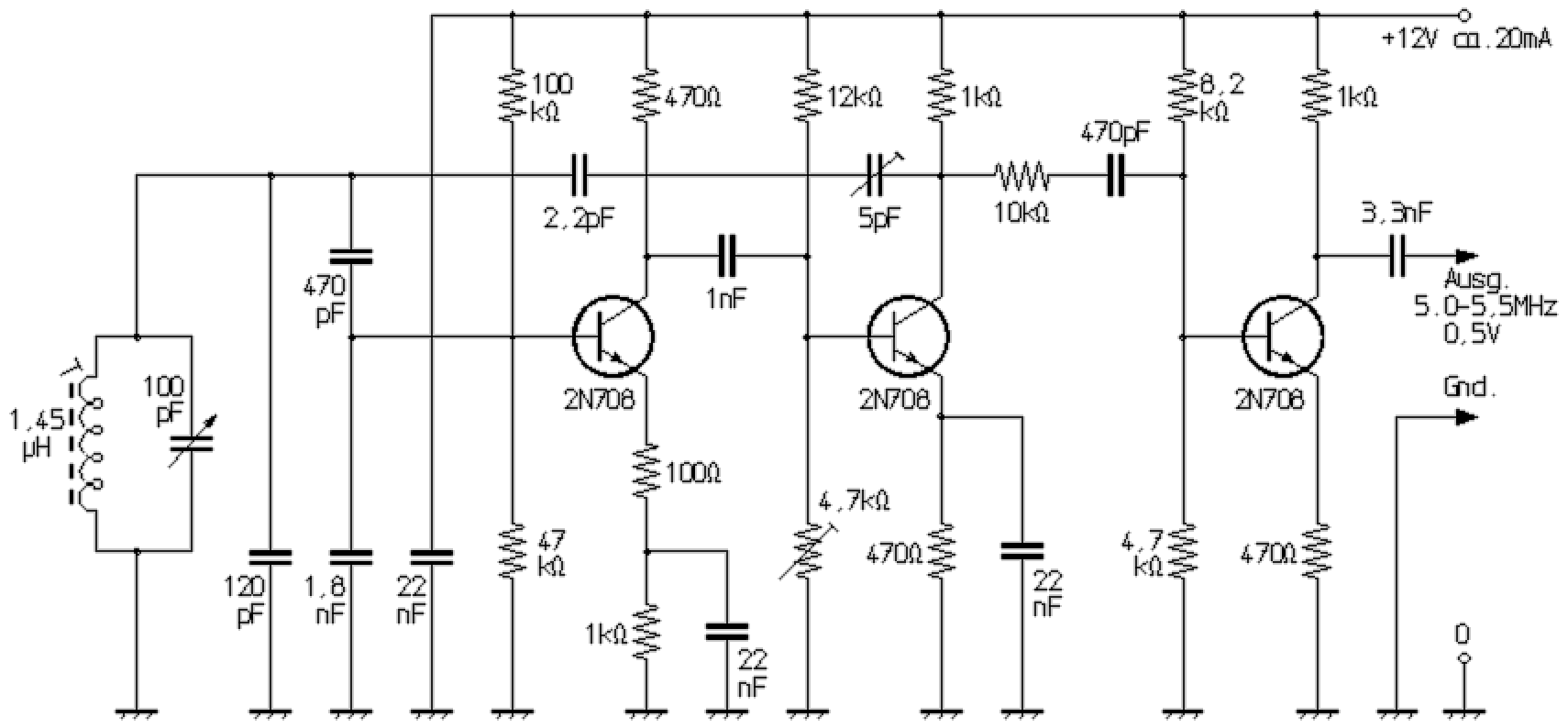
The Franklin oscillator offers exceptionally high frequency stability. In this design, feedback is provided by two stages, which, in the original tube circuit described by its inventor, were operated in a common-cathode configuration. The transistorized version presented here operates analogously with two stages in a common-emitter configuration, where the feedback runs from the collector of the second stage to the base of the first. The high overall gain allows the resonant circuit to be connected to the main circuit with such loose coupling that changes in transistor capacitance have virtually no effect. In the circuit shown, a capacitive voltage divider at the base of the first transistor, similar to a Clapp oscillator, effectively places a capacitor with an even larger capacitance in parallel with the input of the transistor stage. Without the drawbacks of a Clapp oscillator, fluctuating transistor capacitances have almost no impact on the frequency in this circuit. The influence of temperature and voltage fluctuations is therefore extremely low. Nevertheless, temperature compensation and supply voltage stabilization should still be implemented. This circuit, presented in Friedhelm Hillebrand's book "Einseitenbandtechnik für den Funkamateur," also features a buffer stage, operating in common-emitter configuration, at the output. This allows for a high output voltage and, through coupling via a series circuit consisting of a capacitor and resistor, good decoupling from the output. The oscillator in its original circuit is designed for the frequency range of 5.0 to 5.5 MHz, as it is equally suitable for transmitter, receiver, and transceiver designs using a 9 MHz crystal filter for both the 80-meter and 20-meter bands. However, with only minor adjustments to the values of frequency-determining components, it can also be used in the range of 3.5 to 3.8 MHz or 7.0 to 7.2 MHz, and thus in conjunction with the described single-sideband transmitters.
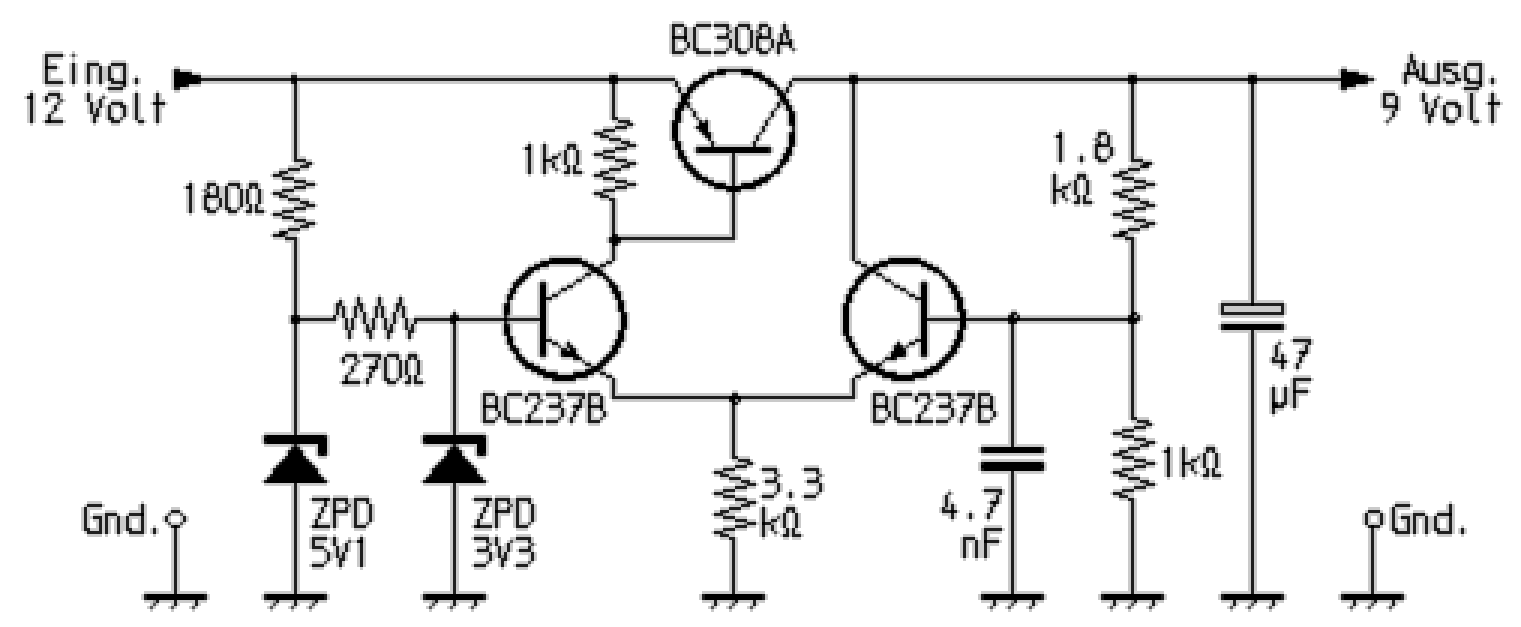
High-frequency oscillators can only offer optimal frequency stability if they are operated with a stable supply voltage. This is especially true for transistor oscillators, and even more so when there is no crystal control. In the simplest case, the voltage can be stabilized with a parallel Zener diode. To limit the current, this diode must be operated with a series resistor. However, for non-crystal-controlled transistor oscillators, this measure is usually insufficient in single-sideband devices. A significantly more stable supply voltage can be achieved by connecting two such Zener diode and series resistor stabilization circuits in series. Ideally, however, using a circuit comparing the actual value of the output voltage with a reference voltage and correct any deviations to the correct value using an electronic control circuit. In the stabilization circuit shown, the comparison of the target and actual values is performed by a differential amplifier consisting of two transistors. This amplifier controls another transistor, which ultimately regulates the current to the value required for the correct voltage. The differential amplifier obtains a constant reference voltage via two cascaded Zener diode stabilizers. The approximately 9 volts available at the output of this voltage regulator is very stable and ideally suited for powering variable frequency oscillators in single-sideband devices. Precise adjustment of the output voltage is possible by replacing the 1 kΩ resistor in the voltage divider at the circuit's output with a 470 Ω resistor and connecting a 1 kΩ trim resistor in series. The circuit also reduces any ripple voltage that may be superimposed on the supply voltage. Such ripple could lead to frequency modulation with an often-present interference frequency (for example, 50 or 100 Hz in Europe, 60 or 120 Hz in the USA) which would result in significant signal distortion in single-sideband devices. Although the previously shown oscillators are specified as requiring a 12 volt supply voltage, they also operate perfectly with the lower voltage supplied by such a stabilizer.
Single-sideband linear amplifier for the 80m band
The circuit of the single-sideband tube transmitter shown at the beginning also includes a small high-frequency output stage, allowing it to be connected directly to an antenna. If higher transmission power is required, a more powerful output stage must be added. In this case, the transmitter's output stage then functions as a driver stage. A special characteristic of single-sideband transmitters is that all amplifier stages must operate in linear mode. This means that the input and output voltage, or input and output power, must always differ by a constant gain factor, regardless of the current signal level. Apart from the higher frequencies they process, such power amplifiers operate in the same way as audio amplifiers. In the tube transmitter, the output stage is therefore wired almost identically to the audio output stage of an old radio. It could also be used in conjunction with the transistor circuits shown so far, but would then still require the high anode voltage for power supply. Especially for mobile or portable operation, it is desirable for all components to be able to operate at a low voltage, for example, 12 volts. This is possible if the transmitter power amplifier also uses transistors. The linear amplifier presented here originated from the circuit design of a foxhunt transmitter, originally published in "Elektronisches Jahrbuch 1970" (DMV-Verlag). The unusual circuit of the driver stage and the push-pull output stage, in which the base terminals are connected to the output circuit at high frequencies, allowed the use of power transistors with a cutoff frequency that would actually have been unsuitable for this purpose in a conventional circuit. Even the Soviet germanium PNP transistors specified in the original circuit were difficult for radio amateurs in East Germany to obtain at that time, and the situation was hardly better in the West. One advantage of using PNP transistors in circuits with a collector at zero potential for high frequencies is that the collector can also be connected to ground for DC operation, provided it is connected to the negative terminal of the power supply. This allows the transistors to be mounted directly to the heatsink without insulation, preventing capacitive shunts that would further reduce the frequency response.
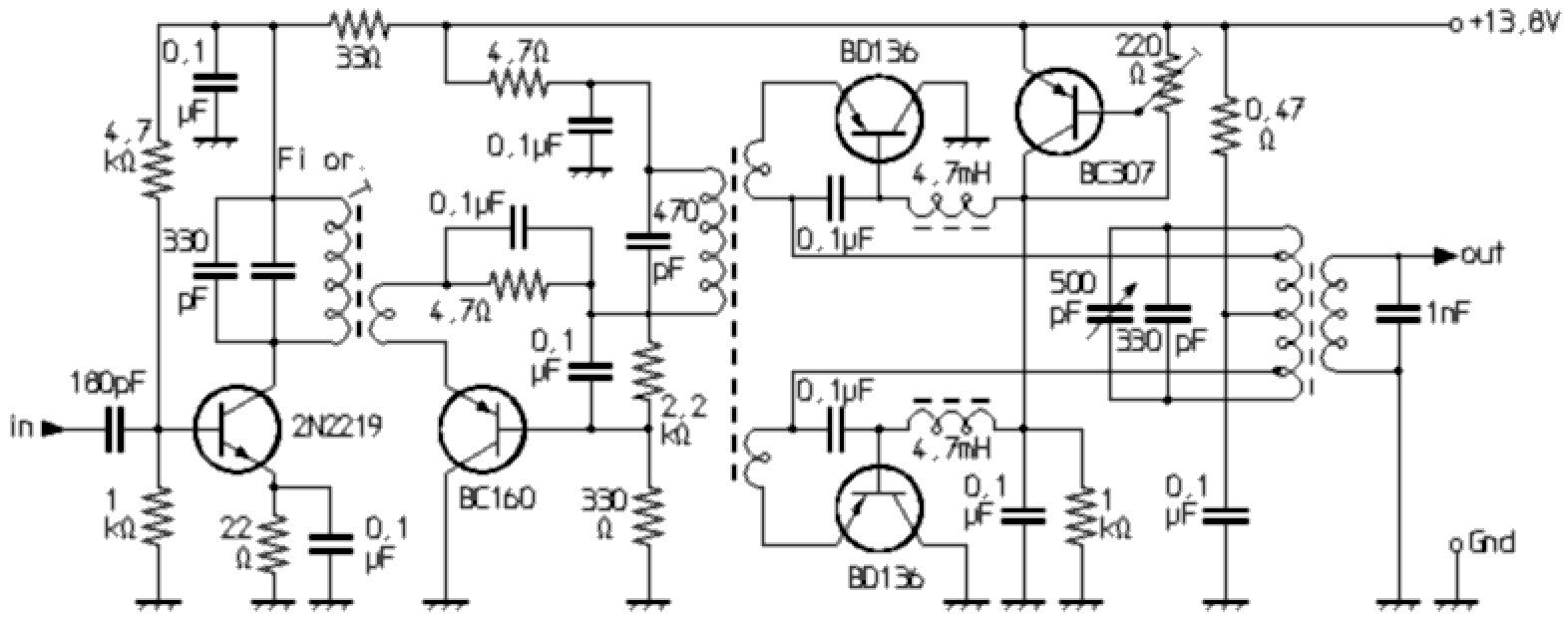
When this circuit was developed, inexpensive PNP transistors, such as the BD136, suitable for shortwave power amplifiers, had long been available in the West. Because the driver and output stage of the foxhunt transmitter, designed for telegraphy operation, were not intended for linear operation, the circuit had to be modified for single-sideband operation. For this purpose, the base-emitter diode junctions of the transistors are biased via RF chokes to ensure a sufficient collector quiescent current. The resulting difference in emitter and base DC potentials is decoupled by capacitors. Additionally, emitter resistors (4.7 ohms for the driver, 0.47 ohms for the output stage) stabilize the operating points. To ensure these remain independent of ambient temperature and self-heating during operation, the output stage employs an arrangement familiar from audio amplifier design. The transistor used for this purpose must be thermally coupled to the output transistors, for example by mounting it to the output stage heatsink with a clamp. The crystal oscillator of the original circuit was repurposed as a preamplifier, so that the driver and output stage can be sufficiently driven by the relatively weak output signal of the single-sideband generator. Depending on the dimensions of the resonant circuits, the resulting circuit is capable of delivering an output power of approximately 5 watts on either 80m or 40m. Since the BD136 transistors used here are suitable for significantly higher frequencies than the types originally specified for this arrangement, the output power can be increased by connecting several of these transistors in parallel. The resonant circuit at the output was wound on a toroidal core suitable for high frequencies and with sufficient power handling capacity. It is recommended to implement the driver circuit in the same way and to tune it with a variable capacitor, as this reduces the risk of self-oscillation. The resonant circuit between the preamplifier and driver stages was created from a shielded 10.7 MHz single-circuit filter with an orange tuning core, the kind formerly found in the intermediate frequency amplifier of the FM section of most Japanese transistor radios. The parallel capacitor allows it to be tuned into resonance on the 80-meter band.
Transistorized superheterodyne receiver for the 80m band
With tube-based equipment, it was once common practice to assemble amateur receivers using discarded radio components. This method was to be applied to a transistorized, home-built receiver suitable, among other things, for receiving single-sideband signals. This goal was to be achieved with the simplest possible superheterodyne circuit, which could be largely realized using components salvaged from an old Japanese AM/FM pocket radio from the 1970s. From these basic considerations emerged a receiver for the 80-meter amateur band, which operates on the input side with a self-oscillating mixer stage. This resembles the input circuit commonly found in the medium-wave section of such pocket radios at that time. However, unlike those, the feedback here is not achieved via a coil tap, but rather by means of a capacitive voltage divider, which allows for larger parallel capacitances to reduce the influence of the temperature-dependent transistor capacitances. With suitable construction and careful component design, a frequency stability perfectly adequate for receiving single-sideband stations can be achieved despite the simple circuit. However, a certain warm-up time must be accepted – but that was no different for many commercially manufactured receivers at the time. The achieved sensitivity is perfectly adequate for the 80-meter band, even with shorter antennas. Even with a length of just a few meters, the noise level typically present there already leads to a noticeable S-meter reading. Adequate stability for single-sideband operation could only be achieved with the two-stage input filtering shown and loose coupling between both of the resonant circuits. With a single circuit at the input, the antenna is insufficiently decoupled from the oscillator, so that approaching the antenna results in unwanted frequency shifts. A two-stage IF amplifier for 455 kHz follows the mixer stage. The demodulator is a circuit of the type occasionally used on its own as a simple straight-ahead receiver. A similar, but somewhat more complex, demodulator arrangement is also found in the receiver Göttinger Baby II, described elsewhere. This allows for the demodulation of AM and SSB/CW signals using only a single transistor. For AM, the fixed regeneration is switched off in this device. With regeneration switched on, the transistor essentially functions as a self-oscillating product detector. This regenerative stage contributes very little to the selectivity in this device. Selectivity is primarily achieved by the three single-circuit intermediate frequency filters. The audio amplifier following the demodulator, with its transformerless push-pull output stage, exhibits hardly distinctive features.
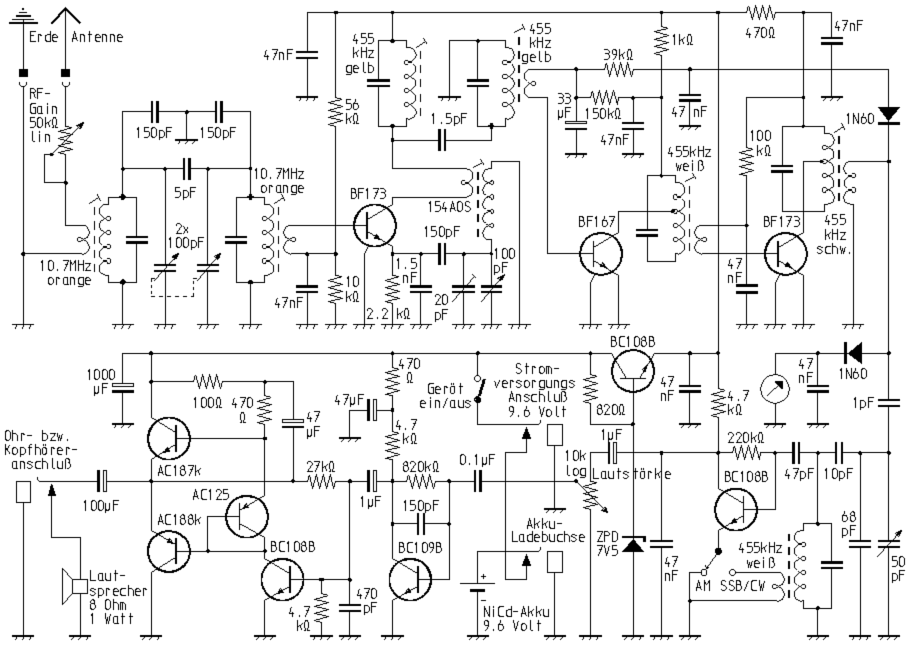
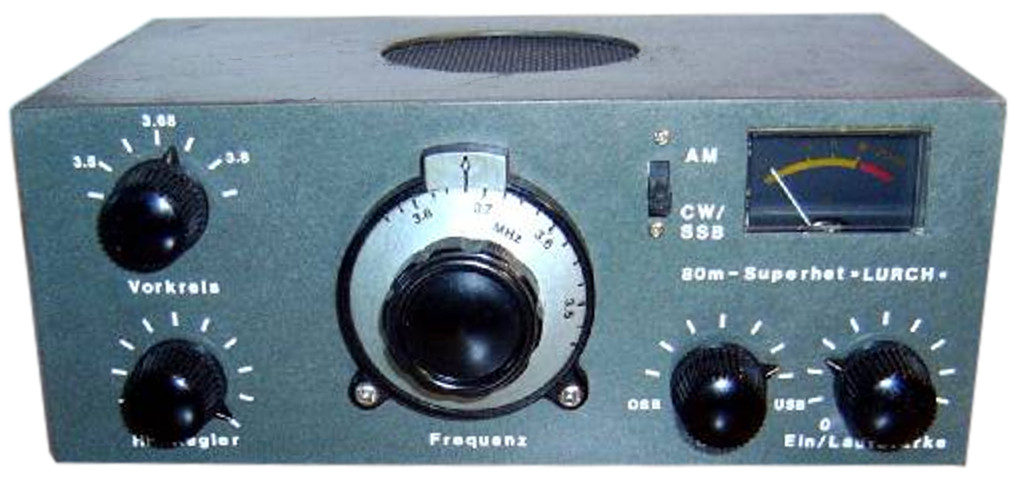
Proper coupling of the self-oscillating product detector to the IF output is quite critical, as it is not only overdriven by excessively strong signals but also prone to synchronization. This effect is reduced when the BFO frequency, as required for USB, LSB, and CW single-character reception, is tuned to the edge of the IF passband. The 1 pF value specified in the circuit diagram should be considered a guideline. It is made from a two-core strip of computer ribbon cable, which was shortened bit by bit until the optimal compromise between low-distortion reception and sufficient volume was found. Winding coils was unnecessary for this receiver: The input circuits were constructed from 10.7 MHz IF filters for FM reception, and the 455 kHz filters and the demodulator circuit were salvaged from the AM section of old clock or pocket radios. A suitable coil for the oscillator circuit was found in the parts box. A 10.7 MHz IF filter could also be used here if the capacitor on the underside is broken out. The device was built into a housing made from soldered, copper-clad epoxy sheets, which are otherwise intended as base material for printed circuit boards. The resulting housing was then painted with model paint and labeled with rub-on lettering. Despite its simplicity and the fact that no special radio components were required, the receiver exhibits surprisingly good reception characteristics. These far surpass, for example, those of a simple regeneration receiver. Despite the extremely simple demodulator circuit, very usable single-sideband reception is possible. The reception quality is also considerably better than that of simple superheterodyne receivers with BFO, which, however, lack a product detector. If such a receiver is to be used for radio operation, for example with the single-sideband transmitters described above, only the low-frequency section should be switched off via a relay during transmission, and the antenna input should be short-circuited simultaneously. This ensures that the receiver does not have to settle to the frequency after each transmission first.
Extension for the 40m and 20m bands
With the simple circuit shown here, a small accessory that is inserted into the antenna line, the 40-meter and 20-meter amateur bands can also be received. This is a converter that again operates with a self-oscillating mixer stage. Thanks to the crystal oscillator, excellent frequency stability is achieved even at the higher reception frequencies. By using an in MOS technologie manufactured field-effect transistor with two separate gate terminals, good operating conditions for the oscillator and mixer can be set. Such transistors are referred to as dual-gate MOSFETs. The crystal used, for the frequency of 10.595 MHz, can be taken from a defective old CB radio for amplitude modulation mode. Using a series trimmer, the oscillating frequency in the circuit shown can be adjusted to the needed value of 10.6 MHz without problems. Without any modifications to the receiver shown before, the converter built in this way could fully receive the 40-meter amateur band, which at that time only extended to 7.1 MHz in Germany. However, in the 20-meter band, the tuning range then achieved with this device starts at 14.1 MHz. The telegraphy range of the 20-meter band is therefore not fully covered. To be able to receive the entire 40-meter and 20-meter bands, a receiver for the range of 3.4 to 3.8 MHz would be needed. This would then provide a tuning range of 6.8 to 7.2 MHz for the 40-meter band and a tuning range of 14.0 to 14.4 MHz for the 20-meter band.
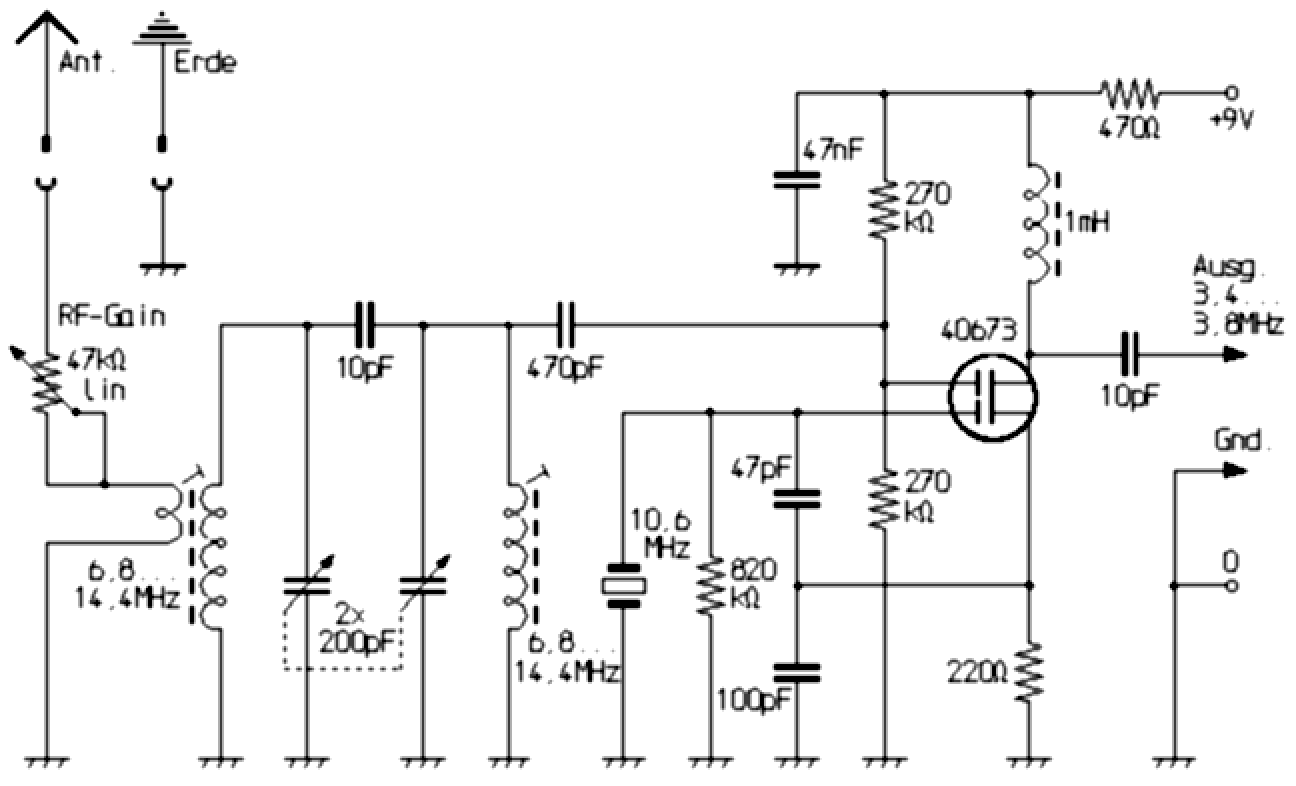
If such a circuit, along with suitable switching devices, is permanently integrated into a receiver for the frequency range of 3.4 to 3.8 MHz, a usable shortwave receiver for the three amateur bands 80m, 40m, and 20m is obtained. With the converter switched on, the selection of the 20m and 40m bands is then achieved simply by tuning to the corresponding frequency range using the 2x200pF variable capacitor. Thanks to the dual-gate MOSFET used, the input sensitivity is quite good. With a good antenna, receiving overseas stations in these frequency ranges is no problem at all, provided suitable propagation conditions exist. Ideally, the converter's output is connected to the high-point of the input resonant circuit of the downstream receiver.
Another option for a three-band receiver operating in this way is to design the downstream receiver for the frequency range of 5.0 to 5.5 MHz outside the amateur bands. If a 9 MHz crystal is then used in the converter, the 80m and 20m bands can already be received. However, this requires that the preselector circuit can be tuned from 3.5 to 14.5 MHz. A transmitting crystal from an old CB radio designed for equipping single-crystals can then be used. In the circuit shown, such crystals oscillate at the fundamental frequency, which is about one-third of the printed frequency. With the circuit shown, crystals for channel 4 (27.005 MHz) can usually be tuned to an oscillation frequency of exactly 9.0 MHz. If this is not possible, a remote control crystal for 26.995 MHz can also be used. To receive signals on the 40-meter band, a 12.5 MHz crystal is required in such a circuit design. However, such a component is usually not easy to obtain. But often it is possible to use a 37.6 MHz crystal from an old CB radio with crystal-mixing synthesis system. Some of these crystals can be tuned to the required 12.5 MHz frequency on their fundamental frequency by replacing the trimmer capacitor in series with the crystal with a tunable coil. The number of turns in this coil is best determined experimentally. With these two crystals, a receiver with 500 kHz wide band segments is obtained, each starting at the beginning of the amateur radio bands: 3.5, 7.0, and 14.0 MHz.
80m self-built superheterodyne receiver optimized for single-sideband reception
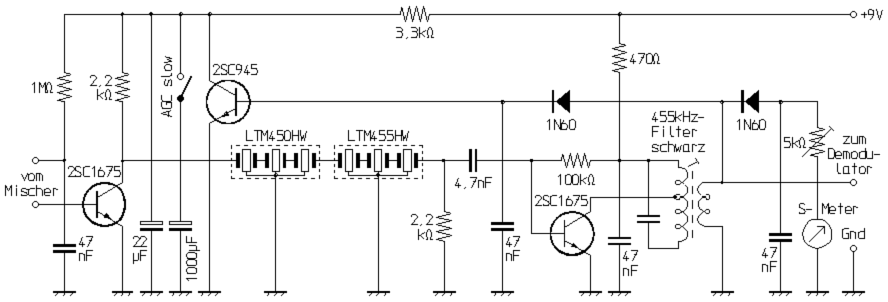
Because the filtering in the intermediate frequency amplifier of the superheterodyne receiver shown uses only LC circuits, its selectivity is only moderate. While signals in the opposite sideband are attenuated when the superheterodyne oscillator is tuned to one edge of the intermediate frequency passband, it hardly constitutes true suppression like that found in seriously communication and amateur radio receivers. This moderate selectivity can be significantly improved by inserting a ceramic filter between the first two intermediate frequency filters. Types such as the LF-B4 or CFW455IT, which have a bandwidth of approximately 4 kHz, are very well suited for this purpose. An almost ideal bandwidth and a well-suited passband curve for receiving single-sideband stations could be achieved with two cascaded 6 kHz ceramic filters, provided their center frequencies were approximately 5 kHz apart, for example, 450 kHz and 455 kHz. The overlap of the two filter passband curves then results in a bandwidth well-suited for single-sideband signals, with a slight dip in the middle of the resulting overall passband curve, i.e., at 452.5 kHz. Because the passband curves of ceramic filters are flatter than those of quartz filters, the usable passband is larger than would be expected from the calculation (450 + 6/2) - (455 - 6/2) kHz = 1 kHz. The resulting symmetry of the passband curve is very good, and effective sideband suppression can be achieved. Such a filter combination is therefore also well-suited for use at the transmitter end. Based on the experience gained with the presented receiver, a receiver optimized for single-sideband reception was developed, which can then be further expanded into a transceiver operating according to the filter method.
Intermediate frequency amplifier with overlap filter and gain control amplifier
For the new receiver, a more suitable intermediate frequency amplifier for single-sideband operation was first designed, employing an overlap filter. Because the two interconnected ceramic filters, with their different fundamental frequencies, offer excellent far-range selectivity, the number of LC filters for the intermediate frequency could be reduced, significantly decreasing the circuit complexity. Furthermore, the automatic gain control (AGC) was improved to achieve a wider control range. This was accomplished with a single regulated stage by controlling its supply voltage with a DC amplifier. As the strength of incoming received signals increases, the stage's supply voltage is reduced, allowing its gain to be dialed down considerably. Adding the 1000µF electrolytic capacitor slows down the control process, preventing interference and noise from being constantly amplified during pauses in speech. This results in a much more pleasant listening experience, particularly when listening to sedately conversations and with sometimes very strong signals. The fast setting is the more suitable option for the rather hectic contest environment.
Frontend with dual-gate MOSFET and separate oscillator
The performance of self-oscillating mixer stages is often significantly underestimated, yet they are certainly not optimal. A separate oscillator almost always achieves better frequency stability. In extreme cases, even strong antenna signals falling within the passband of the input filter can cause changes in the oscillator frequency. Furthermore, with a self-oscillating mixer stage, it is difficult to find an operating point for optimal oscillator amplitude while simultaneously ensuring good mixer performance. Therefore, this receiver, which has been improved in many respects, employs a mixer stage with a separate oscillator. By using a dual-gate MOSFET, where the input and oscillator signals are fed separately to the two gate terminals, the oscillator can be effectively decoupled from the mixer stage. In the shortwave range thus eliminating the need for a further buffer stage. The input impedance of circuits with MOSFETs is even higher than that of circuits with junction field-effect transistors, abbreviated as JFETs. This results in even less damping of the resonant circuit at the gate terminal. The resulting higher Q factor leads to better preselection. In contrast, a JFET is used in the oscillator, which, with a simple circuit, provides good frequency stability. Because input and oscillator resonant circuits are practically indispensable, the overall complexity of this frontend is hardly greater than that of a comparable arrangement using an integrated circuit.
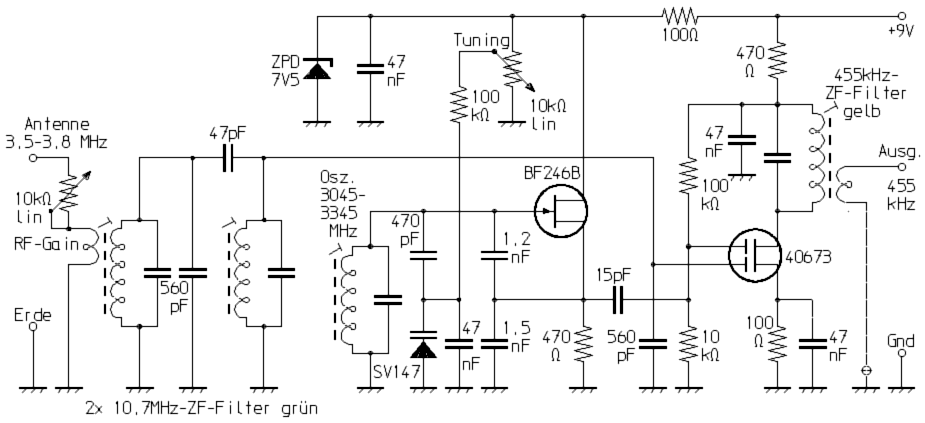
By using pre-made filter coils, no coils had to be wound by hand in this improved receiver too. Single-circuit filters, originally designed for an intermediate frequency of 10.7 MHz, are again used for the oscillator and input resonant circuits. Parallel capacitors with appropriate capacitance values decrease the resonant frequencies for 80m reception. The two input circuits are now more tightly coupled than in the original 80m superheterodyne receiver. Staggered tuning results in nearly uniform sensitivity across the entire band. This eliminates the need for synchronous tuning of the preselector. As is well known, receivers for the 80m band generally do not require an RF preamplifier. Such a preamplifier would primarily only degrade the large-signal handling capability without improving the signal-to-noise ratio. Mixer stages with dual-gate MOSFETs produce so little inherent noise across the entire shortwave range that a high-frequency preamplifier can usually be omitted in the 20-meter and even in the 10-meter bands. Because of that only by modifying the oscillator and input resonant circuits this arrangement can also be used for the higher shortwave bands. However, due to the low intermediate frequency of 455 kHz, with higher frequencies image rejection deteriorates significantly. Therefore, at least a three-circuit input filter should be used for the 20-meter band, and ideally, four resonant circuits tuned to the receive frequency range should be used for the 10-meter band. The input sensitivity control is also less suitable for the higher frequencies. A multi-stage attenuator with several switches for different attenuation levels, matched to the antenna impedance (e.g., 50 ohms), is preferable. On the 80-meter band, the circuit is so sensitive that, depending on propagation conditions, even a test line approximately 30 centimeters long can be used as an antenna to receive strong stations from all over Germany and many other European countries. When coupled to a proper antenna, reception is hardly weaker than with commercially available shortwave transceivers.
Product detector also operating with a dual-gate MOSFET
The new device also features an improved product detector, likewise equipped with a dual-gate MOSFET. In this configuration, such a transistor offers the advantage of processing signals of widely varying intensities, thus achieving a large dynamic range. With weak signals, the product detector produces virtually no inherent noise, while distortion only occurs with very strong signals. However, this is usually prevented by the AGC of the intermediate frequency amplifier. The product detector configured in this way can therefore deliver quite high output voltages and also provides a significant gain, meaning the intermediate frequency amplifier does not need to have a particularly high overall gain. Due to their suitability in arrengements like this, MOSFETs were formerly popular in direct-conversion receivers and simple telegraphy transceivers equipped with them, where they served simultaneously as a mixer stage and product detector.
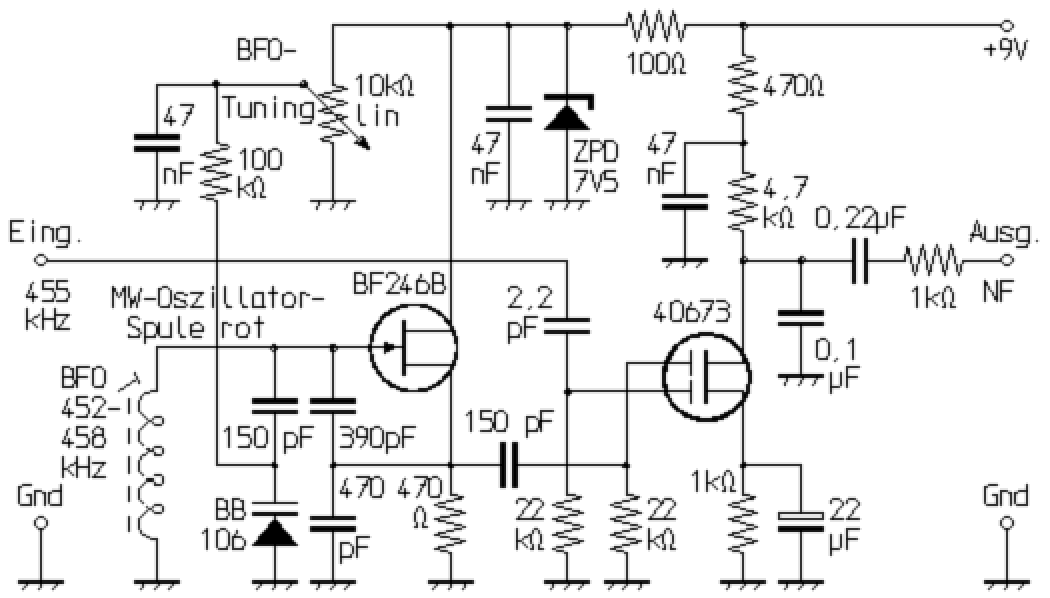
As with the frontend, the product detector also does not operate as a self-oscillating arrangement but with a separate oscillator. This beat frequency oscillator is again equipped with a JFET. The receiver thus constructed, consisting of the frontend shown, IF amplifier, product detector, and a subsequent audio frequency section with an integrated circuit of type TA7368, fit into the housing of an old CB mobile radio. Even under the difficult reception conditions of high activity, such as during contests, this receiver offers very clear reception, good selectivity, and good suppression in the frequency range of the opposite sideband. The sound quality of received signals is pleasantly smooth due to the less sharp filter slopes.
Oscillator suitable for calibration or as beat frequency oscillator
The crystal oscillator presented here is well-suited for frequencies below 4 MHz. With a suitable crystal, it can be used effectively for calibrating analog receiver scales. A 1 MHz crystal provides tuning points at intervals of exactly one megahertz using its harmonics. The 4 MHz harmonic, for example, can be used to calibrate a receiver for the 80-meter band with a tuning range of 3.5 to 4.0 MHz. For other amateur bands, the harmonics falling at the lower band edges, such as 7 or 14 MHz, are more commonly used. A 3.5 MHz crystal can be used to calibrate the fine-tuning scale of a receiver with a continuous shortwave range to the band edges of the 80-meter, 40-meter, 20-meter, 15-meter, and 10-meter bands. If the coarse adjustment is tuned to the quartz frequency or one of its harmonics, then the fine adjustment scale can be calibrated for frequencies within the amateur bands. The oscillator's adjustment range is below 1 kHz, allowing for very precise tuning to the target frequency. With a high-quality tuning trimmer, this oscillator achieves excellent frequency stability. Therefore, the precision remains good even at 28 MHz, as any deviations at this frequency are magnified by a factor of eight.
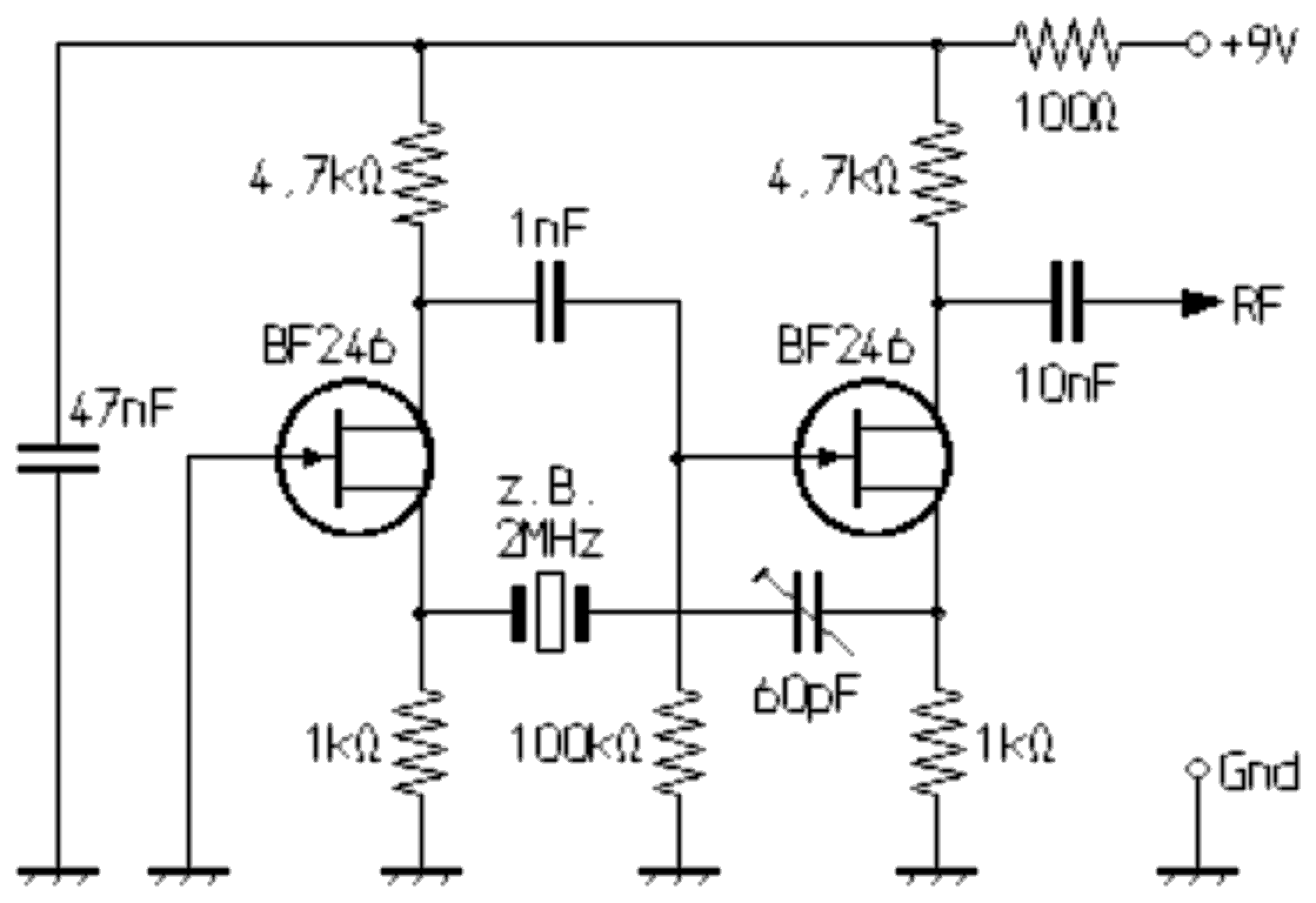
Without modifications, the circuit also works with ceramic resonators. Since such resonators are available for frequencies around 455 kHz, it is also ideally suited as beat frequency oscillator, for example, instead of the tunable oscillator in the previously shown product detector. With ceramic resonators, a significantly larger adjustment range can be achieved, up to approximately 20 kHz at frequencies around 455 kHz. By using switchable trimmer capacitors, the circuit can thus be used for both the lower and upper sidebands. Because the frequency stability is significantly better than that of the tunable oscillator in the product detector, an externally accessible adjustment is not necessary for this circuit.