The construction of simple shortwave amateur radio stations
After passing the amateur radio license exam, radio operators typically began with a simple, home-built transmitter. This was added to an existing receiver, which had previously only been used for listening on the amateur bands. The station thus assembled was initially usually only suitable for telegraphy operation, although amplitude-modulated signals can also be received with an regenerative receiver. With a single-stage transmitter, sufficient frequency stability for telegraphy operation could almost only really be achieved with crystal oscillator control. However, suitable crystals were expensive, and one was tied to a specific frequency, meaning that one could not respond to CQ calls arbitrarily on the band. Therefore, the first transmission attempts usually began with two-stage setups. These typically consisted of a variable frequency oscillator (VFO) tunable via a turnable capacitor. This was followed by a transmitter output stage (PA), for which a radio output pentode such as the EL41 or EL84 was usually used. To achieve sufficient drive power to simultaneously operate the final stage as a frequency doubler, an identical tube was often used in the oscillator. With such small two-stage transmitters, radio contacts could be established with many amateur radio stations in distant countries using telegraphy under good propagation conditions – especially on the 40m or the 20m band.
A simple two-stage tube transmitter for 80 and 40 meters
With an effort not significantly greater than that of a single-stage transmitter, a two-stage transmitter can also be built using a compound tube. Despite the minimal material usage, significantly better frequency stability can be achieved compared to a single-stage transmitter. In the circuit presented here, the triode section of the compound tube is used as a Hartley oscillator. It operates in the 80-meter band and delivers a fairly high output voltage. To achieve the best possible frequency stability, its anode voltage is stabilized to a constant value of approximately 150 volts by a voltage regulator tube. If the coil of the output resonant circuit is pluggable, the final stage can be used either as a direct amplifier or as a frequency doubler by simply replacing the coil. Without having to modify the oscillator's tuning circuit, by this way the transmitter can also be used for the 40-meter band. However, the output power, which can reach up to about 5 watts in the 80-meter band depending on the construction, will then be somewhat lower.
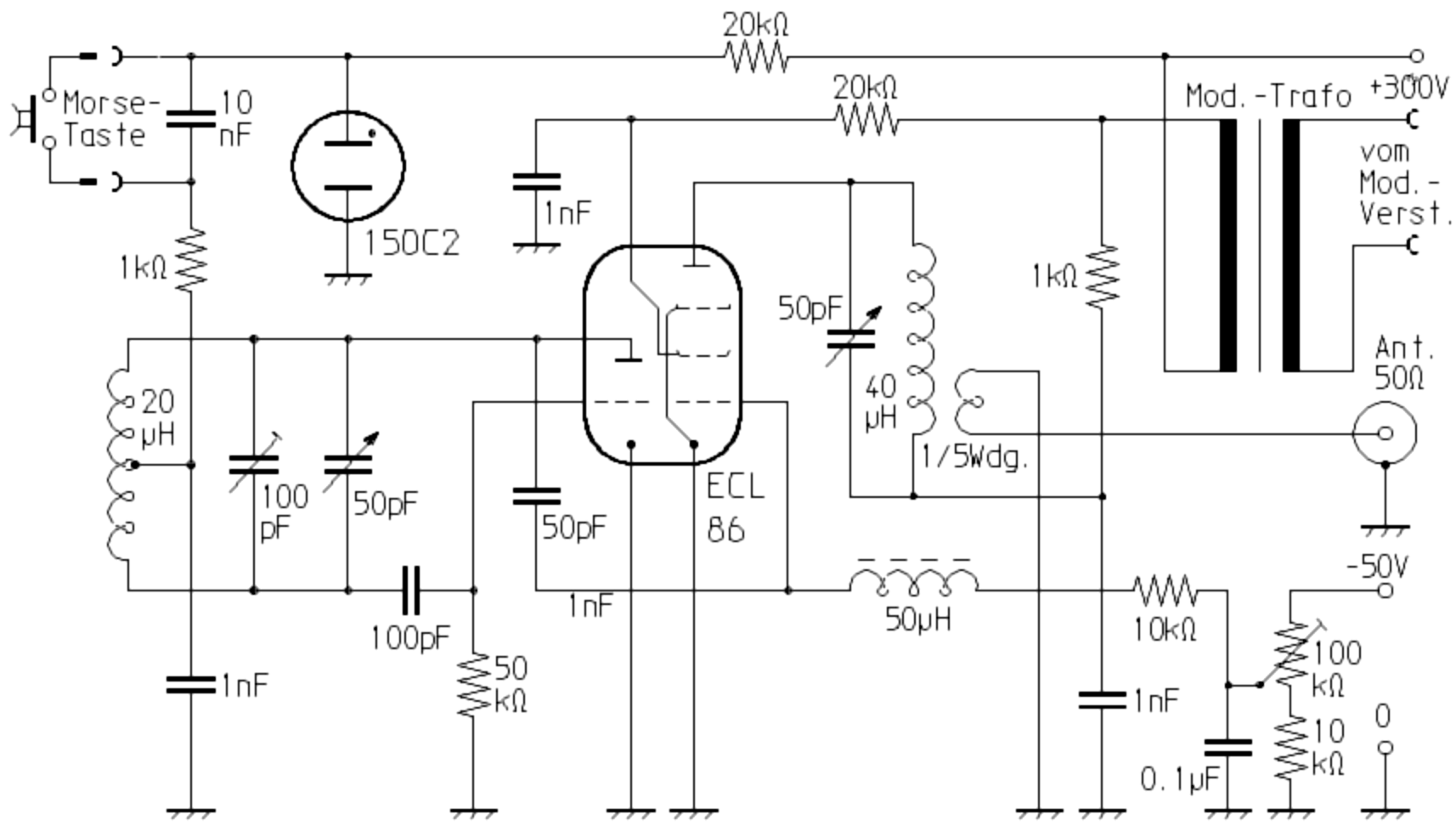
Because this simple transmitter is keyed by interrupting the oscillator's anode voltage, this should be achieved using a keying relay, contrary to the circuit diagram. To ensure the Morse code remains easily legible, this relay must not be too slow to respond. The actual key then switches the relay using a low voltage, which can be derived from the heater voltage, for example, by half-wave rectification. This prevents potentially lethal contact with otherwise live parts of the Morse key.
In the modulation possibility shown in the circuit diagram, the primary winding of the modulation transformer is connected to the anode circuit of an audio output pentode. For this anode-screen grid modulation, the amplifier used must be able to deliver a power output approximately on the order of the transmitter's output power. An EL95 tube, for example, is suitable, but when using a dynamic microphone, it requires a preamplifier to achieve sufficient modulation volume. This preamplifier can be built, for example, with an ECC83, in which the input stage preferably operates in grounded grid configuration. The microphone's signal terminal is connected to the cathode of the input tube via a small electrolytic capacitor (e.g., 4.7 µF), while the grid directly is connected to the ground. Despite the high overall gain, the by this way reached low input impedance minimizes problems with RF interference at the microphone input. The turns ratio of the modulation transformer should be approximately 1:1.5. To keep saturation distortion as low as possible and achieve the best modulation efficiency, the anode current of the output stage and the modulation amplifier must flow through the transformer in opposite directions.
Further articles on radio technology in the shortwave range:
- No need to switch ranges: Antenna tuner by PA0FRI for 3.5 to 30 MHz
- The NYFAZ or_DL4CS antenna - a small-dimensions shortwave antenna
- Tri-band CW QRP transceiver Heathkit HW-7 with direct conversion receiver
Single-stage 80m tube transmitter for amplitude modulation
The popularity of the 80-meter bA typical amateur radio station from the 1950s, consisting of home-built equipmentand at the time was certainly due in part to the fact that, even without crystal oscillators, sufficient frequency stability for amplitude modulation could be achieved at those low frequencies with a single-stage transmitter. When using suppressor grid modulation, a single preamplifier pentode is sufficient for the modulator. For optimal modulation quality, the suppressor grid must be slightly negatively biased. The exact value should ideally be adjustable via a trim potentiometer. With a carbon microphone, such as those commonly used in telephones at the time, no further preamplifiers are needed for sufficiently strong modulation. An audio transformer is used to match the low-impedance signal from the microphone to the high-impedance input of the modulator tube. This allows to be driven to its full power.
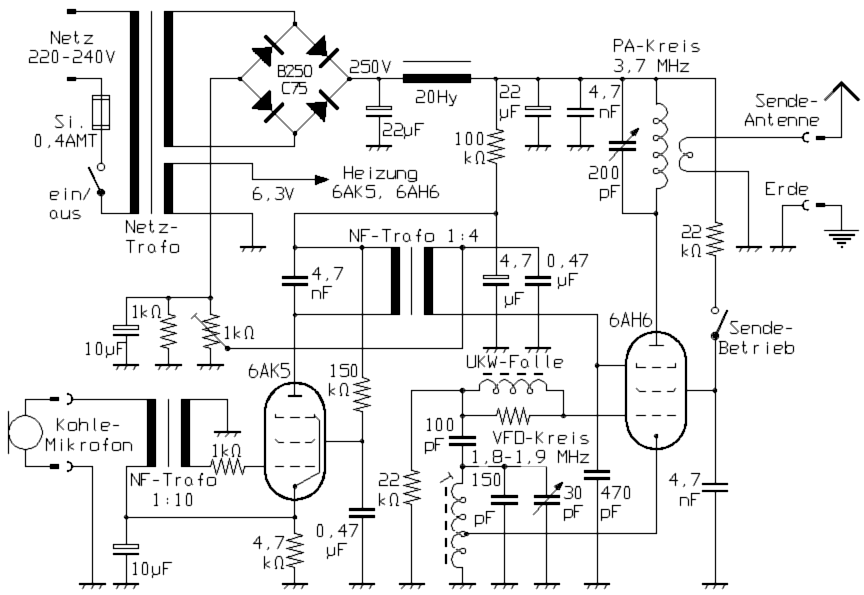
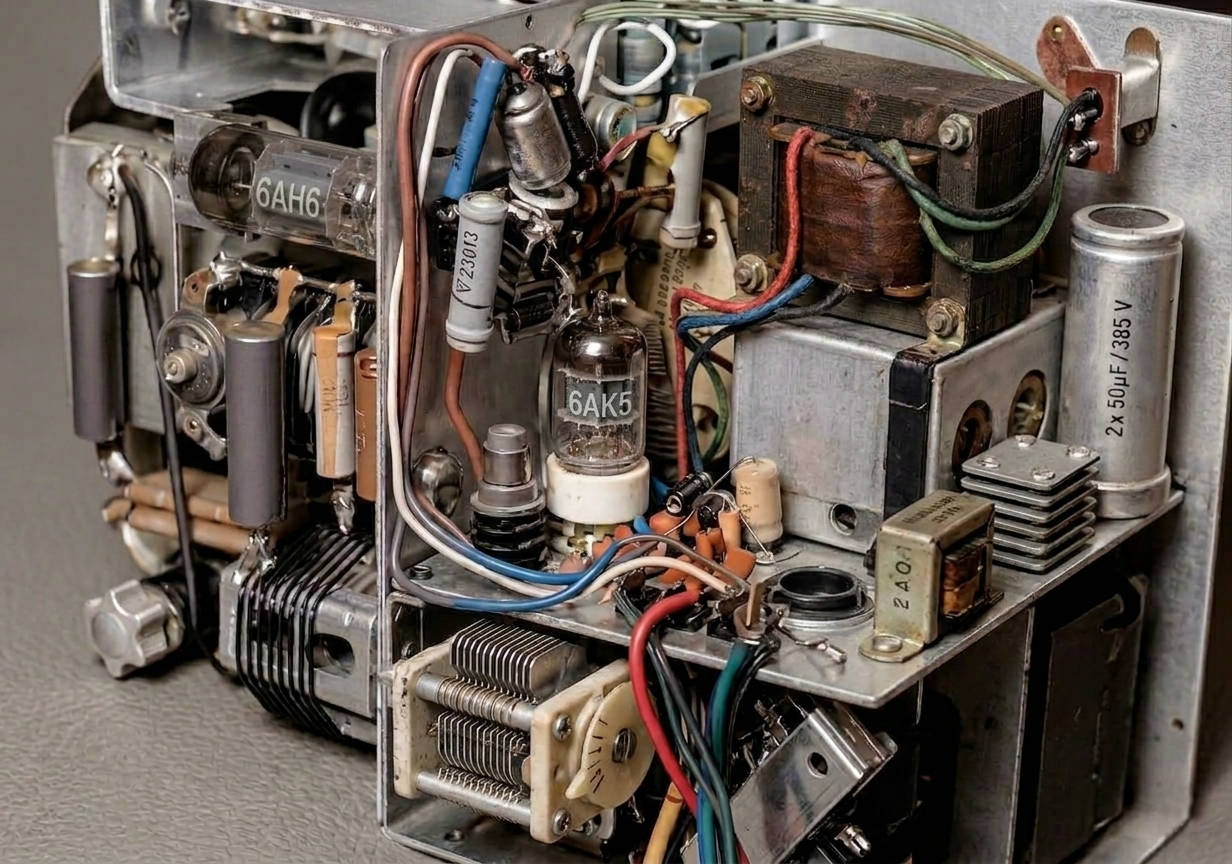
The ranges achievable with such entry-level devices, in Germany often referred to as QRPeters in the past, were usually limited due to the relatively low output power for the 80-meter band and the not particularly efficient amplitude modulation. However, under good conditions, with an unoccupied frequency and a sufficiently long wire antenna (e.g., a half-wave dipole) suspended outdoors, the signals from such transmitters—albeit with low signal strength—could still be received several hundred kilometers away!
For radio operation, a regenerative receiver with RF preamp is better.
For use in a radio station, especially in telegraphy operation, the reliability of the receiver tuning is crucial. With a simple regenerative receiver, mostly the frequency changes as it approaches the antenna, which can cause the pitch of the Morse code from the received stations to change so drastically that it is no longer received. A regenerative receiver with an RF preamplifier solves this problem, and even allows for scale calibration. In the receivers for amateur radio beginners that I presented in another article, an regenerative receiver is shown where the audio amplifier is configured as a reflex stage for simultaneous RF amplification. However, a pentode preamplifier in a common-cathode configuration, tuned to the receiving frequency, is preferable. This also allows for gain control via a potentiometer at the cathode connection, enabling even better adjustment of the sensitivity and gain to the receiving conditions and the signal strength of the receiving stations. To continue using plug-in coils for different bands, the preamplifier's tuning circuit is best implemented as a separately adjustable preselector. This also avoids potential tracking problems between the preamplifier and the detector resonant circuit. If the preselector is implemented with combined, mechanically coupled tuning via a variable capacitor and variometer, it can be tuned to resonance on all amateur bands from 80m to 10m without switching. Switching the coil is then unnecessary. A much less complex design, and therefore considerably better suited for home construction, is an all-band circuit, as shown in the circuit diagram. In both cases, changing bands is limited to replacing the plug-in coil and tuning the preselector.
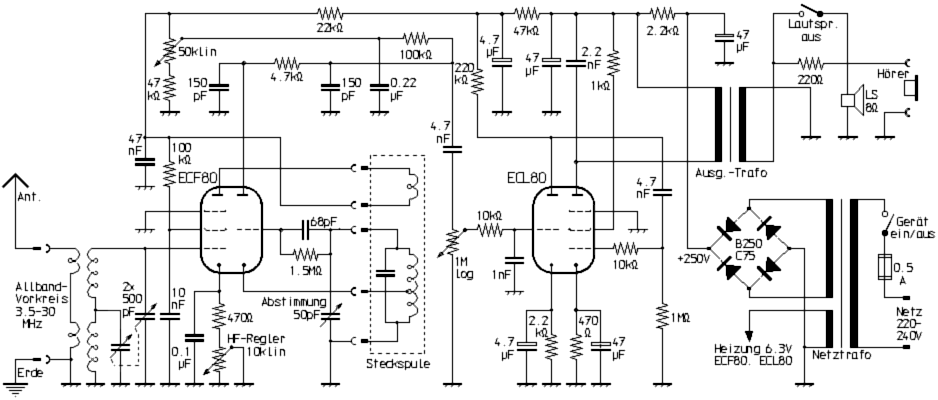
For the receiver of an amateur radio station, sufficient overall gain is desired to receive even weak signals at an adequate volume. This also enables loudspeaker reception of weak stations. Furthermore, in this case, headphones with low efficiency can be used, which are often sonically superior. By using compound tubes, each with a triode and a pentode section in a single glass envelope, only two tubes are needed to fulfill all these requirements for a amateur radio receiver. For one of these tubes, a version for small-signal amplification is sufficient, f.e. an ECF80 or an ECF82. The pentode section with it acts as a high-frequency preamplifier, and the triode, as in the entry-level receivers I have presented elsewhere, as regenerative detector. The other tube is configured as a two-stage audio amplifier, with the triode section serving as the preamplifier and the pentode section as the output stage. It is advisable to use a tube with a more powerful pentode system, such as the ECL80. With an ECL86, depending on the output transformer used at the loudspeaker, power outputs of up to approximately 4 watts can even be achieved.
Not much more complex than a good regenerative receiver: The dwarf superhet
The simplest superheterodyne receivers, in some places also known as a dwarf superheterodyne, was a type of receiver in which a mixer and oscillator stage were added before the regenerative receiver. Such a device essentially operates on the superheterodyne principle, where the selected receiving frequency is converted to a fixed intermediate frequency. This is achieved by superimposing the input frequency with the signal from an oscillator, for example, using a mixer tube or a suitable transistor stage. This results in the sum and difference frequencies of the two signals. The principle is the same as how the Morse code signals from received telegraphy stations are made audible in an oscillating regenerative receiver. Their pitch corresponds precisely to the difference between the frequency of the received signal and the oscillation frequency of the regenerative detector stage. In a superheterodyne receiver, however, a mixing product generated above the audible range is filtered out and amplified; in many shortwave, medium wave, and long wave radio receivers, this is, for example, 455 kHz.

In the miniature superheterodyne receiver, a fixed-frequency audion now serves as the intermediate frequency amplifier and demodulator, significantly reducing the circuit complexity. Thanks to the feedback of this audion, which now functions as the IF stage, good selectivity can be achieved with a single, high-quality intermediate frequency resonant circuit. Due to the fixed intermediate frequency, the feedback level no longer changes depending on the selected receiving frequency. Therefore, the feedback setting only needs to be adjusted to select between receiving stations using amplitude modulation, single-sideband modulation, or transmitting telegraphy signals.
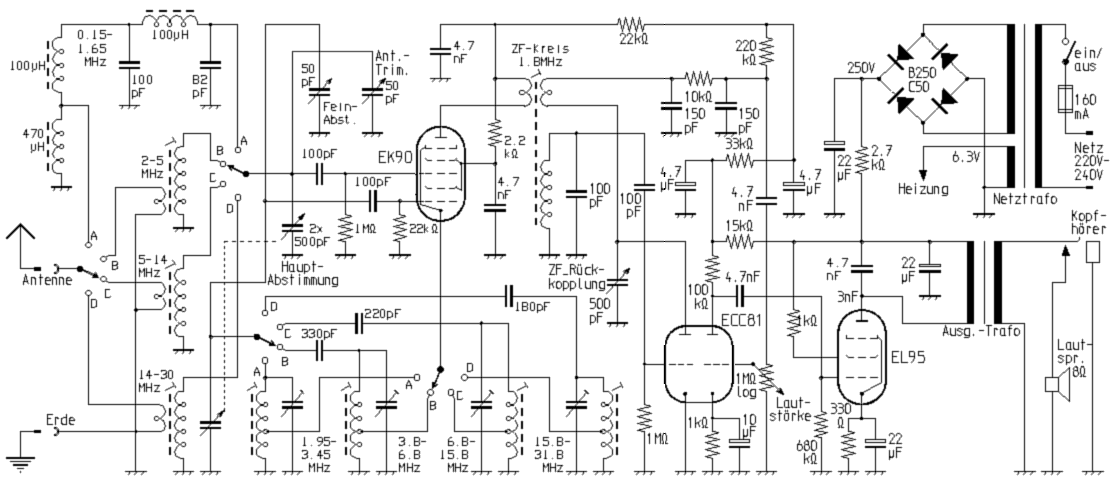
The circuit shown for a dwarf superheterodyne receiver features three switchable shortwave bands, covering the range from 2 to 30 MHz without gaps. Fine tuning allows the receiver to be tuned within the amateur bands. This tuning can be equipped with a scale for the amateur bands. If a crystal oscillator for exactly 3.5 MHz is available, the scale can be calibrated to the band beginnings of the 80m, 40m, 20m, 15m, and 10m bands by tuning the receiver to the fundamental frequency or harmonics using the main tuning knob. Additionally, the receiver has a combined medium and longwave band based on the principle of a single-band superheterodyne receiver, which gained some importance in the 1930s. Because the intermediate frequency of 1.8 MHz is above the medium wave range, a low-pass filter that attenuates all frequencies above the medium wave range is sufficient as input selection. This results in a continuously tunable medium and long wave range from 150 to 1650 kHz.
Transistorized telegraphy transceiver with direct-conversion receiver
Later, simple transceivers became established, designed solely for telegraphy mode, featuring direct-conversion receivers. Such devices were hardly feasible using classic vacuum tube technology, primarily due to the mains hum originating from the heater circuit, as audio signals in the microvolt range had to be amplified to at least headphone volume. Now these transistor-based devices, usually designed for battery operation, often employed a dual-gate MOSFET for the mixer stage. With such devices, usable reception of amplitude-modulated stations was virtually impossible. However, this was hardly a problem, as almost no stations operating in this mode had been heard on amateur shortwave bands since around the mid-1970s. These transceivers significantly simplified operation because the transmitter and receiver shared a common oscillator and thus automatically operated on the same frequency. The need to manually tune the transmitter to the set receiver frequency was therefore eliminated. To make the Morse code tone audible during single-frequency operation, a fine tuning adjustment (RIT) is sufficient, which allows the oscillator to be detuned by a few hundred Hertz up or down during reception. For communication between two stations, however, it is enough if they operate at a frequency difference corresponding to the pitch of the Morse code tone (e.g., 400 Hertz). This operating principle has recently regained popularity for very simple kit or home-built radios.
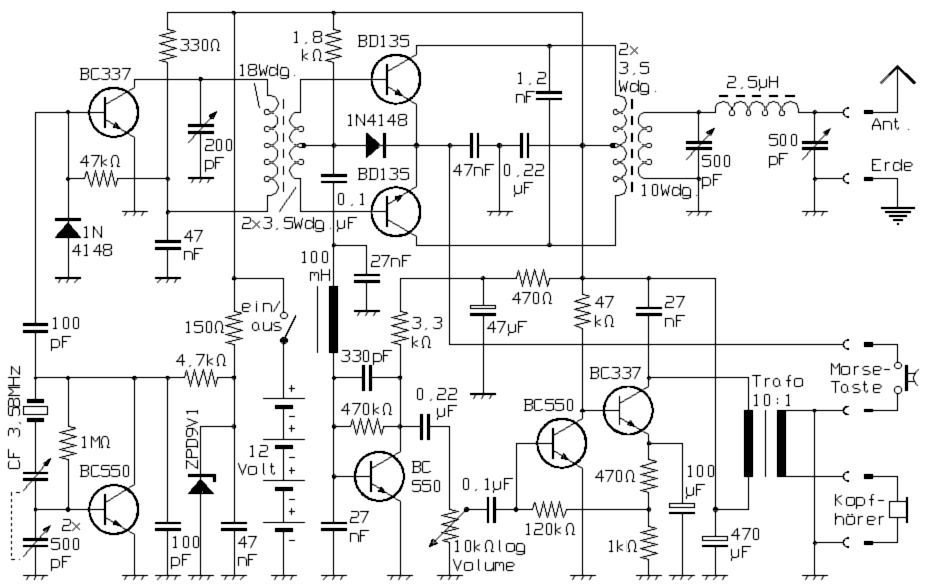
In the circuit shown here for a small transceiver designed for telegraphy mode, the receiver works as a direct mixer too. However, the mixing is not performed with a dual-gate MOSFET, but rather at the diode junctions of the transmitter's output transistors. Because the transmitter's output stage operates in a push-pull configuration, the resulting mixer for reception also operates in push-pull. This has the advantage that even particularly strong broadcast transmitters operating near the amateur radio band can hardly interfere with reception. The oscillator uses a ceramic resonator and, in the configuration shown, can be tuned in the range of approximately 3.5 to 3.6 MHz. Because the device is designed for the 40-meter band, a frequency doubler follows the oscillator. Consequently, the device can be tuned across the entire 40-meter band from 7.0 to 7.2 MHz. By adding another multiplier stage, which can operate either as a doubler or a tripler, a three-band transceiver would be conceivable, enabling operation on the 20m band and the 15m band as well. The input and output circuits of the final amplifier would, of course, need to be switched accordingly.