A self-built transistor guitar amplifier
All-transistor guitar amplifiers, often called solid-state guitar amplifiers, can certainly produce sounds reminiscent of vintage 1960s amplifiers. However, their tonal character will always be different from that of tube amplifiers. A further distinction exists between solid-state amps equipped with individual transistors and those using operational amplifiers. The latter contain complex internal circuitry with numerous transistors operating with high levels of negative feedback. With amplifiers using individual transistors, special attention should be paid to the levels at each individual stage to achieve a vibrant sound due to their limited output headroom. For clean sounds, as many of the amplification stages as possible should be driven just enough to produce barely perceptible distortion at the peaks. For overdriven and distorted sounds, several stages should ideally be pushed into overdrive.
With these considerations in mind, I designed the guitar amplifier presented here. The goal was not to build an amplifier that simply copied the sound of any other device. After building several tube amplifiers, I intended to construct a transistor-based amplifier. Nevertheless, it was meant to have a unique sound but reminiscent of the 1960s. To achieve this, it was deliberately designed completely differently from a typical transistorized hi-fi amplifier. While not aiming to uncompromisingly imitate the sound of a tube amplifier, many of its features were incorporated into the circuit design. Negative feedback was therefore largely avoided. Consequently, the use of integrated circuits, and especially operational amplifiers, was out of the question. The result is a device that primarily produces very lively clean sounds. Slightly overdriven sounds via the boost channel are particularly convincing at high volumes, where even slight power amp distortion is already present. Overall, the sonic musicality comes very close to that of tube amplifiers.
In order to achieve a high input impedance at the lowest possible expenditure, the input stages are constructed with field-effect transistors. So it comes to a low damping of the guitar pickups and the sound character of the instrument used can fully unfold, pickup resonances are included in the sound.
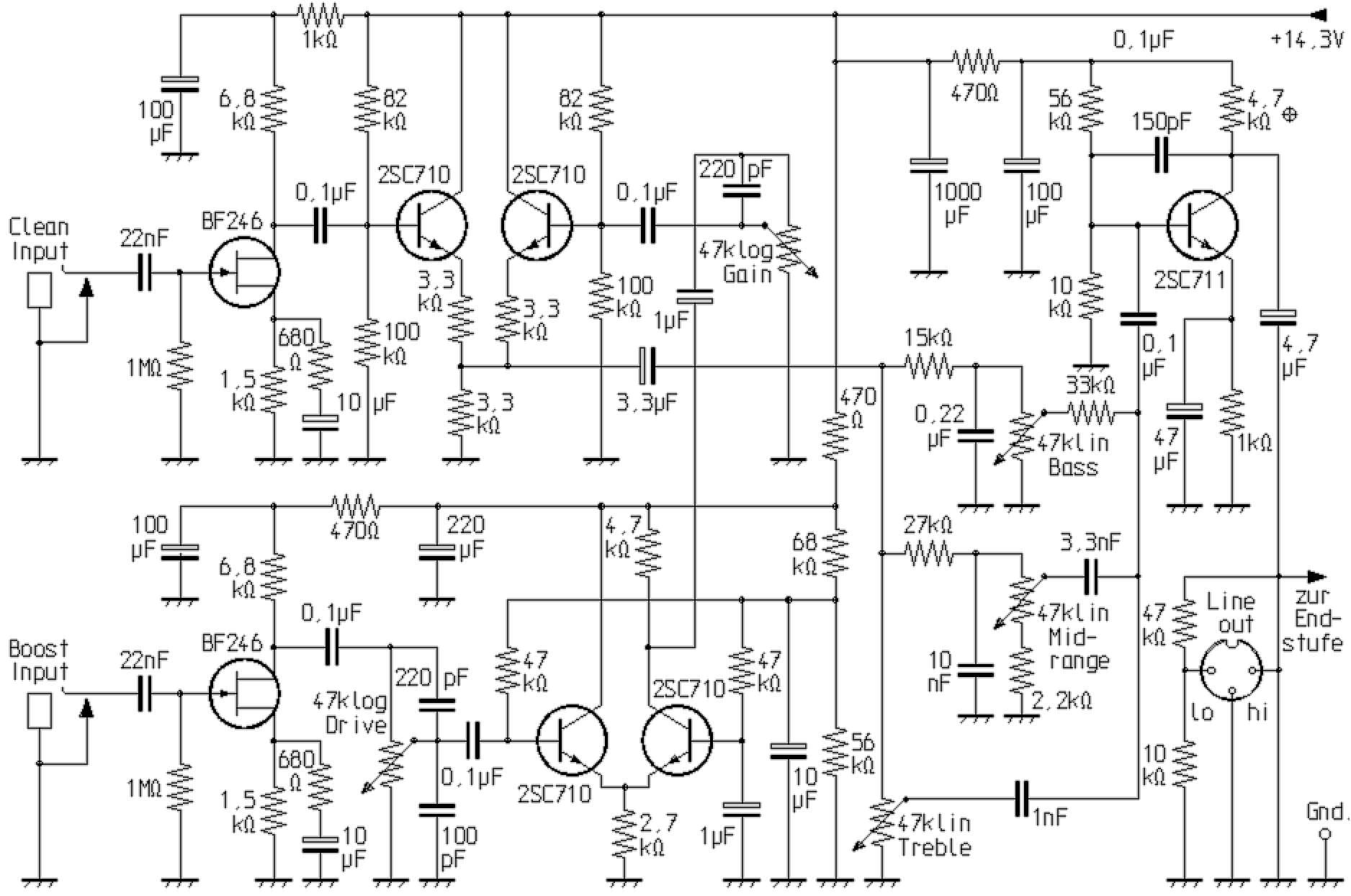
The boost channel is followed by a differential amplifier, which provides a very soft limiting when overdriven. Due to the properties of bipolar transistors, the transfer characteristic has no similarity to that of tubes. The signals from the Clean and Boost channels are merged in a mixer stage and fed to a passive three-band tone control borrowed from tube technology. Via a transistor stage to compensate for the level losses in the tone control, the signal reaches the power amplifier. On a three-pin DIN socket, the signal from the pre-stage can be tapped with two different levels. Thus, the amplifier can also be used as a pure guitar preamp or can be connected directly to a PA.
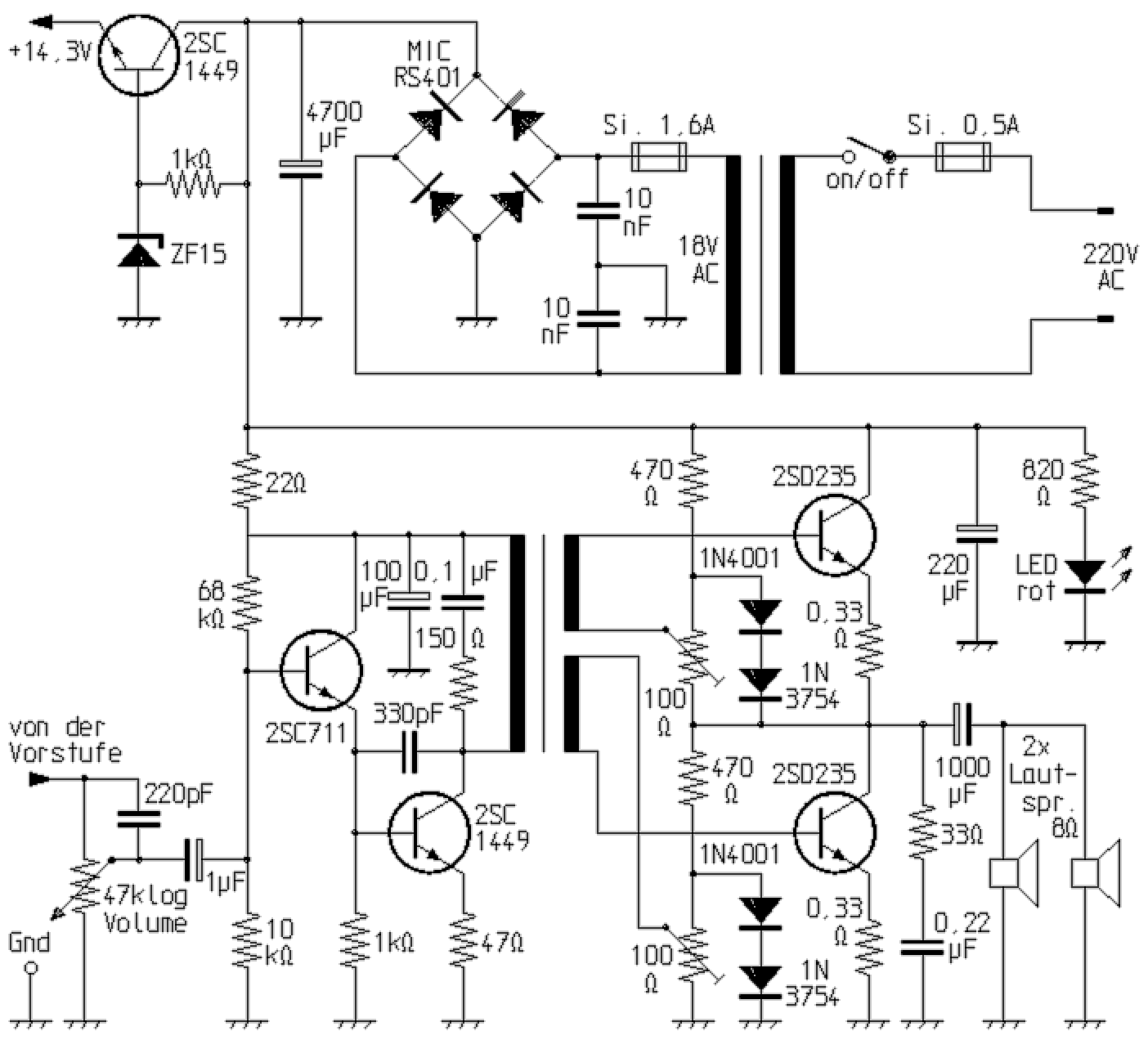
At the input of the output stage is the (Master) volume control. With the exception of current negative feedback in the driver stage, the power amplifier works virtually completely without negative feedback. As a result, the characteristics of the driver transformer contribute not insignificantly to the sound character. With the exception of the unbalanced coupling of the loudspeakers, the push-pull power stage is strictly symmetrical, as is the case with tube amplifiers. In contrast, however, it is circuited as a series and not as a parallel push-pull amplifier. The type 1N3754 diodes have transistor housings and are screwed to the heatsink of the output stage transistors for thermal stabilization of the bias current with cooling clamps.
The power supply has no special features. The pre-stage gets its power supply via a simple transistor stabilization. This improves the Störsignalabstand and prevents tendency to oscillate.
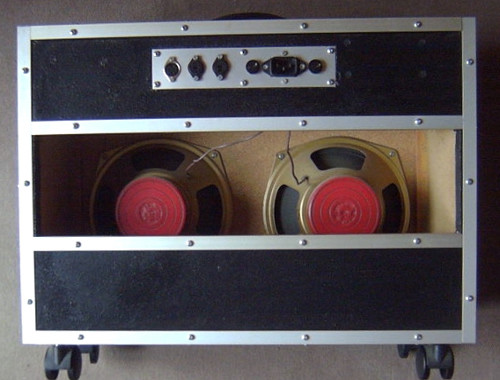
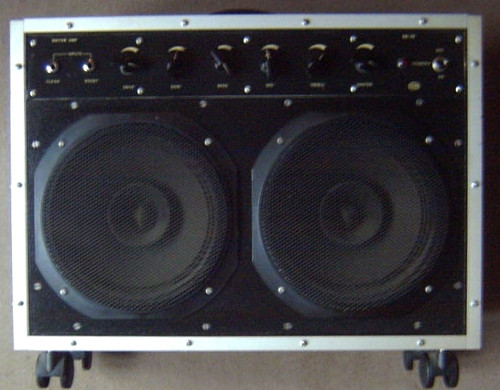
The housing was glued together from chipboard blanks from the hardware store. It was then painted with water-based acrylic paint. Edge protection is provided by aluminum L profiles from the hardware store. The aluminum front panel painted from the spray can is labeled with transfer letters and symbols. Subsequently, fixing varnish was applied.
The speakers are very old Alnico full-range speakers, which give the sound additional an own character.