Homemade hybrid guitar amplifier
The first experimental guitar amplifier circuit that I actually got working used an ECC83 from a broken tape device in the preamp stage. In the power amp, I used an EL84 from an old radio. The two triode sections in the preamp provided more gain and allowed for the inclusion of a proper tone control network. This resulted in a significantly better sound overall than with a tube radio, wich had a single-stage preamp using only the triode section of an EABC80 and a simple tone control circuit with only a single potentiometer.
To my surprise, years later, in the 1980s and 1990s, more and more designs for very similar amplifiers appeared, primarily intended for home practice. These days, various manufacturers produce devices of this type, suitable as practice amps or, using microphone pickup, for use in the studio or with a PA system. Typically, they use power tubes like the 6BQ5, 6V6, or EL84, delivering around 5 watts. Of course, the power of such amplifiers alone isn't sufficient for stage use. I initially developed my circuit further by introducing a three-band equalizer. I didn't use the arrangement and dimensions from either Fender or Marshall amplifiers, now often referred to as American or British EQ, respectively. Personally, I prefer my three-band Equalizer, which emerged from numerous experiments, especially in terms of the variety of possible tonal colors. Others might feel differently, perhaps because it's unfamiliar.
I used that same tone control in a DIY guitar amplifier in the early 1980s, featuring a tube preamp and a transistor power amp. The latter was a pre-built 120-watt power amp unit from the PA manufacturer Franz Grigelat, based on Siemens application circuits. For more gain, my preamp used an EF86 pentode. This was followed by a triode section of an ECC83, which could then be driven with significant overdrive. The preamp, via the aforementioned tone control network, terminated with a cathode follower stage using the second triode section of the ECC83 to match the power amp. The master gain potentiometer was located between these stages. This guitar amp, designed as a head, sounded almost like an all-tube amplifier despite its transistor power amp. The power output and volume were perfectly suitable for stage use. At that time, designs with transistor preamps and tube power amps, as found primarily in Dynacord equipment, were still common. So, my reverse setup with a tube preamp and transistor power amp initially elicited some incomprehension and head-shaking. Today, however, it's nothing unusual. Many transistor amplifiers now have tube preamps. In my opinion, though, configurations where the preamp contains only a token tube don't even come close to producing a sound similar to a full tube amp. It seems the main goal is simply to market such devices as tube amplifiers.
Nevertheless, there was still something different about my amplifier compared to an all-tube amplifier. It's difficult to describe in words and wasn't so much about the tone. It was simply a slightly different feeling when plucking the strings, perhaps a less direct response. Because this was likely due to the strong negative feedback of the transistor power amplifier, I came up with the idea of dedicating the final power amplification to a single-stage push-pull output stage with transistors. I used the EF86 again for the input stage, now followed by the triode section of an ECL86 for the second preamp stage. The pentode section of the ECL86, originally intended as the power stage, now functioned only as a driver stage. The ECL86 can only produce an output power of about 4 watts. This power output would have been limited to that of a practice amplifier, but is sufficient to achieve power outputs on the order of up to about 100 watts with the down-stream output stage, which is arranged like my solid-state amp - provided sufficiently powerful power transistors are used.
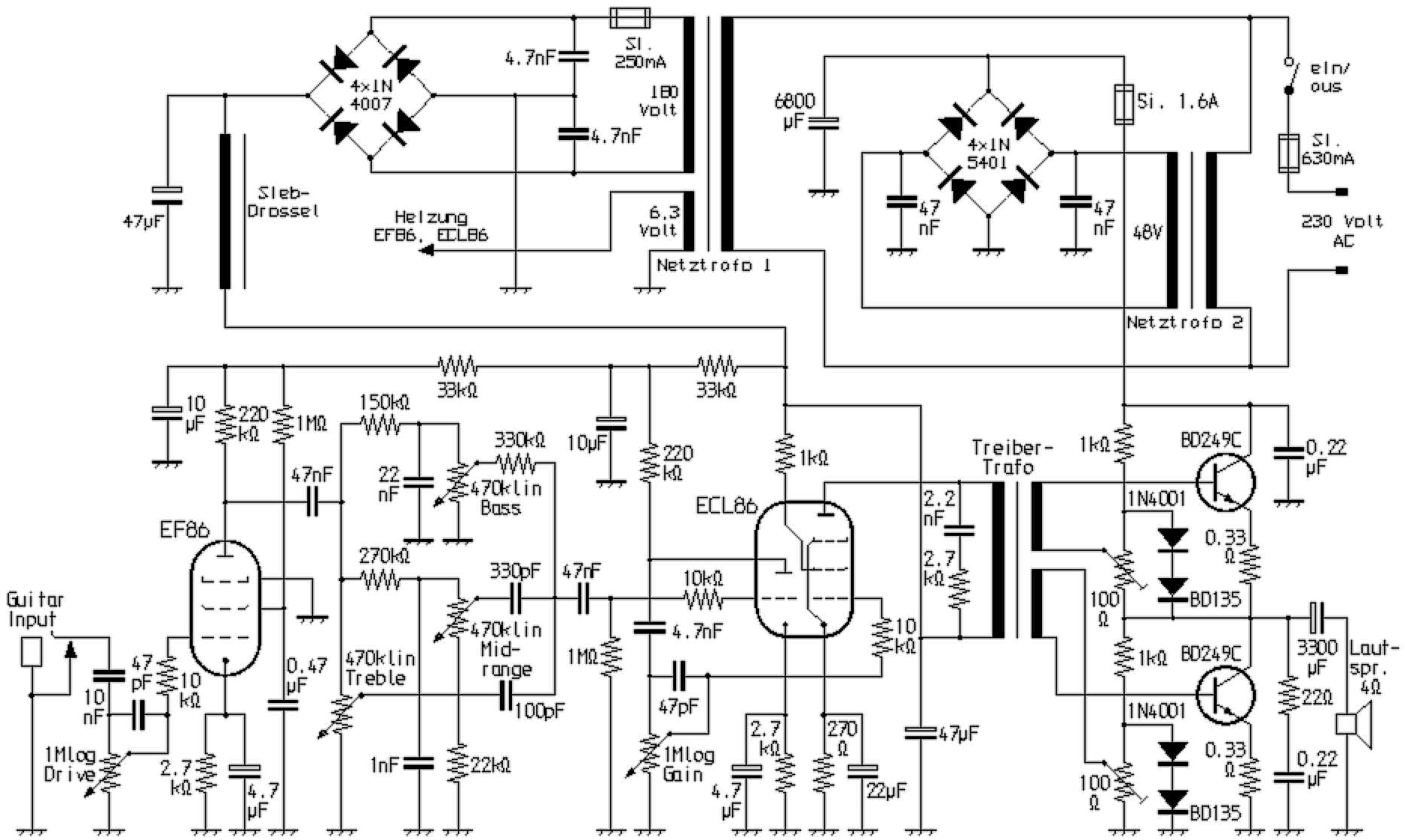
With the resulting circuit, a guitar amplifier can be built with remarkably little circuitry, characterized by virtually unadulterated tube sound while simultaneously delivering stage-worthy power. In the specified configuration, the amplifier delivers over 50 watts RMS and, depending on the 48-volt power transformer, up to approximately 100 watts of music power. The 4-ohm load is achieved, for example, by connecting two 8-ohm speakers in parallel. Two 12-inch speakers will produce excellent volume. Aside from an improved damping factor, the transistor stage is virtually sonically neutral. The pentode input stage provides ample gain, ensuring plenty of headroom for overdriven or distorted, yet always authentic tube sounds! The gain control adjusts the output level of the ECL86 pentode system, which, as mentioned previously, serves as the driver. As the volume increases, genuine tube-style power amp distortion develops in the pentode section of the ECL86. However, the transistor output stage, which is actually superior from a hi-fi perspective, means that specific speaker characteristics contribute less to the sound, even though this is precisely what's desirable with certain guitar speakers. This can be remedied by inserting an impedance matching transformer for PA amplifiers at the amplifier output. This transformer also allows the amplifier to maintain maximum output power even with different speaker impedances (e.g., 4, 8, or 16 ohms). Slightly undersizing such a transformer at high power levels also results in saturation distortion, which further approximates the sound of a true all-tube amplifier.
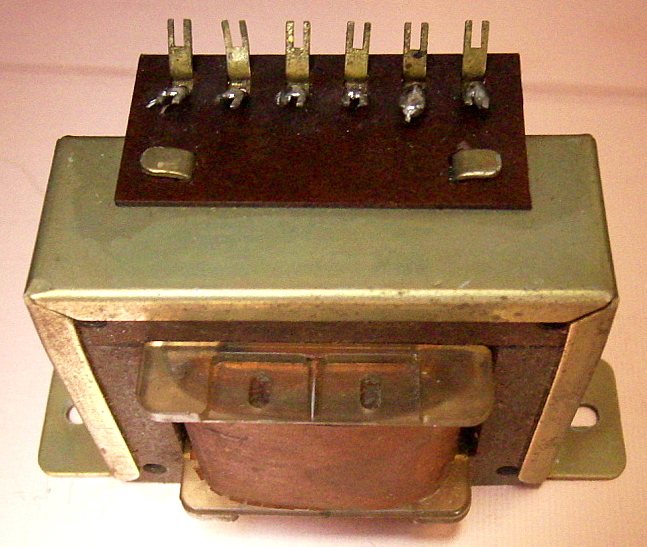
The driver transformer can be obtained by alteration of an output transformer as it shown below. It was from an old tube radio with a single-ended power amplifier for a five-ohm speaker. First, the wires are unsoldered from the terminal block and then removed the headband. The E sheets of the EI core must now be removed from the winding body. Then completely the always external disposed secondary winding can be unwound. Afterwards it is wound up exactly in two halfs again. Does it f.e. consist of out of 120 turns, then 60 turns are wrapped twice. When connecting, it should be noted that these windings drive the two transistors, which incidentally need to be well cooled, in antiphase.
The diodes designated BD135 are transistors of this type, which are screwed to the temperature stabilization with the output stage heatsink and of which only the base-emitter diode path is connected. In order to operate the transistor stage without negative feedback sufficiently low distortion, it must be adjusted very accurately. First, set both 100 ohm trimmers so that no bias current flows. Then turn them up alternately piece by piece, until a bias current of up to about 100 milliamps results. The best value for the bias current is if the power amplifier just even does not distort at low levels. For that at the collector of the lower Transisor against ground half voltage must be applied. On this occasion the collector-emitter voltage at both transistors must be the same. Furthermore transistors should be selected to the same current amplification factor!