Power supply for tube devices
The power supply for circuits using vacuum tubes is often more complex than for modern devices with semiconductors. The actual electronics usually require a fairly high voltage, sometimes even different voltages for the anodes, screen grids, and control grids. Most importantly, however, a current is needed to heat the cathodes, which is typically drawn from a low-voltage source.
I would like to point out that experiments on high voltages should be made only by qualified persons!
Tube power supply with low-voltage transformers
For the construction of tube devices, the required power transformers are usually not easy to obtain. But there is the possibility to win the anode voltage with two low-voltage transformers. Of these, the second transformer is connected in reverse, i.e. it transforms the low voltage again high. As a rule of thumb, the second transformer should have about half the power of the first one. This leaves enough reserve for the heating power, because it makes sense to use transformers, which are designed for the value of the heating voltage. A value of 6 volts is within tolerance for E-tubes (6.3 volts heating voltage).
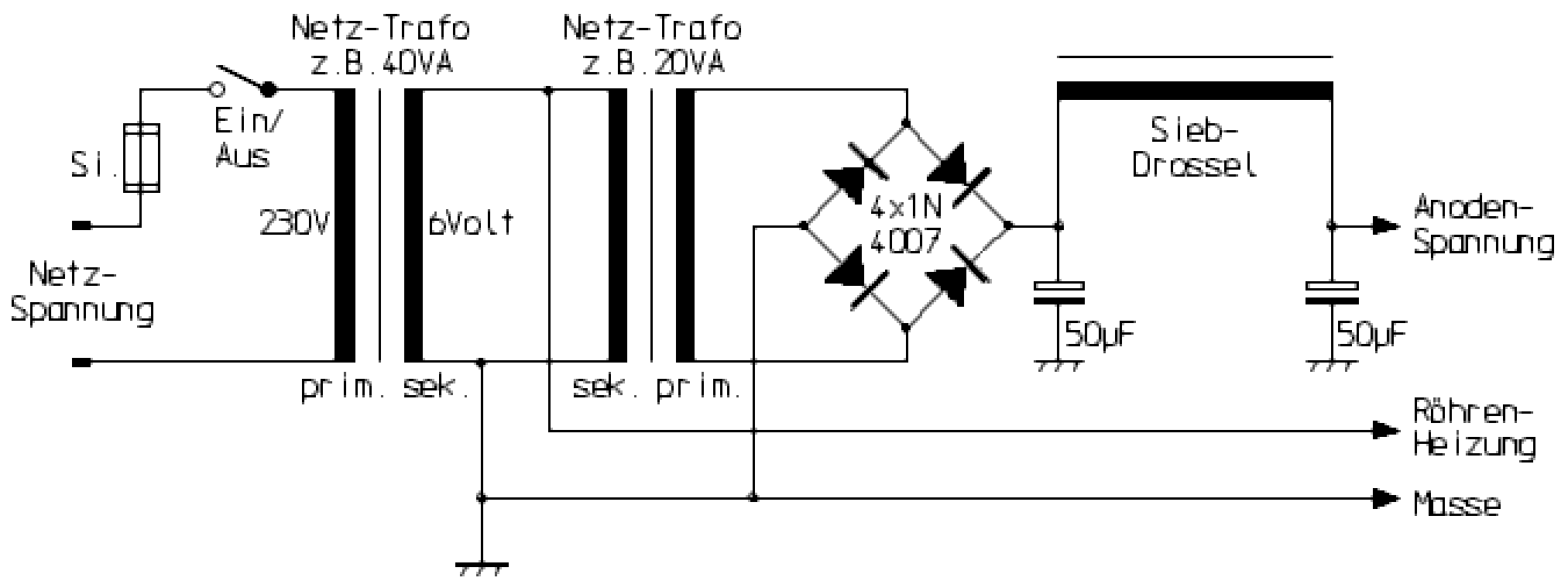
If e.g., for receiver or preamplifier circuits, a lower anode voltage is needed, the second transformer may be designed for a by the corresponding factor higher secondary voltage (e.g., 9 volts instead of 6 volts). It should be noted that the anode voltagewithout load almost reaches the peak value of the AC voltage, so at 230 volts, well above 300 volts. If a selenium rectifier is used instead of the diodes, here this value is again significantly reduced by the voltage drop.
Transverter for operating tube devices on 12 volts DC
In order to operate tube devices with batteries or on board of motor vehicles, the available low DC voltage must be converted into a much higher anode voltage. An AC voltage produced by a power generator can be brought to the desired value with a transformer. After subsequent rectification and smoothing, a high anode voltage is available, as is commonly required for tube circuits.
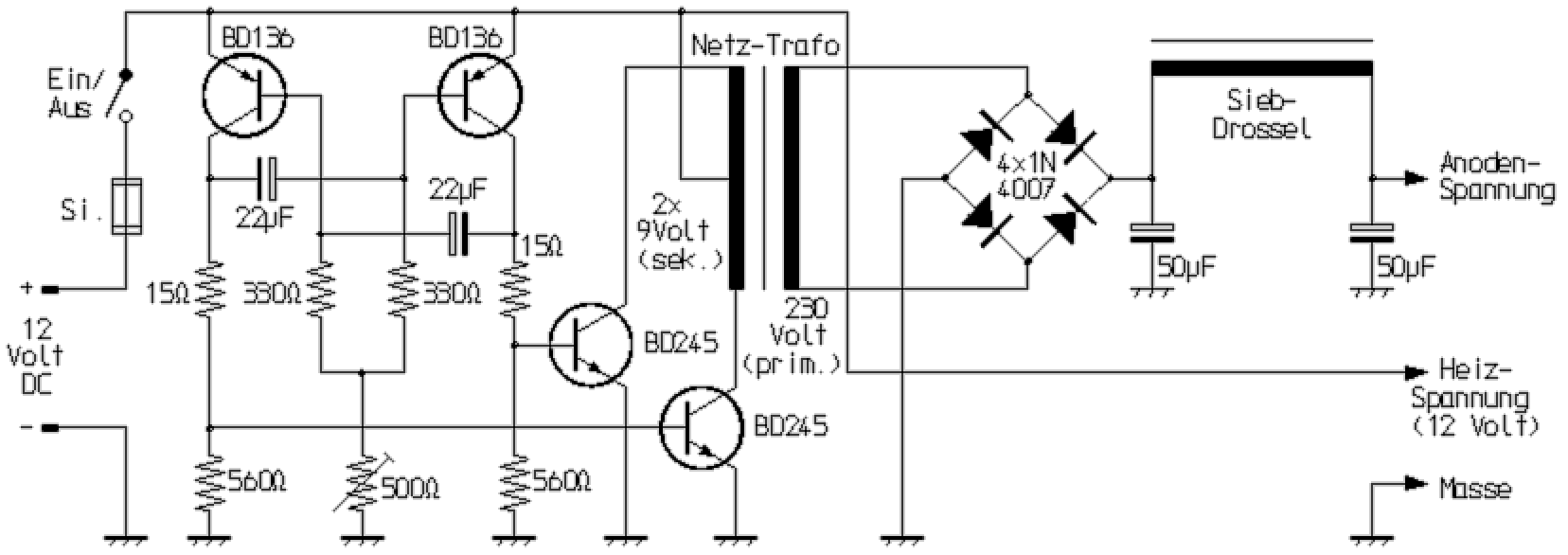
In the circuit shown, a conventional power transformer is operated in a reverse manner by feeding the working by four transistors power generator to the medium-tapped secondary winding of a conventional power transformer. Is that designed for 2 x 9 volts, builds a voltage of about 230 volts, when supplying the circuit with 12 volts on the primary winding of the transformer, so that after rectification well 300 volts are available. In the dimensioning shown, the circuit is suitable for powers up to about 50 watts. The two transistors of the type BD245 must be well cooled! The input voltage can also be used to heat tubes with a voltage of 6.3 volts when two filaments are connected in series for the same heating current (for example, 0.3A for an EF184 or ECC81).