The NYFAZ or DL4CS Antenna
Despite its compact dimensions, this antenna - which I designed myself - is suitable not only as a receiving antenna but also as a transmitting antenna for shortwave frequencies. A standard two-core speaker wire serves as both the radiator and the coupling loop. In the past, the industrial designation for this type of wire was NYFAZ, which is why I originally named it the NYFAZ antenna. However, feel free to call it the DL4CS antenna ;-)
Operating Principle: The Dual-Resonator
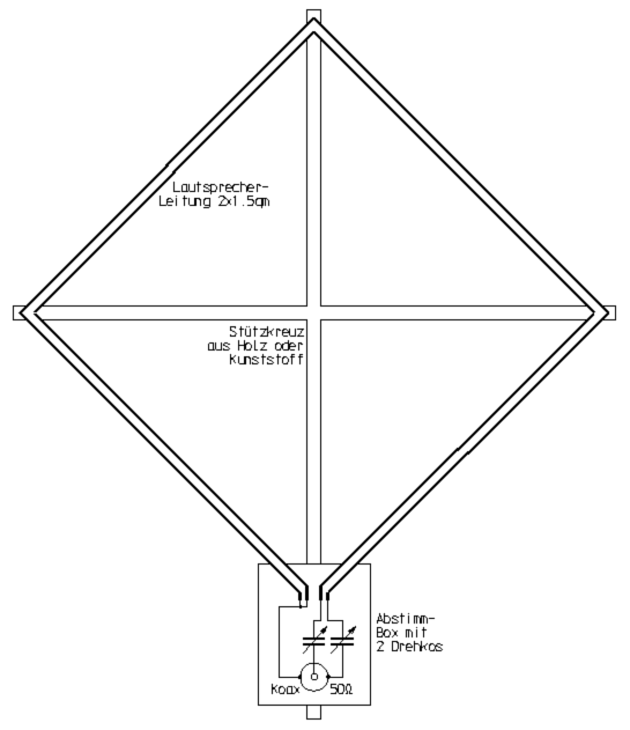
The underlying principle of the antenna is based on two tightly coupled resonant circuits, which results in a slightly wider bandwidth than conventional magnetic antennas of comparable size. From a physical perspective, it consists of two electromagnetically and capacitively coupled circuits where the system utilizes the two cores of the twin-lead wire for different tasks. The Primary Circuit is fed by the radio and completed by a variable capacitor in series. This circuit forces the current flow from the transmitter into the system and ensures impedance matching to 50 ohms. The second core forms a parallel resonant circuit with the second variable capacitor. This acts as an energy storage unit with a high quality factor (Q) and builds up the high voltage necessary for radiation. Since both cores run immediately parallel over their entire length, they form a line transformer. Energy is not transferred at a single point (as with a toroid) but is continuously coupled inductively and capacitively over the entire length. In this setup, both cores form an inductance with only a single, elongated turn. This reduces inherent losses and ensures that energy is transformed directly where it can be radiated.
Tuning and Practical Results in the 10m Band
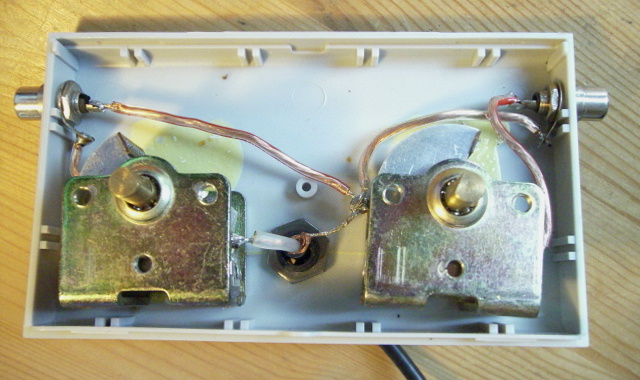
In practical use, the resonance point is sharp and coincides with the best Standing Wave Ratio (SWR) when tuned correctly. The tuning process is similar to that of a classic Pi-network (Collins filter), where the two variable capacitors are adjusted alternately for the best match. Even with varying lengths of coaxial cable, an SWR of better than 1.5 was easily achievable in all tests. Although the antenna should primarily be viewed as a makeshift solution for confined spaces, the results surprised even me. With a support cross of approximately 40 x 40 cm and two 50 pF capacitors, it is suitable for the 10m band as well as CB radio. Using the RF power of an old AM CB radio modified to 10m FM (approx. 1 watt), I was able to produce a practically noise-free S9 signal at the Hamburg 10m repeater DF0HHH, located about five kilometers away - operating indoor from the top floor of a residential building in a densely built-up area.
The 40m Version of the NYFAZ Antenna
For the 40m band, a support structure made of two-meter-long wooden slats proved suitable. With the resulting wire length of about 5.6 meters and two 500 pF capacitors, good results were also achieved. Even when mounted under the roof and fed with approximately 100 W PEP from a Drake T4-XC transmitter, it was possible to participate in SSB rounds with stations from Switzerland, Southern Germany, and the North Sea during late afternoon and evening hours under favorable propagation conditions. My signals were not exceptionally strong but were mostly well-received. Compared to a half-wave dipole of about 20 m length hung under the same roof, the signal levels were usually only about one S-unit lower; occasionally, stations even reported a better signal with the much more compact NYFAZ antenna. My own monitoring of test transmissions using various Web-SDR receivers confirmed these results.
A Multiband Antenna Set for Travel
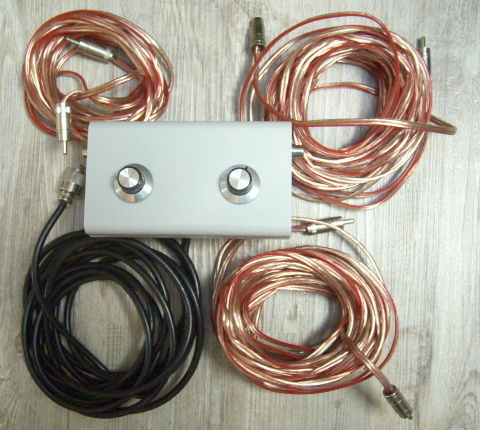
There are virtually no limits to the imagination when it comes to constructing portable NYFAZ antennas. While fixed constructions are ideal for stationary use, the antenna can be used without a support frame as a "wire-throw" antenna, making it perfect for mobile use in hotel rooms or hospitals. The speaker wire can simply be fixed to furniture with shoelaces or clothespins, or even spread out horizontally on the floor. My travel gear usually contains a coupler with radiators for the 40m and 20m bands, along with an extension piece for the 80m band.
Interestingly, an antenna can also be constructed using coaxial cable instead of twin-lead wire based on the same principle. This works because the radiation occurs primarily via the secondary circuit; in this case, the shield of the coaxial cable takes over the function of the radiating element. Practical tests with classic silver-plated RG-58 cable led to promising results. Notably, the cable length had to be significantly increased to achieve resonance at identical capacitor settings. This is likely due to the much higher self-capacitance of the coaxial cable, which acts in parallel with the resonant circuit and significantly influences the overall resonance behavior.
Warning: High Voltage at the Capacitor!
Particular attention must be paid to the voltage rating of the secondary circuit. Even at low power levels, a considerable high voltage builds up across the capacitor, which caused me to get a "nasty zap" several times during experiments. Therefore, a variable capacitor with sufficient plate spacing must be chosen for the secondary circuit. For power levels up to 5 watts, tubular trimmers have proven effective for the 10m band; for lower frequencies, old broadcast-style air-dielectric variable capacitors should be used. Models manufactured up until the mid-1950s usually featured wider plate spacing and thus a higher voltage rating.
In summary, the NYFAZ antenna is certainly no miracle and will not replace a full-sized base station antenna - after all, you wouldn't enter a tractor in a Formula 1 race. Nevertheless, it offers astonishing performance in the tightest of spaces. For anyone looking for an antenna characterized by minimal manufacturing costs, a remarkably simple setup, and extremely portable dimensions, this is a solution that enables successful radio operation even under the most difficult conditions.