Parametric Amplifier for the 70cm range
With the ever-increasing importance of VHF/UHF radio technology in the late 1950s and early 1960s, many amateurs strove not only to keep pace with technical developments but also to actively participate in new innovations within the field of radio communications. Furthermore, there was a desire to contribute to the systematic research of propagation conditions in the VHF/UHF range. By this time, FM radio broadcasting as well as television broadcasting in the VHF and later UHF bands had already been introduced. Similarly, the police utilized the advantages of VHF technology for communication between stations and patrol vehicles, taxis increasingly received their orders via radiotelephone, and the first simple car phone networks were being established. Consequently, almost everyone came into contact with modern VHF equipment in some way. This was a development that amateur radio could by no means ignore if it did not want to be considered obsolete.
While some amateurs preferred to use simple transceivers to investigate the possibilities of VHF technology for mobile and portable applications, others were primarily concerned with taking a closer look at the maximum range potential of VHF radio. The motivation for this stemmed primarily from the fact that in the 1920s, it had been radio amateurs who first established transatlantic connections via shortwave, thereby proving the utility of this waveband for long-distance communication. It became evident that, compared to the medium and long waves previously used exclusively for this purpose, significantly lower transmitting powers were perfectly sufficient. The well-founded hope was now that, with highly sensitive receiving systems and high-gain directional antennas, similar results could be achieved in the VHF range with even lower power.
In the era of vacuum tube technology, the construction of high-quality VHF equipment was associated with great technical effort. Only special tubes, developed specifically for such high frequencies and accordingly expensive, were usable for input, mixer, oscillator, and transmitter stages. The larger mechanical dimensions of active and passive components—along with the associated stray capacitances and parasitic inductances of the wiring—made specialized and mechanically complex construction techniques, such as "chamber" or "cellular" construction, necessary in the VHF range. Additionally, the standard capacitors and resistors available at the time were often unusable for these high frequencies due to their self-inductance. Furthermore, with tubes, transmitters and receivers had to be built stage by stage, as compact functional units for high-frequency amplification, such as today's integrated circuits, did not yet exist. To keep the effort manageable, it became standard practice in VHF amateur radio to augment existing shortwave radio equipment with suitable frequency converters. This allowed one to concentrate fully on the optimal design of the VHF stages. Similar to today's satellite radio in the GHz range, a converter was used to transpose the received signal. While initially free-running oscillators, mostly operated in push-pull circuits, were predominantly used to generate the injection signal, crystal-controlled versions soon prevailed. For the corresponding transmit converter, the transverter, almost only the significantly more frequency-stable crystal control was chosen from the outset.
The VHF receiving system thus consisted of an existing HF (shortwave) receiver, which might be a device the amateur had previously built themselves, and the VHF converter. To achieve peak performance, however, many amateurs preferred to use particularly frequency-stable and powerful commercial communication receivers as "IF-strip" or follow-on receivers. Popular examples included devices such as the Hammarlund HQ-110, the National HRO, the Geloso G209, and the Funke RX57. In terms of material and dimensions, however, the transmitting system in amateur stations usually took up significantly more resources. It often consisted of several separate devices, such as the exciter (VFO), frequency multiplier, RF power amplifier (PA), modulation amplifier, and transmitter power supply, housed in various sheet steel cabinets. For VHF operation, a corresponding amplifier for VHF was now required instead of the shortwave PA, along with the transverter itself. This, in turn, often existed in the form of separate apparatuses: the frequency converter, preferably working with a balanced mixer stage including the driver stage, the PA driven by it, and the unit for generating the local oscillator (LO) signal. In the latter, the desired mixing frequency was generated from a crystal oscillator operating at a low frequency—designed for ideal stability—via several subsequent multiplier stages. For example, if one wanted to use the signal of a 20m transmitter (tunable from 14 to 14.5 MHz) as the base signal for 2m transmission, the injection frequency generator had to be able to provide the frequencies 130 MHz, 130.5 MHz, 131 MHz, and 131.5 MHz. The first-mentioned frequency could be generated, for instance, with a 10.833 MHz crystal by following the oscillator with one tripler and two doubler stages. For further 500-kHz segments, additional crystals with correspondingly higher frequencies were, of course, required.
The distribution of the radio system across numerous individual devices had the decisive advantage that it could be constantly improved without having to start the construction from scratch every time. For example, if one wanted to increase the transmitting power, only the transmitter amplifier had to be replaced by a new, more powerful model. To increase frequency stability, only a more high-quality generator for the injection signal was needed. Receiving characteristics could be improved by replacing the converter. Initially, this path was taken with 2m systems, and soon also in the 70cm range when it was released for amateur radio. And here, the receiving system was often supplemented by yet another device. Because the noise characteristics of the first receiver stage decisively influence the overall sensitivity, a preamplifier stage designed for ideal noise characteristics was often placed ahead of the converter. Again designed as a standalone device, this allowed freedom for experiments with different arrangements. With clever construction, such a device could also be mounted at the feed point of the antenna. Thus, the preamplifier was able to compensate for the losses of the antenna feed line during reception.
Consequently, experiments were conducted with numerous, completely different arrangements for such devices. For VHF preamplifiers, and even more so for UHF preamplifiers, the use of triodes seemed sensible only to achieve the best noise characteristics, as these possessed sufficiently small equivalent noise resistances and thus produced the lowest inherent noise. Push-pull preamplifiers were particularly popular. This was not only because neutralization—required at least in the VHF range—could be accomplished relatively easily through crosswise capacitive coupling of the grid and anode circuits. Furthermore, the input resistances of the tubes, caused by electron transit time, are in series here, meaning the input circuit is significantly less damped. This arrangement also leads to more favorable noise characteristics compared to a single-ended stage. This is related to the fact that, with ideal balancing, the fourfold increase in resonance voltage (due to the quadratic function) is accompanied by only a twofold increase in noise voltage. For UHF preamplifiers, where the problems of neutralizing grounded-cathode stages were hard to manage even in push-pull arrangements, grounded-grid push-pull stages were popular for these reasons.
While it was possible to realize quite usable preamplifiers for 2m receiving systems using the methods described, the problem remained when building 70cm input stages that the inherent noise could not be kept sufficiently low. Only with the greatest effort was it possible to push the value below ten kt0 units in UHF preamplifiers. But soon a "magic word" against noise began to circulate in UHF amateur circles: with the "Parametric Amplifier," these problems were supposed to be manageable even with amateur means. Some even spoke of this arrangement not noise at all. But what was this arrangement, and what did it actually achieve?
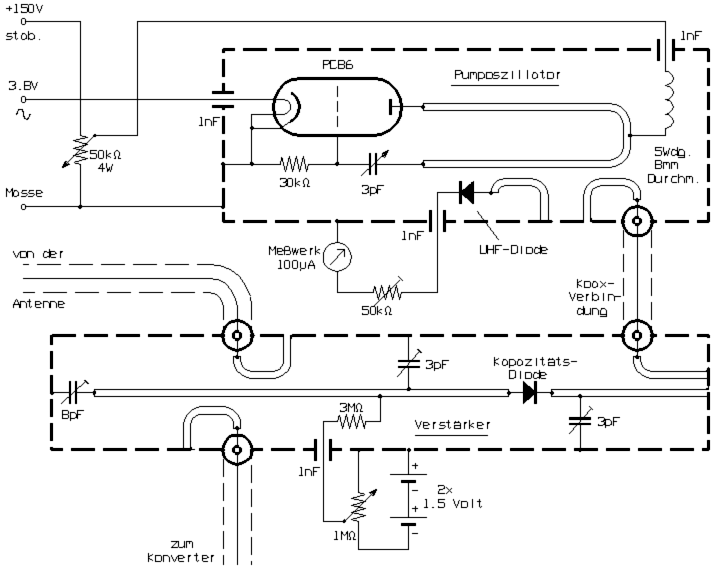
The principle of parametric amplification had been well known in theory decades earlier. Mathematically, it could be proven that a periodic change in capacitance in a signal circuit, with suitable design, had to result in signal amplification. This was due to the fact that a reduction in the capacitance of a charged capacitor, because of the unchanging amount of charge, had to lead to an increase in voltage. The subsequent increase in capacitance would only partially counteract this effect if a suitable modulation frequency was used. Analogously, amplification could theoretically also have been achieved by a periodic change in inductance. Therefore, it was often referred to as a reactance amplifier. The problem, however, was that initially, no suitable components were available with which this theoretical model could have been realized. The required reactance modulation with a sufficiently large swing at a high enough frequency was thus initially not feasible.
The situation changed, however, with the appearance of semiconductor-based crystal diodes, which soon became usable for ever-higher frequencies. Even specimens suitable for the highest frequencies possess an unavoidable depletion layer capacitance, which is rather undesirable in other applications. Due to the relationship between reverse voltage and depletion layer capacitance present in semiconductor diodes, there was now, for the first time, an effective way to perform reactance modulation with sufficient speed and to test the theoretical principle in practice. For parametric amplification, a modulation frequency—supplied by the so-called pump oscillator—is required that is twice or, better yet, three times as high as the signal frequency. In the presented circuit, an oscillator designed for the 23cm range serves this purpose, utilizing a UHF tube originally developed for TV tuners. A "lecher line" or coaxial cavity served as the resonant circuit.
Even more suitable for the reactance amplifier were the varactors that soon became available, developed specifically for use as variable capacitances in resonant circuits. Here, the change in depletion layer capacitance is no longer an unwanted side effect. After varicap diodes for AFC (automatic frequency control) circuits soon found their way into radio and television technology, they also became easily available to radio amateurs. Amateurs soon began building such amplifiers, which achieved nearly ideal properties in the 70cm band with what was, for the time, low electrical and slightly more mechanical effort. However, the construction and operation of such amplifiers was not easy. First, the resonant circuits, formed with the help of silver-plated brass tubes, had to be brought to the correct resonance frequencies. Then, the ideal position of the coupling loops had to be found. During operation, the pump oscillator had to be adjusted as precisely as possible to three times the signal frequency. In addition, its oscillation amplitude and the diode operating point had to be adjusted. Many of these settings influenced each other. One was then rewarded for the effort with a gain of approx. 12 dB at a noise figure that could reach values of less than 1 dB. The extremely narrow-band amplification also improved the large-signal behavior of the receiving system. However, even with systems reaching the limits of what is physically possible, expectations could not be met. Even with the greatest technical effort, gigantic dipole arrays, several hundred watts of power, and highly sensitive reactance amplifiers, VHF and UHF frequencies cannot be used regularly for long-distance and certainly not for intercontinental radio connections.
The claim made in some quarters that the parametric amplifier does not noise at all is only theoretically true. However, the noise produced by normal amplifiers is eliminated. Only unavoidable loss resistances lead to the parametric amplifier also producing noise, but far less so. For VHF and UHF receivers today, transistors are available with which receivers can be built that nearly achieve the limit sensitivity. The use of parametric amplifiers in the input of receivers for the 2m or 70cm band therefore no longer makes sense. For special applications in the microwave range or for receivers in radar systems or radio telescopes, however, the principle of the reactance amplifier remains significant even today.