Crystal-controlled 10m receivers using integrated circuits
AM receiver for 29 MHz using the TCA440
The TCA440 integrated circuit is well known to be suitable not only for AM broadcast receivers for medium and long waves, but also for receiver circuits for frequencies up to the shortwave range and moreover. Furthermore, the oscillator section can be easily arranged for crystal-controlled operation. Consequently, numerous circuits have been published for use in model radio control receivers, one example of which is shown here.
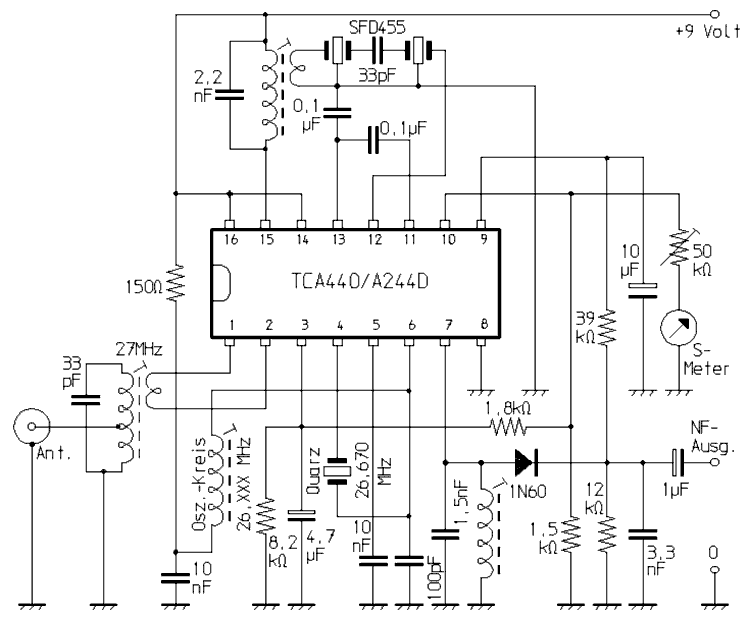
For remote control of models, long ranges are not critical, so the transmitter signal always arrives at the receiver with a sufficient high field strength. Therefore, lower demands are placed on sensitivity and selectivity. The frequencies used for remote control in the 27 MHz band are typically spaced 50 kHz apart. To be able to operate several models simultaneously, for example in a competition, expectations regarding close-range selection are not particularly high. Such a circuit thus yields very usable results for these kinds of applications.
A completely different situation arises when the receiver is to be used in a two-way radio. Here, the following must be considered:
- Good image frequency suppression should be ensured
- Improved input sensitivity is required
- The receiver operates on switchable channels
- Good adjacent channel suppression should be achieved
- The receiver should produce as little self-noise as possible
- A squelch circuit should be connectable
I have therefore optimized the circuit shown in this respect at various points in the manner described below.
Improvement of image selection
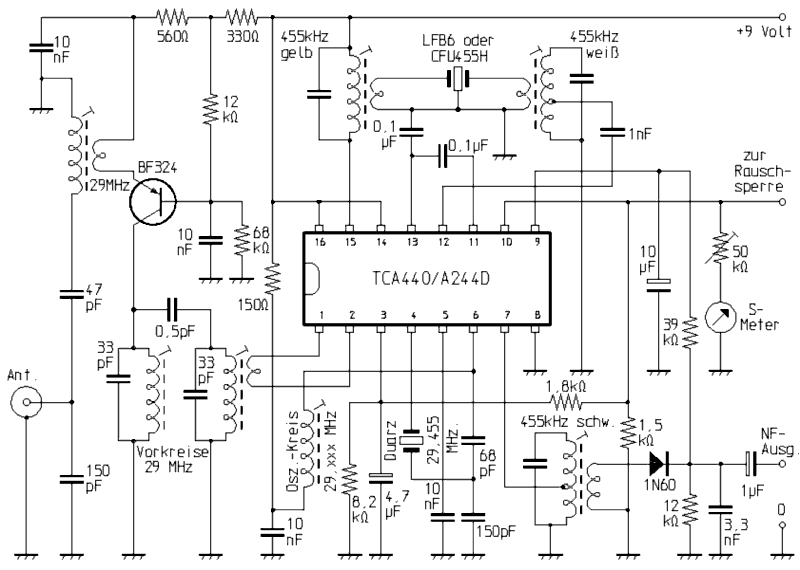
To achieve reasonably good image selectivity above 20 MHz with a simple superheterodyne receiver with a low intermediate frequency of 455 kHz, a single filter circuit at the receiver input is by no means sufficient. With appropriately designed AM two-way radios, interference from strong transmitters in the 11-meter broadcast band could be observed in the past under good propagation conditions. Some assumed this was deliberate interference from foreign two-way radio stations. In reality, however, the problem was image frequency reception. Due to the significantly reduced number of AM broadcast stations, this is less of an issue today. However, if such a receiver is to be operated in the 10-meter amateur band, this problem should not be underestimated. For reception of the frequencies commonly used for AM today at 29 MHz, the image frequencies, with the crystals usually oscillating below the reception frequency, fall into a range slightly above 28 MHz. It is precisely in this range that there is a lot of activity (CW, digital modes) under good conditions. However, it is possible to make the oscillator oscillate above the receiving frequency, thus shifting the image frequencies to just under 30 MHz. Even with this method, however, complete protection against interference is not guaranteed. Furthermore, it is a better solution to prevent the reception of image frequencies from the outset through circuit design. This requires at least a high-quality, two-stage bandpass filter, which is found in the improved receiver. If the antenna signal were fed directly to this filter, for example via a coupling winding, the filter's quality would degrade significantly due to damping from the antenna when the receiver is adjusted for optimal sensitivity.
Optimization with RF preamplifier
Antenna damping can be reduced by using an RF preamplifier. Provided a sufficiently low-noise amplifier is used, this also increases the receiver's input sensitivity. This is achieved with a common-base preamplifier using a transistor designed for FM tuner circuits. The preamplifier should not have too much gain, otherwise the good large-signal handling characteristics of the push-pull mixer in the TCA440 would be lost. The input circuit is relatively broadband. It is not set for maximum signal voltage, but rather tuned for optimal noise matching to the antenna. The high-impedance collector circuit of the preamplifier imparts only minimal damping to the subsequent two-stage bandpass filter. Consequently, signals appearing at the image frequency can be effectively suppressed by the bandpass filter.
The modified crystal oscillator
In the TCA440, the crystal oscillator is operated in a manner not typically intended for standard overtone crystals. Using various CB crystals, it was observed that the circuit oscillates with highly variable amplitudes. Often, completely different oscillator coil tuning is required for different crystals. This causes problems for a receiver that needs to be switched between multiple channels. Furthermore, some crystals didn't oscillate at all in this circuit. A minor circuit modification, in which the crystal is coupled to the oscillator circuit via a capacitive voltage divider (68pF, 150pF), largely eliminated the described difficulties. The ideal solution would certainly be an external oscillator, but this would further increase the circuit complexity.
Redesign of the IF filtering
One might assume that the SFD-455 ceramic filter, designed for broadcasting purposes, would have sufficient selectivity for two-way radio. After all, longwave and mediumwave broadcasting use a 9 kHz channel spacing, while shortwave uses a mere 5 kHz. However, despite the slightly larger 10 kHz channel spacing used in AM two-way radio on the 10 and 11-meter bands, this is not the case. While the SFD-455 is sufficiently narrowband, it exhibits inadequate adjacent channel attenuation. The quality requirements for this are simply lower in broadcast equipment. Therefore, at least the CFU455HT or LF-B6 filters, designed for AM two-way radios, should be used. The otherwise excellent Fieldmaster ASH-2012F CB base station actually used an SFD-455 in its receiver. As a result, stronger stations operating one or two channels above or below the operating frequency, while exhibiting a reduced S-value, are still clearly audible. Under the same conditions, such stations, when using a CFU455HT or an LF-B6, produce at best splatter, but no S-meter reading and are no longer intelligible. These filters simply have a significantly better slope.
The redesign of the IF filtering also allowed for a reduction in the notoriously high inherent noise of the TCA440's IF amplifier. As long as there is no received signal and the AGC is not attenuating, the high gain of the TCA440 inevitably leads to a fairly substantial amount of noise. Ideally, this noise should not originate from the IF amplifier itself. By inserting an additional IF filter between the ceramic filter and the input of the IF amplifier, selectivity is further improved, and less inherent noise is produced at its input. Furthermore, this solved a problem that can be observed in many commercially available devices using the TCA440: the S-meter often shows a reading even without a signal. Closer investigation revealed that this is not related to the DC operating points of the AGC amplifier. In many circuits, the oscillator signal is directly fed into the input of the IF amplifier, causing the AGC to start operating even without a signal present. You can verify this yourself by building the same circuit with two TCA440s, using only the input stage of one and only the IF stage of the other. This problem can otherwise only be addressed with a suitable circuit design, ideally a PCB with a continuous ground plane on the top side. However, by improving the matching of the ceramic filter via a coupling winding and tapping the additional LC filter, this effect has now been eliminated without such measures. A corresponding arrangement at the output of the IF amplifier further reduces the broadband noise spectrum that the IF amplifier output would otherwise supply to the demodulator. Furthermore, the standard filter set, previously common in many radios and wireless devices and consisting of Toko-LC filters with core colors yellow, white, and black, can now also be used for the receiver circuit with the TCA440. These modifications did not reduce the receiver's sensitivity in any way. Overall, the changes had a positive effect on the receiver circuit's performance.
General information
As shown in the circuit diagram, the signal present at pin 10, to which the S-meter is also connected, can be used to control a squelch. Instead of the TCA 440, the A244D, which is sometimes still available and was manufactured in East Germany or Eastern Europe, can also be used. Non-Siemens-manufactured parts were often identical to this and were simply labeled TCA440 for the Western European market. The Russian IC K174XA2 can also be used instead of the TCA440.
Simple superhet for narrowband FM using the MC3357
The MC3357 integrated circuit was primarily developed for use in dual-conversion superheterodyne receivers for FM two-way radio applications. It includes all the necessary intermediate frequency (IF) stages, from the mixer and oscillator to the IF amplifier, limiter, and coincidence demodulator. A squelch circuit, controlled by the noise signal, is also included. Very little external circuitry is required. In the manufacturer's suggested standard application, an IF input signal of 10.7 MHz is fed to the input via a crystal or ceramic filter. In the mixer, this signal is converted to the second intermediate frequency of 455 kHz using the built-in oscillator, which is driven by a 10.245 MHz crystal. Only the FM demodulator requires an LC circuit and therefore an inductor.
In a configuration that differs only slightly from the original application, the IC can also be used effectively as a simple superheterodyne receiver for the upper shortwave range. This allows receivers for CB channels in the 27 MHz range and, of course, for the 10-meter amateur radio band to be built without the need for additional stages. Unlike similar configurations using the TCA440, which are only suitable for AM demodulation without an additional demodulator, this approach provides a complete narrowband FM receiver with just one IC. To use standard harmonic crystals, they must be operated in series resonance. This requires an additional resonant circuit. The crystal is then connected in the feedback path from pin 2 to the capacitive voltage divider of the resonant circuit, which is tuned to the harmonic frequency.
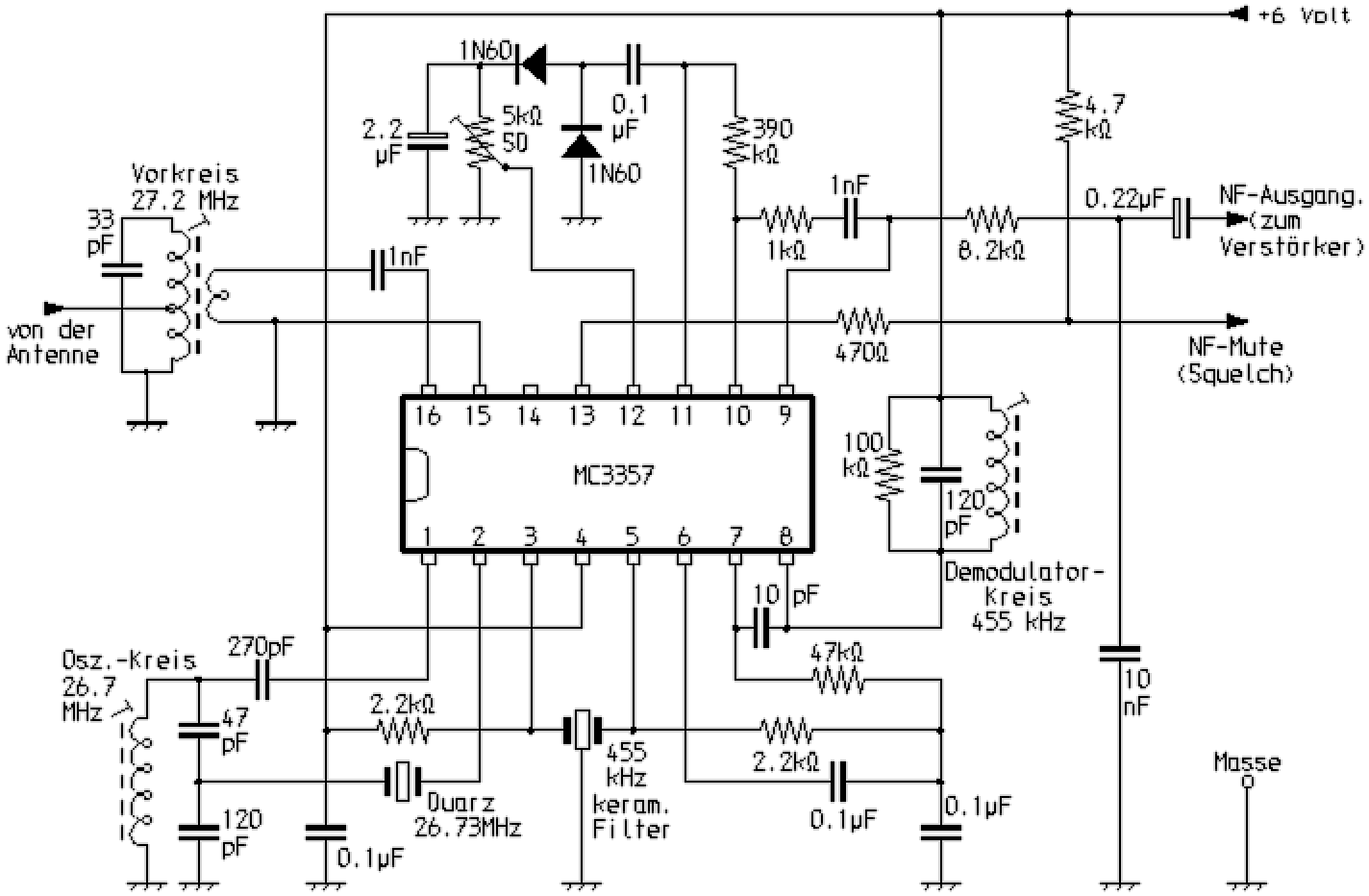
Suitable crystals for CB radio are still readily available today. They typically oscillate at an by the value of the intermediate frequency lower than the desired receiving frequency. For example, to receive CB channel 19 (27.185 MHz), a crystal with a frequency of 26.730 MHz is required. However, obtaining suitable crystals for receiving frequencies in the 10-meter band is not so easy. In principle, the oscillator could also operate 455 kHz above the receiving frequency. However, to receive the repeater frequency of 29.690 MHz, suitable crystals for both 29.235 MHz and 30.145 MHz are only available as expensive custom-made products. Therefore, to use standard CB crystals, I employed the setup described elsewhere, in which the frequency generated by a CB crystal is mixed with a free-running oscillator in the range of approximately 2 to 3 MHz. The desired channel frequencies could be adjusted using varactor diode tuning and a spindle trimmer. The resonant circuit with capacitive voltage divider and the crystal connected to the MC3357 then was not needed. The injection signal was fed to the IC externally via the 270 pF capacitor. If the level of the externally supplied signal is too low, pin 2 can be shortened from ground with a capacitor (e.g., 10 nF).
The input sensitivity achievable with this 10m receiver is already quite good without an additional RF preamplifier. However, to achieve usable image rejection, at least a two-stage bandpass filter should be present at the receiver input. An RF preamplifier allows for looser coupling without loss of sensitivity, thus achieving better filtering. Furthermore, the filter array is then no longer damped by the antenna. Therefore, an additional RF preamplifier generally results in little significant increase in sensitivity, but does noticeably improve image rejection.
FM dual conversion superhet using MC3361 and TDA7212
The FM receiver presented here allows CB or remote control crystals, as used in older AM receivers, to be used directly as channel crystals. This enables the reception of, among other frequencies, the 10-meter FM repeater frequencies, such as 29.690 MHz. This is the frequency used, for example, by the 10-meter transmitter of the repeater station DF0HHH, located on the radio tower in Rosengarten, south of Hamburg. Instead of the MC3357 used in the previously shown receiver, this circuit employs the somewhat more modern MC3361. Since this receiver is also a double superheterodyne receiver, a front end with the TDA7212 is used. This IC was developed for cordless telephones, paging systems, remote control receivers, and similar applications. Unlike the widely used NE602, this IC contains an RF preamplifier stage in addition to the mixer and oscillator circuitry. The TDA7212 can therefore be operated with separate RF preselection and an RF intermediate circuit, which, in addition to the higher first IF, further improves image selectivity. The circuit shown achieves excellent input sensitivity and very usable large-signal handling capability.
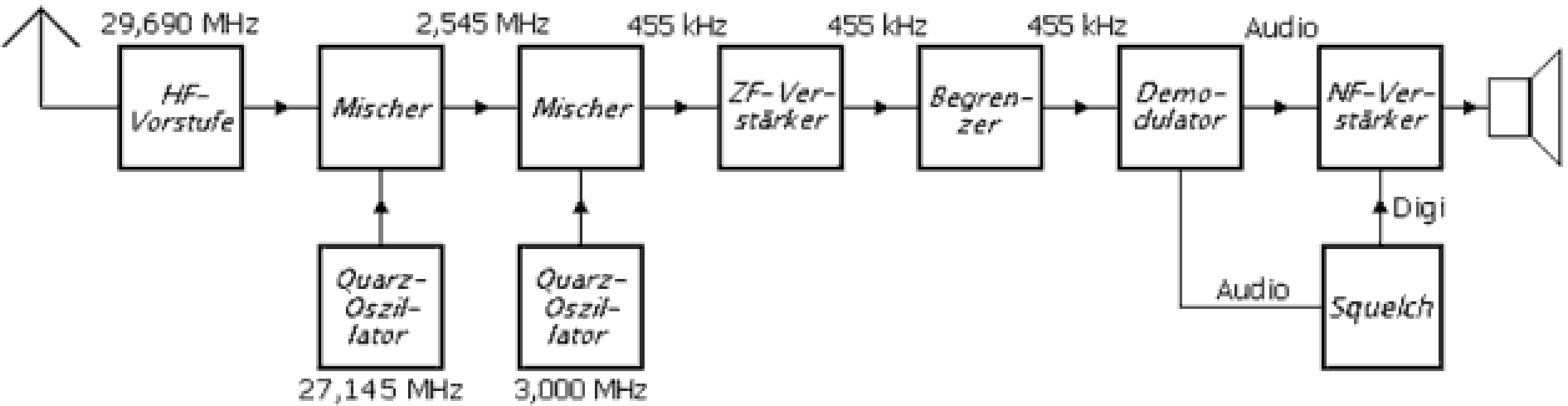
The single-circuit LC filter used for the first intermediate frequency (IF) is actually designed for 10.7 MHz. Its frequency is reduced by the parallel capacitor (1 nF). A readily available 3 MHz crystal is used for the second IF of 455 kHz. This results in a first IF of 2.545 MHz. With this value, standard 27 MHz harmonic crystals (3rd harmonic) can be used as channel crystals. For reception at 29.690 MHz, a transmit crystal for 27.145 MHz is required, such as those available for radio control applications. A remote control crystal for 27.045 MHz would be suitable for receiving the repeater input (29.590 MHz). Using transmitting crystals from old AM CB radios, various other 10-meter frequencies can be received, e.g., 29.620 MHz with a crystal for 27.075 MHz. The coils for the preselector, intermediate circuit, and oscillator come from old CB radios. They can be found in, among others, the following models: Stabo Stratofon P3, P6, M12, and F12; Lehnert MS120, HS120, HS220; Topfunk/Universum CBR2000; and Waltham WT512S. The demodulator circuit (455 kHz white) can also be taken from these radios. The matching 10.7 MHz filter with an orange tuning core can be found in, among others, the Grundig CBM100 and CBH1000 radios, as well as in many old Japanese FM/AM radios (e.g., clock radios). By the way the necessary 455 kHz demodulator circuit also would be located in such radios. Desoldering such filters requires some practice and a good desoldering pump. However, this avoids the otherwise necessary winding of coils.
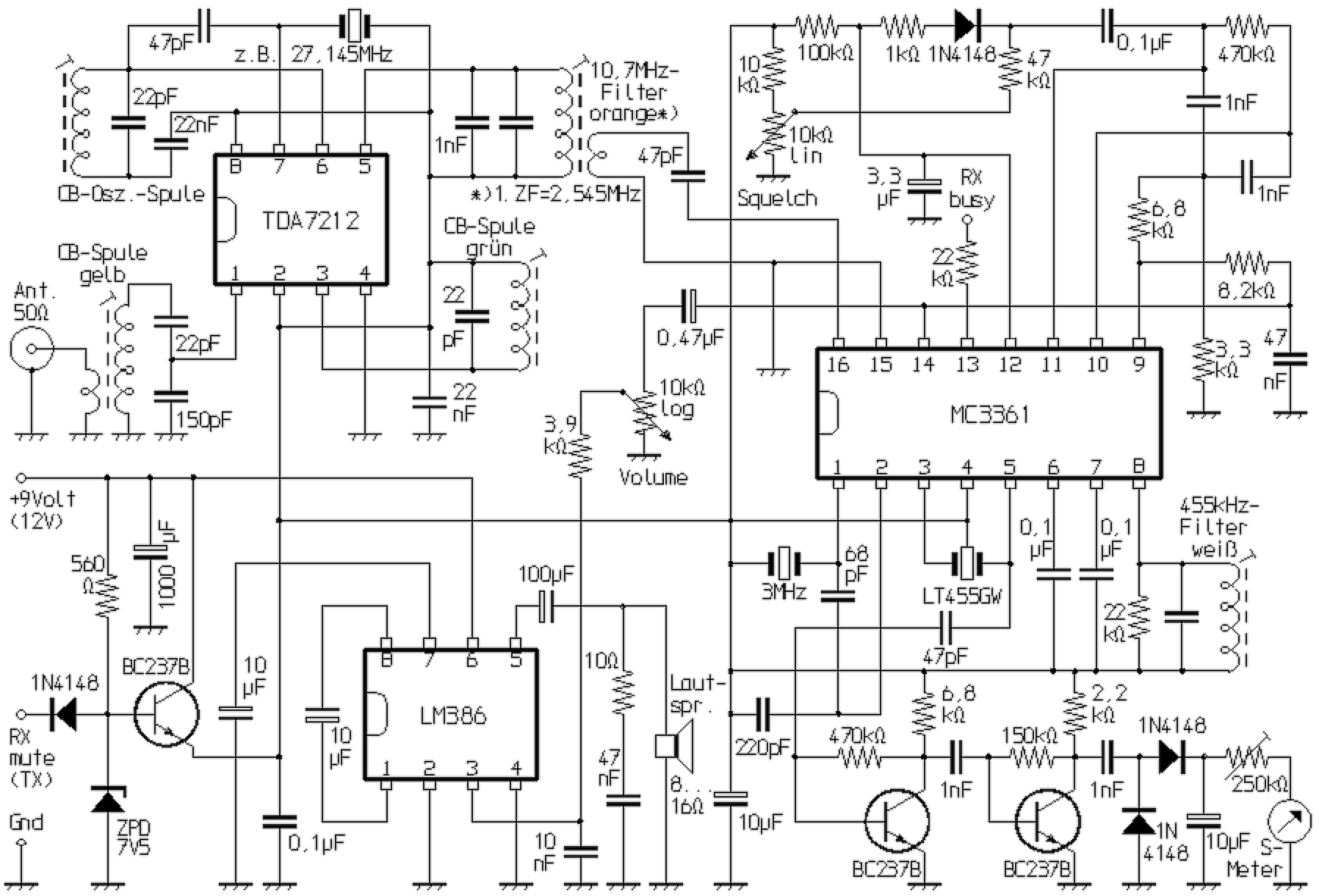
The receiver is suitable for loudspeaker operation and equipped with a noise-voltage-controlled squelch circuit and an S-meter. It also features an RX busy output (logic high when the squelch is open) and an RX mute input. Connecting the latter to ground switches the receiver off. When combined with a 10-meter transmitter, the receiver can easily be expanded into a complete transceiver. While the squelch, largely built according to the datasheet and application circuit, switches silently and exhibits practical hysteresis, it has the disadvantage of not completely suppressing the noise floor. This is due to the switching transistor in the IC, which has a resistance of approximately 10 Ω when fully engaged. A faint noise floor, which is usually acceptable at this level, therefore remains audible. Complete suppression could be achieved, among other things, by additionally switching a FET in the audio signal path via the RX busy output. The use of a CMOS analog switch is also conceivable. Another possibility is to simply switch off the speaker using a relay switching stage. In this case, even the inherent noise of the audio amplifier is suppressed when the squelch is closed.
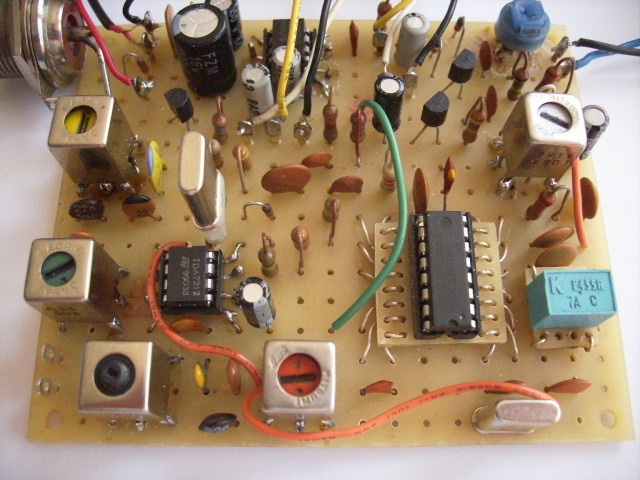
I deliberately kept the concept of this receiver as simple as possible. This results in the disadvantage of image frequency suppression that doesn't meet all requirements. However, compared to old CB radios with a simple superheterodyne receiver, like the ones I listed above as parts donors, it is still significantly better. The image frequency related to the first intermediate frequency (IF) leads to a signal interference point on the rarely used frequency of 24.6 MHz (29.690 MHz - 2 x 2.545 MHz). Due to the relatively large frequency separation from the receiving channel, this can be suppressed quite well with the existing pre- and intermediate circuits. An improvement would be achieved with a bandpass filter at the receiver input, which can be implemented with two capacitively coupled single-stage circuits of the specified type. The image interference of the second mixer stage causes a signal interference point on the frequency of 30.6 MHz (455 kHz + 3 MHz + 27.145 MHz), which is also rarely used by radio services. The single resonant circuit in the first IF stage provides at least usable suppression, since the incorrectly arised IF of 3.455 MHz is far from the correct value of 2.545 MHz. Additional suppression is provided by the pre- and intermediate circuits thus attenuate this image frequency, which is also only 910 kHz away here. By the way, these resonant circuits were also unsoldered from a CB radio with a simple superhet receiver. Sufficient suppression of the 30.6 MHz reception error, even under difficult conditions, would be achieved with two IF circuits coupled via a 22 pF capacitor for the first IF stage.
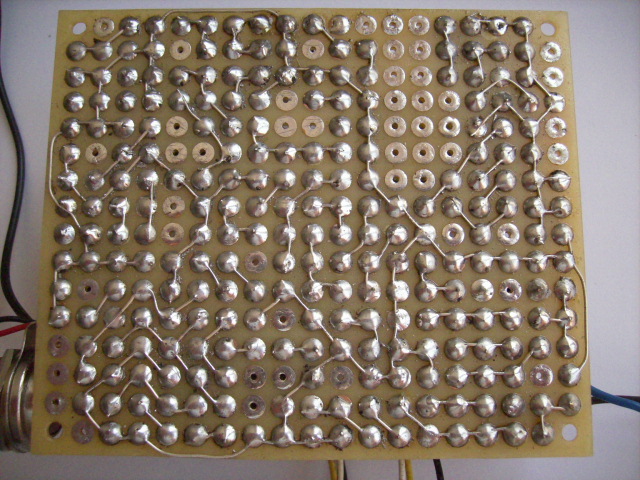
The prototype shown was built on a perforated circuit board with a 5.08 mm grid spacing. Incompatible components, such as ICs and filters, are adapted using wires or adapter plates with a 2.54 mm grid spacing. I soldered all the wiring connections, as experience has shown that otherwise interference can occur, manifesting as an annoying crackling sound. Unused grid points are tinned to prevent oxidation. Receiver alignment is very simple: The oscillator circuit is adjusted so that the oscillator reliably starts oscillating. This can be checked with a receiver tuned to 27.145 MHz. The RF intermediate circuit (green CB coil) and the IF circuit (orange 10.7 MHz filter) are then adjusted for maximum S-meter reading with a weak input signal. The demodulator circuit (455 kHz filter, white) should be adjusted for optimal audio volume. In this case, the demodulation should also exhibit the lowest distortion. The preselector circuit is adjusted for minimal noise with a weak input signal. Adjusting the S-meter for analog meters from older CB radios, where the lower display range is usually stretched due to the AGC required for AM, can be achieved with a 1N4148 diode connected in parallel with the meter in forward bias. Connecting a trimmer (e.g., 50 kΩ) in series with this allows for adjustment of both the display sensitivity and the display characteristic.