Transistor power amplifiers for universal use
15-watt power amplifier with NPN power transistors
15-watt power amplifier with NPN power transistors
This classic amongst the transformerless audio power amplifiers among others is suitable for smaller music systems, karaoke amplifiers or for guitar practice amplifiers. For stereo applications, of course, two such units are required. The circuit operates with a quasi-complementary output stage, so that two identical output stage transistors (here BD241) can be used. All stages are DC coupled. Complementary driver transistors (BC327 and BC337) are required for the antiphase activation of the final transistors. Previously, silicon PNP type power transistors were very expensive, and the available power transisers had only small current gain factors well below 100, making this arrangement the best compromise of low construction cost, low circuit efford, good frequency range and low distortion. The requirements of the hifi standard DIN 45500 could thus just be met.
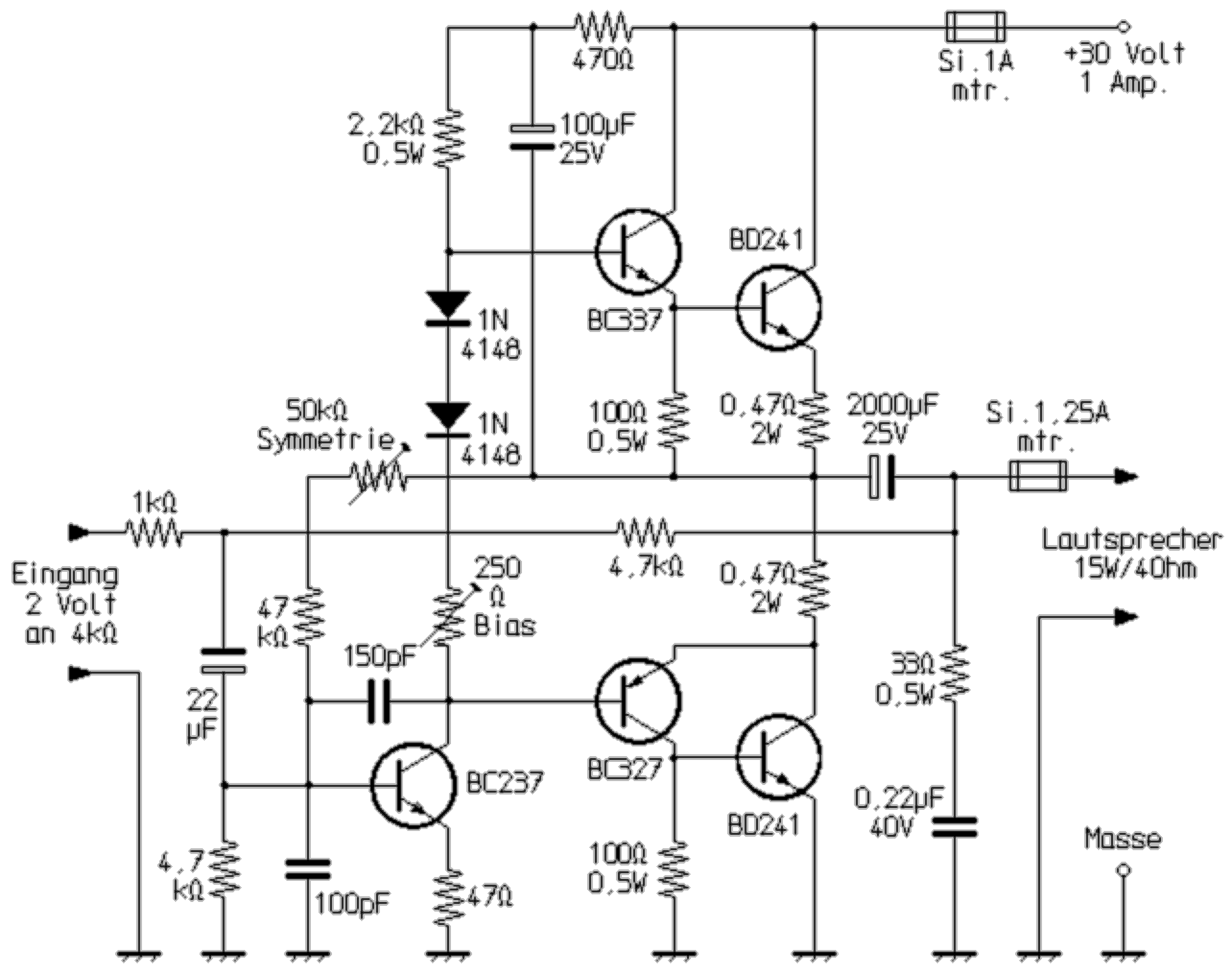
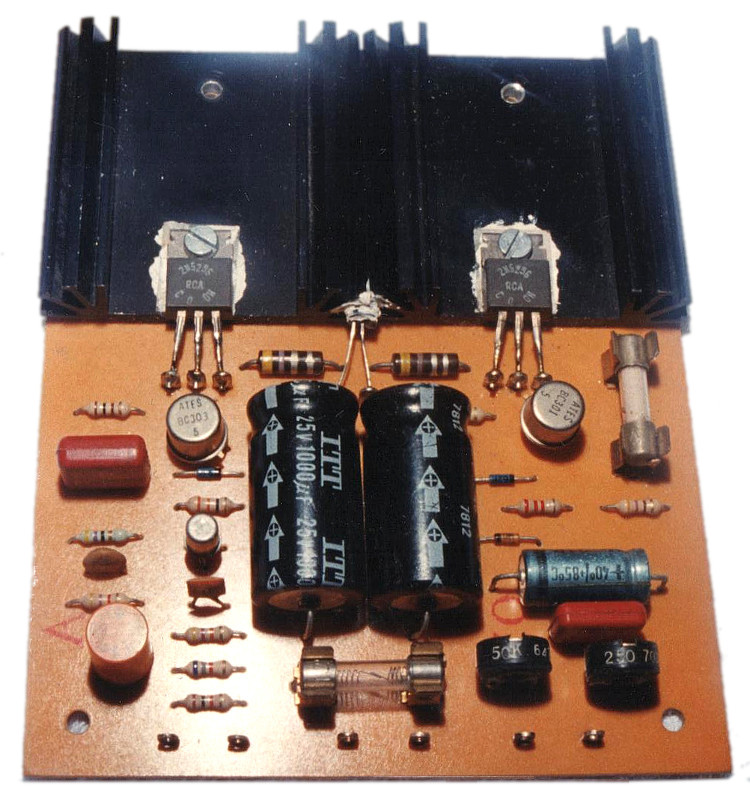
The entire voltage gain is provided by the pre-amp transistor (BC237), all other transistors act as pure current amplifiers. A bootstrap circuit (470Ω, 100μF) increases the headroom of the pre-stage. The symmetry is set with the 50kΩ trimmer. When set correctly, the voltage at the positive pole of the output electrolytic capacitor (2000μF) is exactly half the value of the supply voltage. This achieves maximum controllability and therefore the highest output power. Since only one small open-loop gain is achieved with the one pre-amp stage, with the 47Ω emitter resistor and the 4.7kΩ resistor it has a double negative feedback from the output to the input to reduce the distortion factor. In order to keep the distortion small, the driver and output stage transistors must also be selected for as equal as possible current gain factors. In addition, with the 250Ω trimmer a sufficient power amp bias current must be set. It is adjusted so that when there is a weak input signal (i.e. at low volume) the current transfer distortions of the output stage transistors just disappear. For temperature stabilization of the bias current, the diodes must be mounted on the output stage heat sink for thermal coupling.
In principle, the circuit with stronger driver and end transistors at higher supply voltage would be suitable for higher power. With a view to a small harmonic distortion and the then required even larger input signal, a circuit with a further stage for voltage amplification is much better suited for this purpose.
Simple 15 watt power amp using darlington transistors
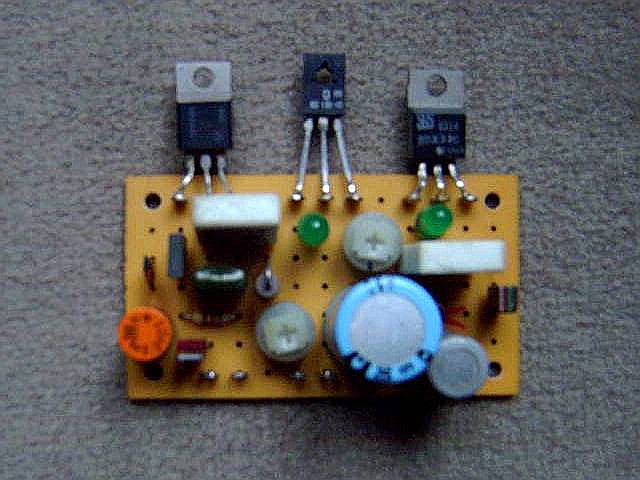
The circuit complexity for a final stage can be significantly reduced by the use of high-gain Darlington transistors. The 15Watt power amplifier shown here has even better performance in spite of lower effort, like the 15 Watt power amplifier presented before.
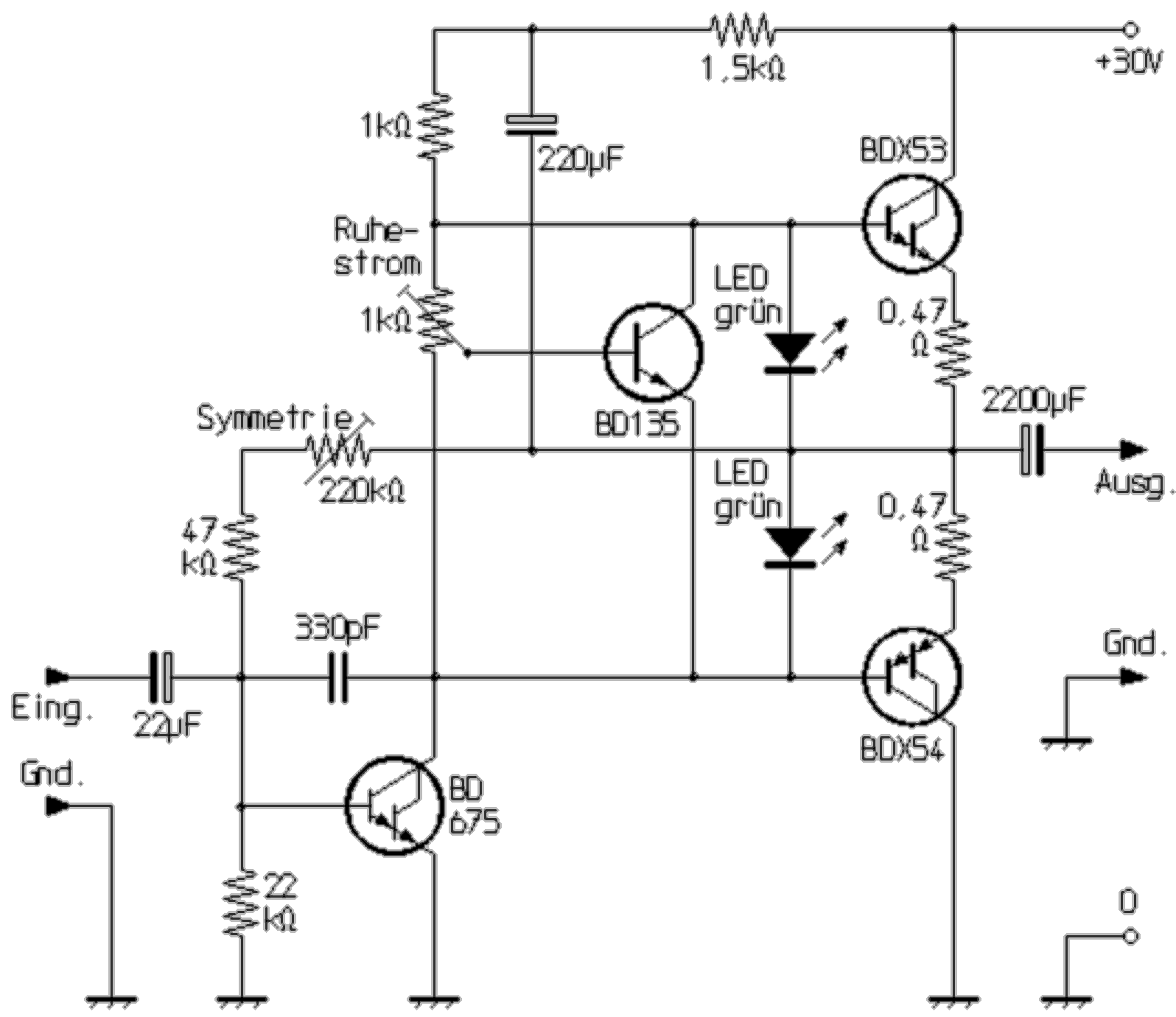
The LEDs cause a current limit in case of a short circuit in the loudspeaker line. Although this is not enough to secure the amplifier for longer-lasting short circuits, since then the allowable power dissipation of the transistors would be exceeded. But if the poles of the loudspeaker lines touch during operation only for a short time, the end transistors are so adequately protected. In practice, such occurs more frequently, e.g. if the wires are dissolved from the speaker terminals or if a jack plug on the box is disconnected during operation. For protection against longer lasting short circuits, a fuse should be inserted in the operating voltage line (1A ... 1,25A medium delay). The transistor BD135 is used to stabilize the bias current at temperature changing. It has to be mounted on the heat sink for the power transistors.
50-watt power amplifier with NPN power transistors
Also a classic is the circuit of this 50-watt power amplifier. It is suitable for universal use, e.g. for power mixers, active speakers, instrumental amplifiers or more powerful hi-fi devices. I used such circuits earlier for playing party music. It is, as the 15W power amplifier, a quasi-complementary power amplifier with two equal power transistors. The main difference is in addition to stronger transistors and higher supply voltage, that here an additional preamp stage is inserted. As a result, high idle respectively loop gain is achieved and more efficient negative feedback can be performed. It is set by the ratio of 2.2kΩ to 100Ω resistance at the emitter of the first pre-amp transistor (BC307A) and determines the voltage gain of the entire circuit. With the specified dimensions, it is good 20, so that the power amplifier with just over one volt input voltage can already be fully drived or rather overridden.
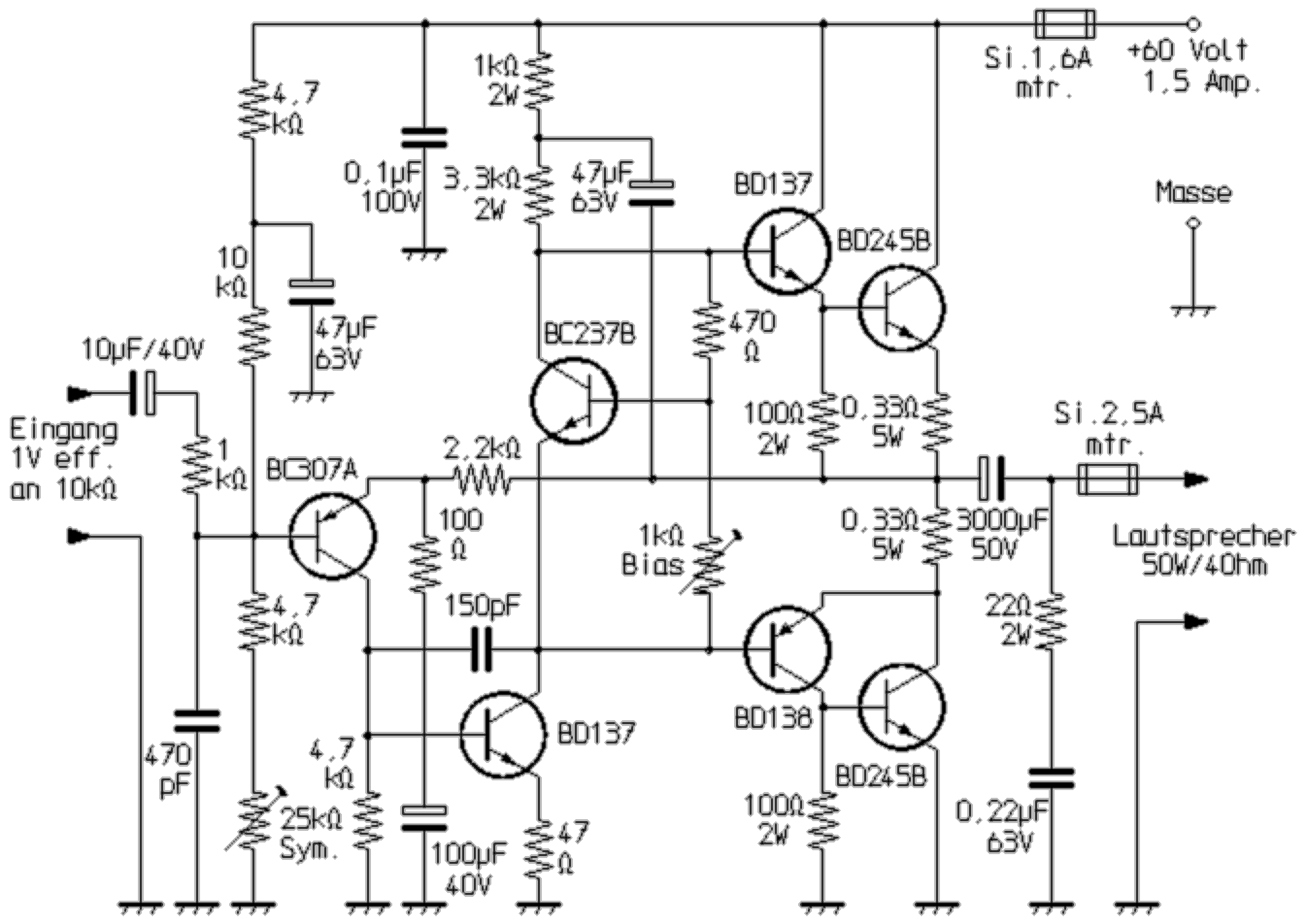
The stronger negative feedback leads to a smaller harmonic distortion. It reaches about 1% only at full drive and remains significantly smaller at lower levels. The transfer range covers the entire audible frequency range (about 16 ... 20000 Hz). Often disregarded in power amplifiers, the power frequency response. While the transfer range refers only to the gain or rather its drop at its upper and lower limits, the power frequency response indicates how far the achievable power drops at the limits. Based on a drop of 3 dB (= half power) it is about 30 ... 15000 Hz in this circuit. In music with powerful lowbasses, e.g. at electronic dance music (techno, etc.), the amplifier may thus be quieter compared to a 25W amplifier, if the power frequency response of that reaches until under 10 Hz. In the bass range, in particular, a lot of power is needed, and with a drop of 3dB at 10 Hz, it can be assumed that the drop in power at the lower hearing limit is already negligible.
The stabilization of the output stage bias current takes place in this circuit via a transistor (BC237B). It must be thermally coupled to the output stage heat sink and thus mounted on this. This more efficient type of circuit is advantageous when the amplifier is operated at the power limit for a long time. As the 15W amplifier, this amplifier has no electronic protection circuit, so that short circuits in the speaker line during operation must be avoided. A certain protection offers the micro-fuse in the speaker line. It should therefore not be bypassed or replaced by a higher value. Unexpected failures are possible in such circuits, especially when using cheaper end transistors, also by the so-called secondary breakdown. To avoid this, the 100Ω resistors at the bases of the final transistors must by no means have larger values. More safety is achieved by smaller values (for example 39Ω). Thus, the driver transistors are not overloaded, then they should be cooled.
60W or 120W power amplifier with overload protection
In the semiconductor application notes from Siemens appeared in the early 1970s, the circuit proposed for a hi-fi power amplifier. The output power was up to 60 watts. The circuit was characterized by an elaborate protection circuit for the short-circuit operation. It also offered a good protection of the power transistors even with a permanent short circuit. In addition, unlike many other such protection circuits, it caused only little additional distortion. In addition, an over-temperature protection was provided. After the circuit in the magazine Funkschau had been discussed in detail, appeared very soon appropriate kits. A friend of mine used such amplifiers for his rolling disco. He praised the excellent reliability of this amplifier, because he had since using it no more problems with any failures.
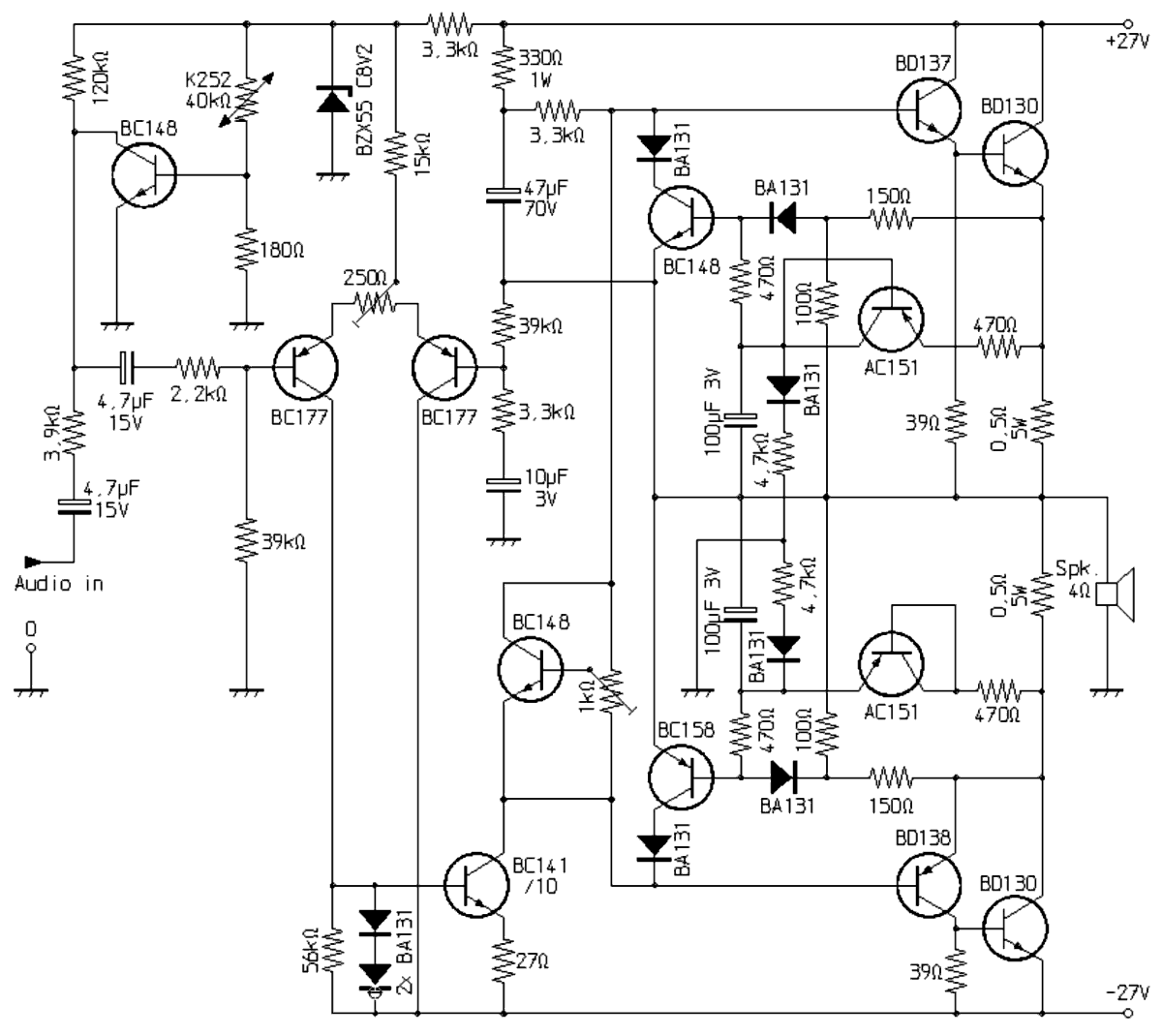
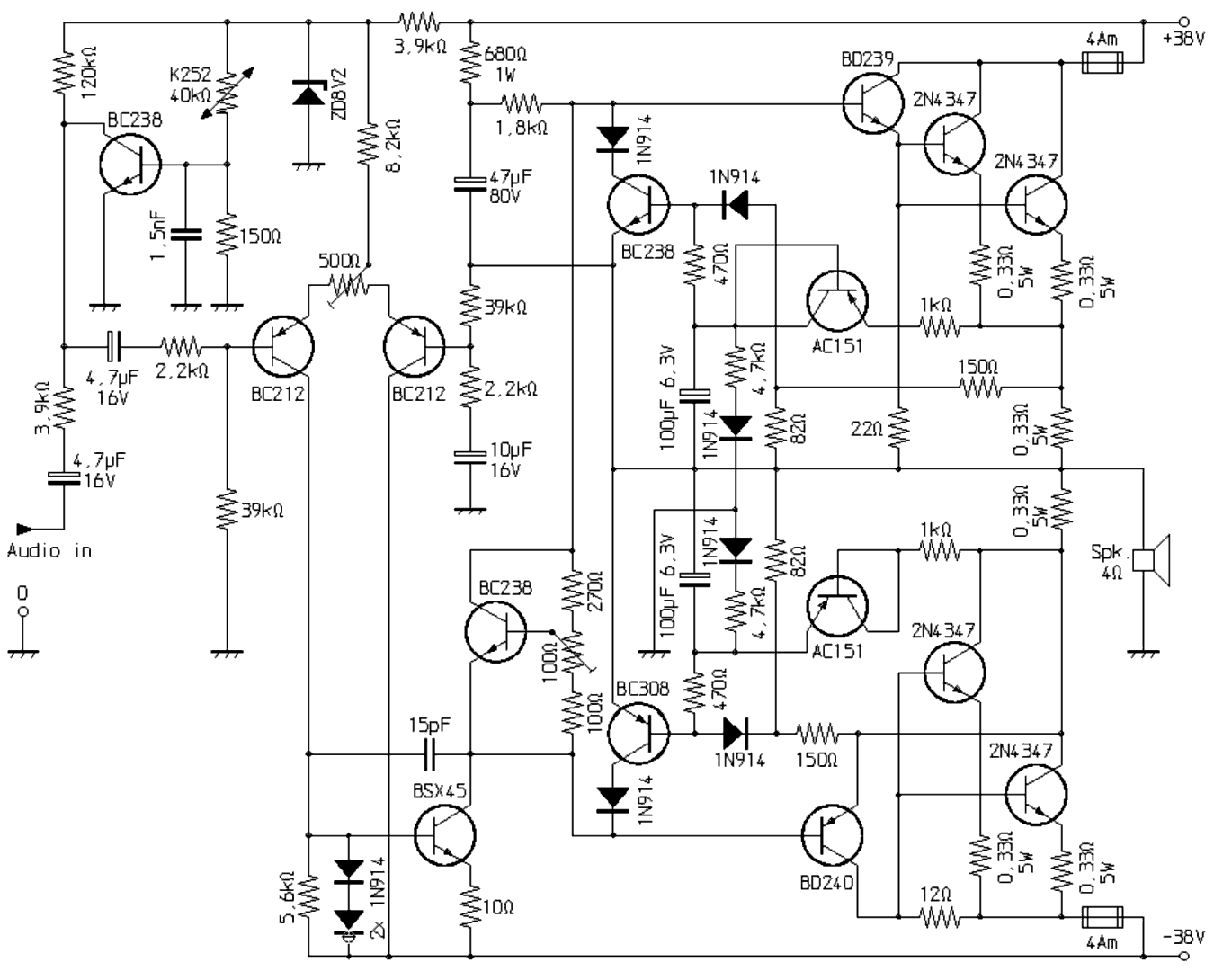
Only a short time later, there were also kits and modules for a 120-watt version, which circuit is shown below. With a supply voltage of ± 38 volts and partly slightly different component values, each two 2N4347 end transistors connected in parallel were used here. I had used such a power amp in a DIY hybrid guitar amp. Previously connected was a tube preamp with an EF86 and an ECC83. The EF86 served as input stage. The first system of the ECC83 was circuited as a voltage amplifier to compensate for the losses of the tone control network. The second system worked as a cathode follower to match the output of the tube circuit well to the input of this power amplifier. Even with me, this amplifier proved to be extremely reliable.
For the sake of completeness here are hints for adjusting and replica, based on the 60 watt version. With the 250Ω trimmer the voltage at the loudspeaker is adjusted to exactly zero volts (so-called zero offset adjustment). The 1kΩ trimmer is used to adjust the output stage bias current. To do this, disconnect the collector connection of the upper BD130 in order to insert a current meter. It is then set without existing input signal, a current of about 100mA. Incidentally, the types BD183 or 2N3055 can also be used instead of the BD130. In the latter, however, there were at times relatively large differences in quality, which in extreme cases, even the reliability of this amplifier could call into question. With good branded products (e.g., RCA), such problems did not exist.