Homemade portable amateur radios for 10 meters AM
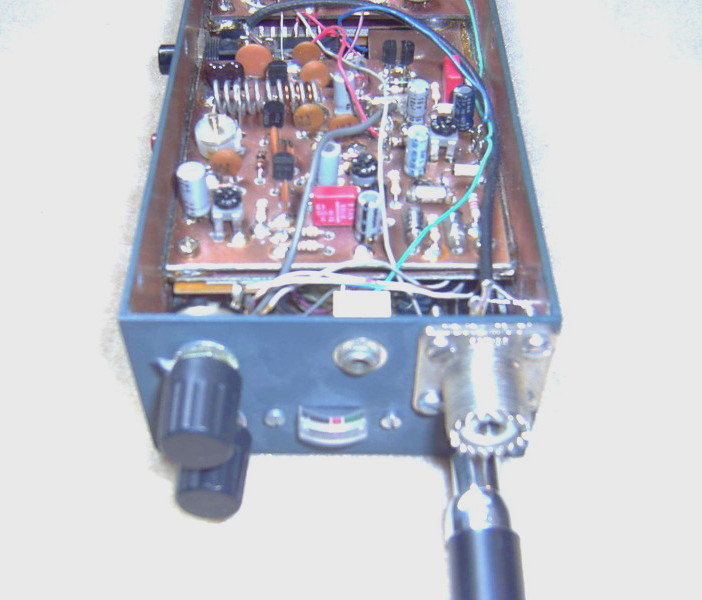
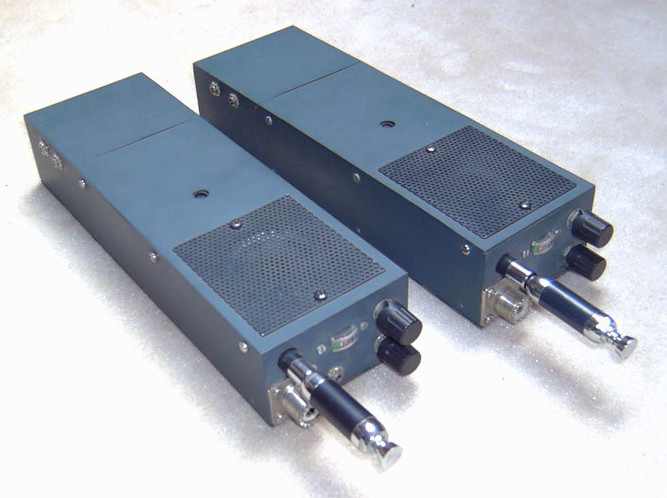
In the following I describe two of my own built AM walkie-talkies. Due to the superregenerative receivers used hardly special components were needed. In order to avoid radiation of the quench frequency via the antenna, the receivers were each provided with an RF preamp. The housings were made from copper-coated epoxy resin boards, which otherwise serve for the production of PCBs. To achieve a pleasing appearance, the cases were painted with enamel paint, which is offered - primarily for model construction purposes - especially under the brands Humbrol and Revell.
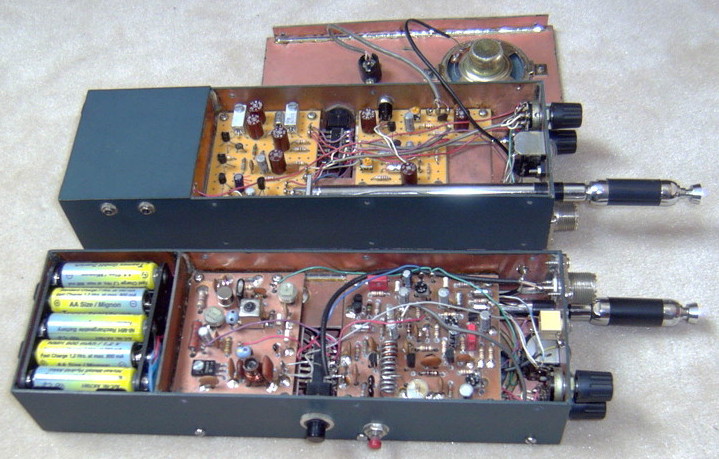
After cheapest handheld radios with superregenerative receivers have been manufactured for decades, and partly will even today, I wanted to test the limits of this technology in the relatively smooth 29-MHz-range. Also, military radio equipment from the 1930s in the range above 20 MHz often worked on this principle, likewise the first 27-MHz radios from the US. But of course, such devices were yet equipped with tubes.
In most cases, the reach of the cheapest walkie-talkies is additionally limited in addition to the already small transmission power of the usual single-stage transmitters by a degree of modulation which is inevitably too small in this technology. This leads to high level of interferences even at good field strengths in the closer range. That is why I used two-stage transmitters. The emitter modulation described by Harry Koch in his book Transistorsender (transistor transmitter) at low outlay proved to be very usable.
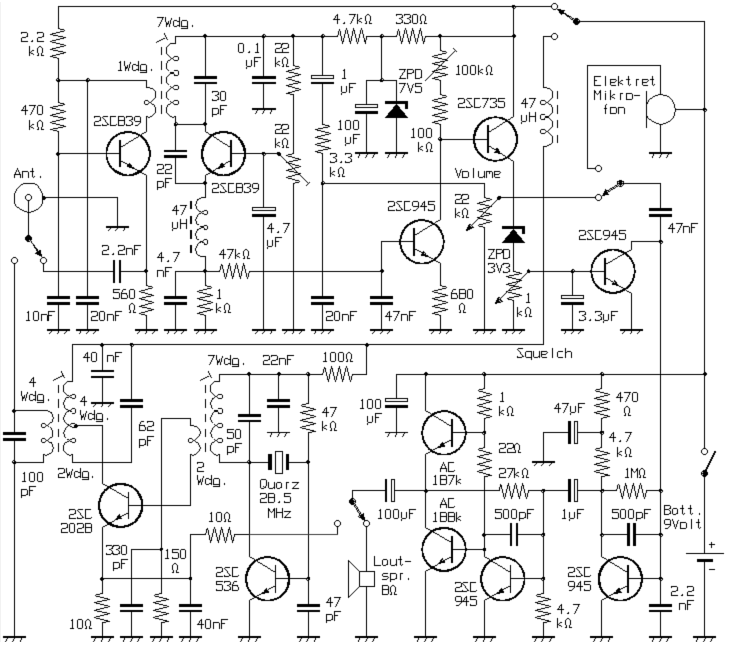
A special feature compared to other devices of this type is the presence of a noise-voltage-controlled squelch circuit, which greatly enhances such devices in practical operation. By using RF preamps, the receiver sensitivity was improved. But above all, by that the disturbing noise voltage of the RF oscillator was kept away from the antenna during reception.
Despite the good receiver sensitivity of better than 5μV, even in the less busy 29 MHz area the excessively bandwidth of this simple superregenerative receivers commuters proved problematic. Nevertheless distances of several kilometers could be bridged under favorable conditions.
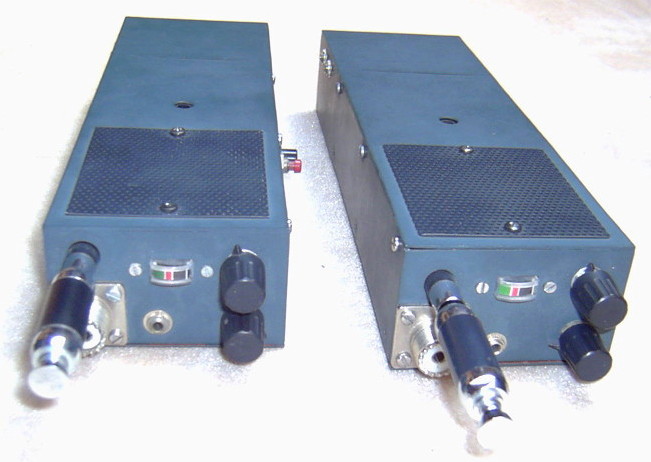
Due to the modular design, it was no problem to provide the handheld radio later with better receivers. The circuit of the superregenerative receiver which I later used at this point can be found elsewhere on my website.
Improved 10m super-regenerative receiver
It is easy to achieve good sensitivity with a single-transistor superregenerative receiver. Such circuits used to be very common in simple walkie-talkies and RC models. Sometimes you can still find them there today. With such arrangements, sensitivities of 5 μV and better can be achieved without much effort. However, the problem is the too large bandwidth and accordingly poor selectivity of such circuits. Individual radio channels can not be separated from each other. Even in the low-occupied 29-MHz area must therefore be expected with interference from other frequencies.
Inspired by the remarks of Heinz Richter in his "Das große Fernsteuerbuch" (The Great Remote Control Book), I experimented with quench and super-regenerative circuits, where the functions quench-frequency-generation, regeneration and demodulation were distributed in different stages. Thus, a working on this principle circuit could be optimally adjusted. Selectivity and sensitivity could be significantly increased.
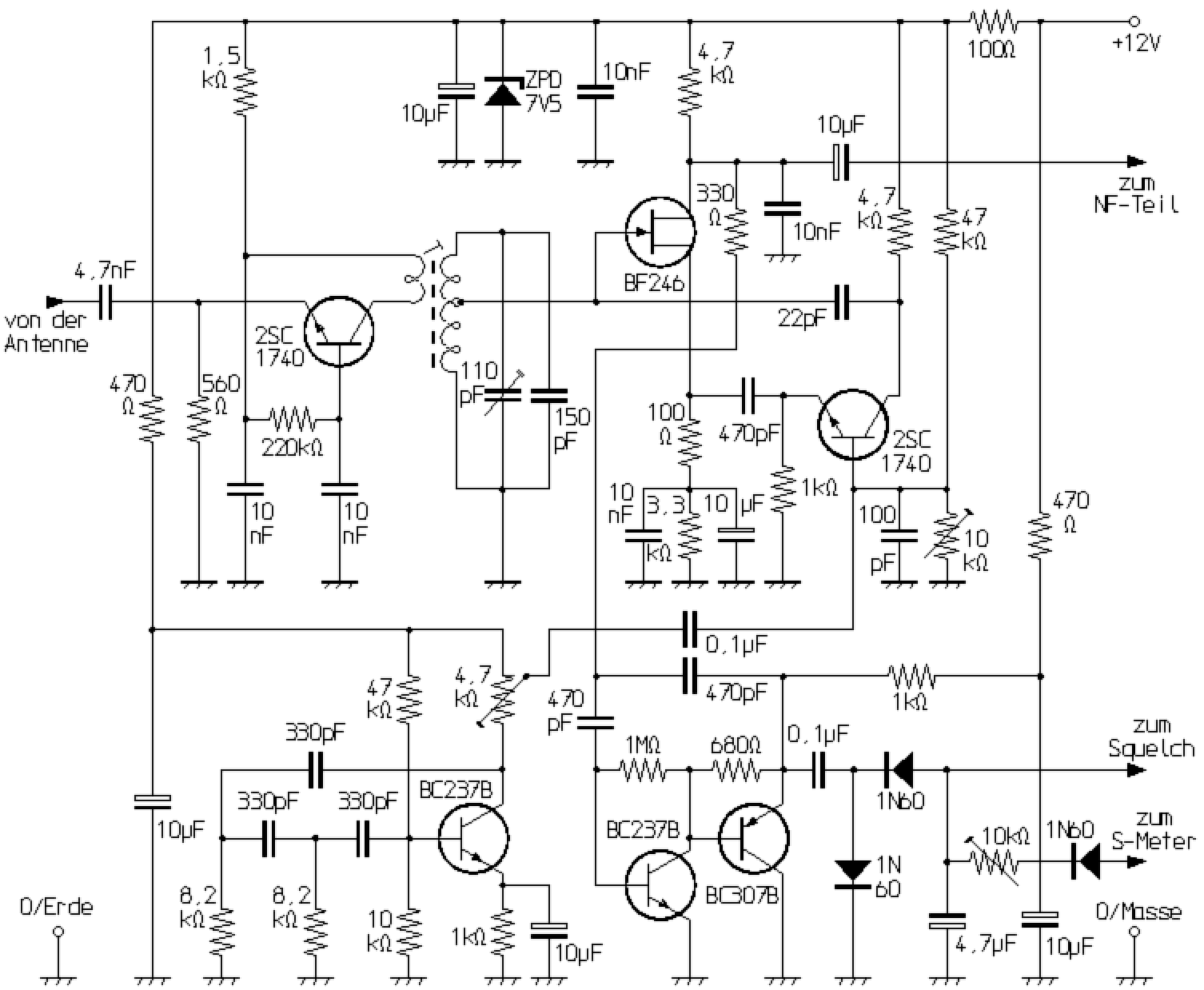
If the shown circuit is set to CB frequencies, stations operating on different channels could clearly be separated, as long as the channels were not too close to each other. Already at a distance of 20 kHz from the set frequency, with optimum justation of feedback and oscillation frequency amplitude a connected oscilloscope showed a reduction of almost 12dB. In contrast, several more closely-studied single-transistor super-regenerative receivers simultaneously picked up at least about 200 kHz wide areas without noticeable subsidence.
As with the simple super-regenerative receiver, which I first of all used in my homebrew walkie-talkies, I also designed a squelch circuit for this receiver later used there. As shown in the schematic, it was also possible to generate a DC voltage for the field strength display from the noise voltage. The blemish that the smallest pointer deflection thereby corresponds to maximum field strength can be compensated by a correspondingly reversed scale label. Another possibility is that the measuring unit is connected instead of ground with a corresponding to the maximum value supplied by the diode, adjustable DC voltage.
Although with integrated circuits today one can built superheterodyne receiver with significantly less effort and noticeably better properties, the construction of such a super-regenerative receiver is nevertheless an interesting experiment. In addition, it is unlikely that a receiver with comparable properties can be built, in which a single resonant circuit makes all selectivity.
The system-dependent control properties of a super-regenerative receiver are pleasant. Weaker stations are hardly received quieter, essentially increases - similar to otherwise only with FM - the noise component.