A simple stereo preamplifier with tone control
The stereo preamplifier shown here has separate bass and treble controls, a volume and balance adjusters and a contour switch. With this, the frequency response can be adapted to the frequency-dependent sensitivity of our hearing, depending on the volume set. The circuit of the tone control is often referred to as a "shelving equalizer" in the specialist literature.
The amplification of the single-stage arrangement is canceled again by the tone control network. In connection with a power amplifier that has sufficient input sensitivity (e.g. 500mV), such as the 50W power amplifier shown elsewhere on this website, you get an integrated amplifier with the corresponding input sensitivity.
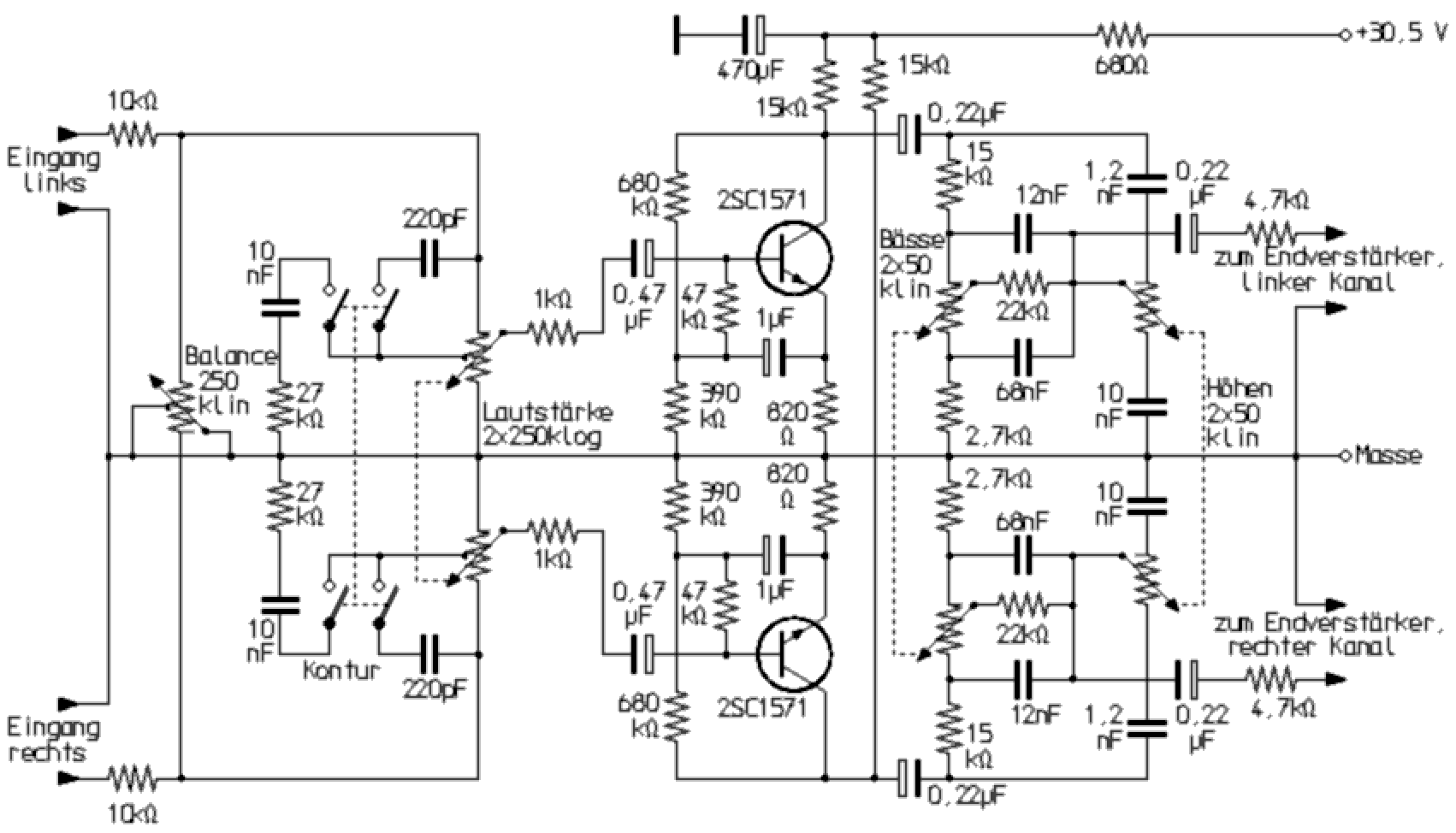
The circuit can also be easily combined with IC power amplifiers (e.g. TDA2030) to form an integrated amplifier. The template for this circuit was provided by the corresponding circuit part of a stereo amplifier with a hybrid power amplifier module from Sanyo from the 1970s. Instead of the specified transistor of type 2SC1571, a BC239 or better still a BC550 can be used with good success.
By using a bootstrap arrangement, the input also allows the connection of very high-impedance signal sources. A selector switch at the input could be used to switch between tape, radio and CD, for example. To connect a magnetic record-player pick-up system, a two-stage preamplifier with cutting characteristic equalization is required, as shown elsewhere.
Stereo preamplifier with active tone control for bass and treble
This is a tone control unit for use in higher quality stereo devices. The bass and treble setting circuit is in the negative feedback branch of the middle transistor stage. This arrangement achieves a linear gain when pots with center taps are used, so in middle position bass and treble are neither lowered nor raised. The adjustment range is in the range of just under ± 20dB.
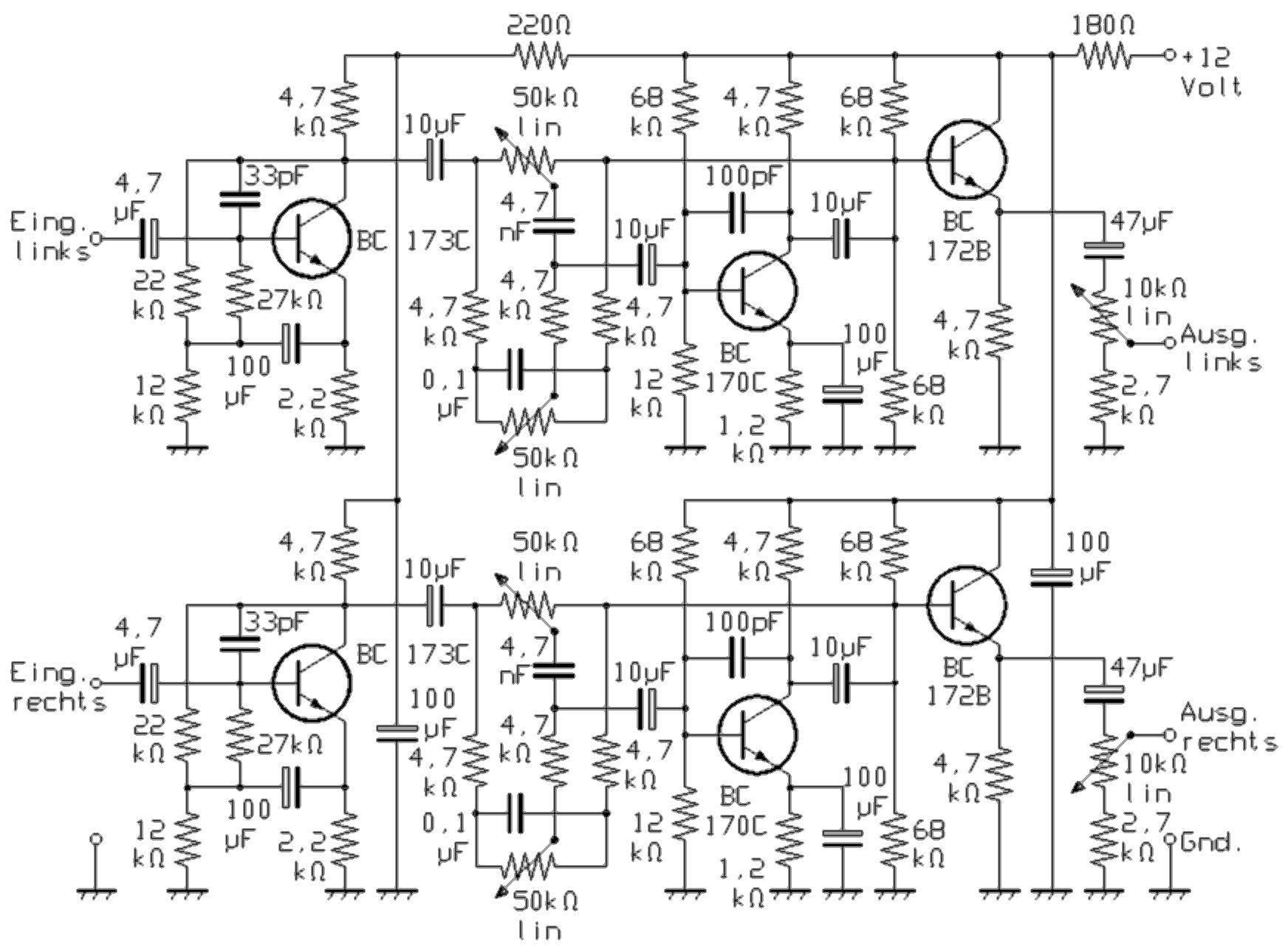
The input stage with bootstrap arrangement provides a high input impedance of over 100kΩ. The voltage is amplified here only by a factor of two, whereby the losses of the balance adjuster are removed, so that the assembly has no total voltage gain. If all the controls are in the middle position, this results in a total gain of 0dB. In the extreme settings of the adjustment pot, the balance setting each causes one channel to be raised by 6 dB, while the other is then lowered by just under 15 dB. As a common collector amplifier the output stage works as impedance converter. The properties of the tone control network and the balance setting therefore remains unaffected by the connected output load. So power amplifiers with input impedances of less than 5kΩ can be drived. The maximum output voltage is about 2 volts.
Circuit for volume contour with standard potentiometer
|
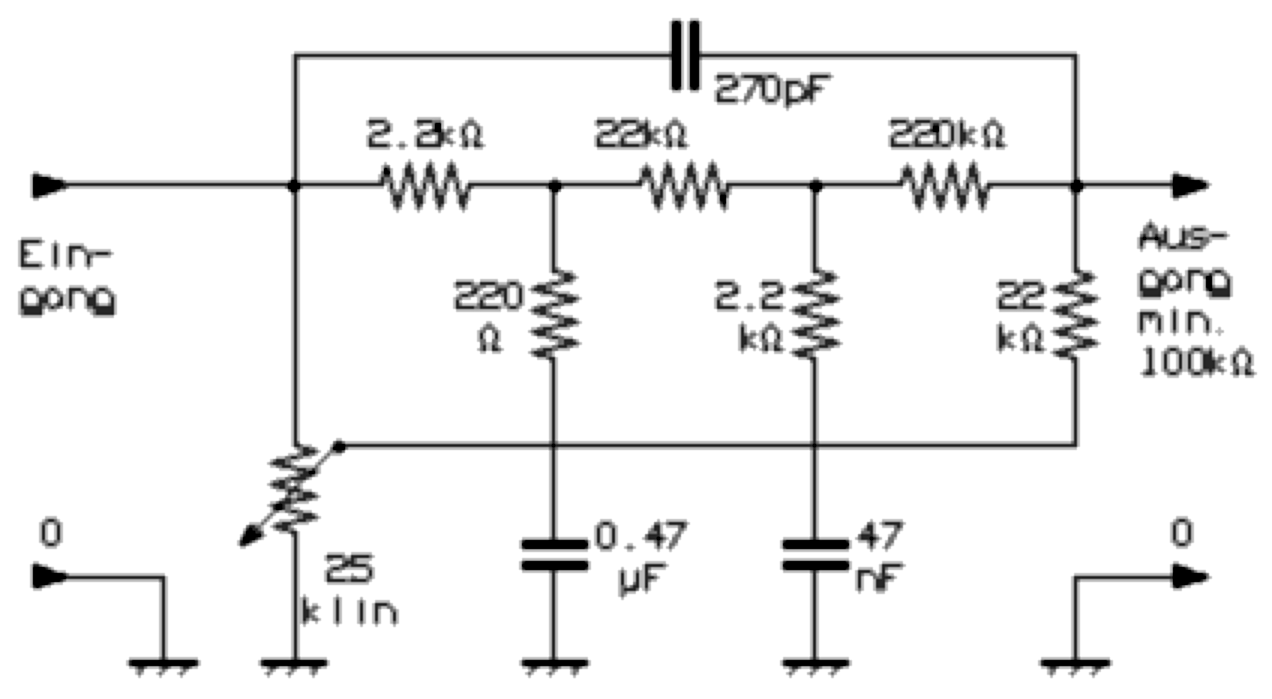
The preamplifier circuit shown at the beginning has a loudness control that adjusts to the varying sensitivity of our hearing at different frequencies by boosting lower and higher frequencies at lower volumes. That circuit requires a special potentiometer with a tap and logarithmic characteristic. However, there are also circuits for volume-dependent tone control that do not require a special potentiometer with taps. An example of this is shown here. The potentiometer should have a linear characteristic. For stereo, a tandem potentiometer and the entire circuit are required twice. |
|
Circuit for stereo width control and enlargement
Most stereo amplifiers have a mono button. With this stereo width control, however, a continuous adjustment between mono over stereo to super stereo is possible. The latter setting can be acoustically meaningful if the two boxes are too close to each other in relation to the listening distance. The adjustment range is approx. -24% to 100% (= mono).
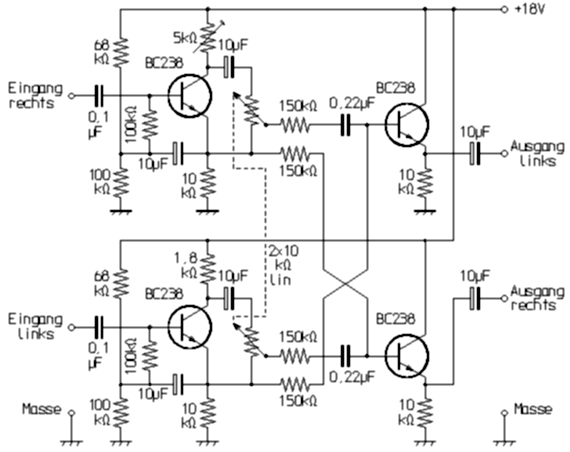
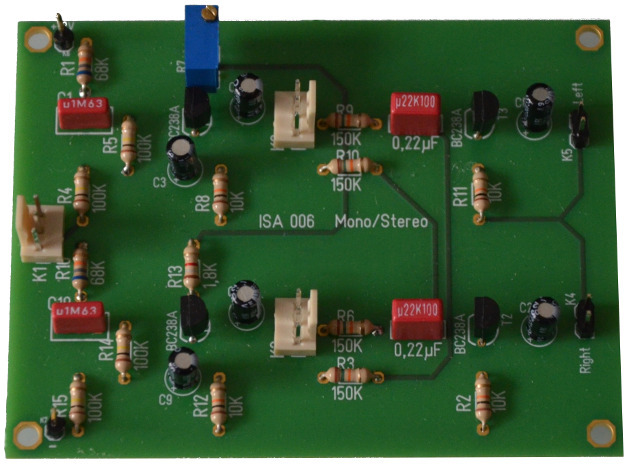
In order to achieve maximum headroom, an exact adaptation of the input-side base voltage divider can be useful. An exact adjustment can be made if the 68kΩ resistors on the far left of the schematic are replaced by 100kΩ spindle trimmers. About half the operating voltage should be present at the emitters of the output-side transistors. More accurate matching is possible with the sine wave signal of a test generator (for example, 1 kHz) and an oscilloscope, by feeding a signal at level limit and set with the two trimmers for the lowest possible distortion and symmetrical limitation. If these facilities are not available, the adjustation also performs well by ear. The photo shows the assembly of a reader. As you can see, he made a printed circuit board for the stereo width adjuster.