An SWR and power meter for 26-30 MHz
For a radio system to function optimally, the RF power supplied by the transmitter must be radiated as efficiently as possible by the antenna. This requires the antenna to be resonant. If it is not, the antenna acts more or less as a capacitive or inductive reactance. As a result, some of the power is reflected back towards the transmitter in the form of standing waves. Furthermore, for optimal impedance matching, the transmitter, feed line, and antenna must be compatible. To assess how well the power is radiated by the antenna, a standing wave meter (SWR meter), formerly often called a reflectometer, is needed. This device allows the intensity of the transmitted waves to be compared with the reflected waves. First, the forward reading is calibrated to full scale on the display instrument, and then the reverse reading can be obtained.
Radio hobbyist are often hesitant to build their own standing wave (SWR) meter. For lower frequencies up to about 30 MHz, the current transformer principle is more commonly used. This has the advantage of less frequency dependence in the meter's sensitivity. At higher frequencies, however, directional couplers are preferred. Depending on the design, a sufficient meter sensitivity for QRP (short-wavelength) devices can be achieved with a directional coupler from about 15 MHz upwards. With higher transmit power, it can also be used successfully at lower frequencies. Neither current transformers nor directional couplers are readily available as ready-made components. For higher frequencies, the directional coupler often consists of a U-shaped metal profile containing three insulated metal rods. One serves as the conductor for the transmitted signal, while the other two couple the signals for the propagating and reflected waves. Replicating such designs is not without its challenges regarding dimensions and materials and requires a well-equipped mechanical workshop. However, the template shown can also be used to easily build a directional coupler with an etched circuit board measuring approximately 8 x 5.2 cm. This board also provides space for the electronic components required for a standing wave ratio (SWR) indicator.
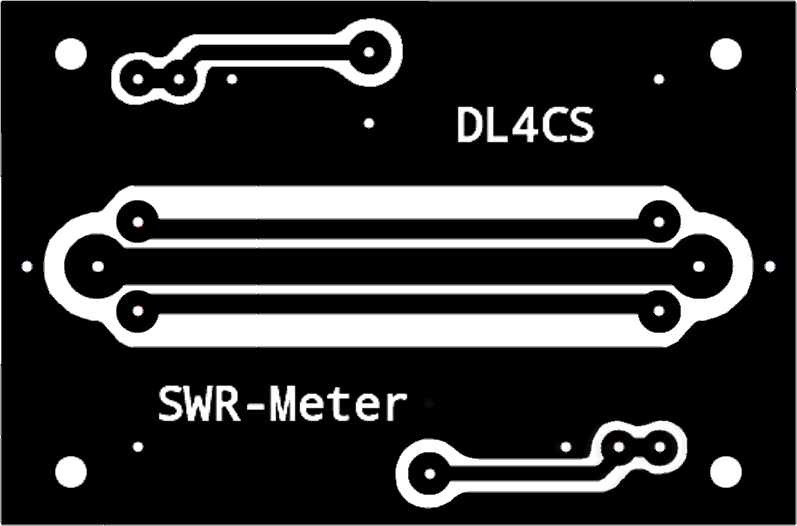
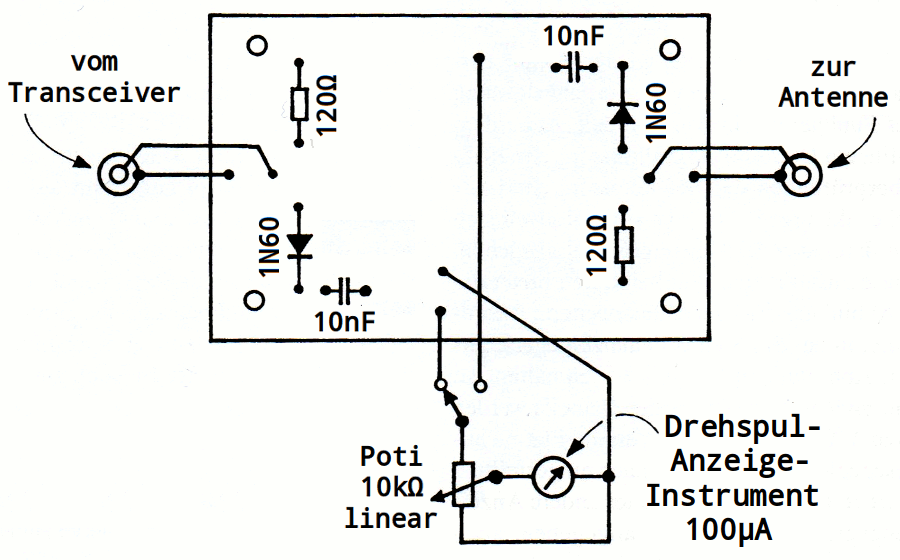
For display the standing wave ratio (SWR) with a moving-col instrument, the circuit board requires only two diodes, two resistors, and two ceramic capacitors. The 50Ω coaxial connectors for input and output should be connected to the corresponding terminals on the board using the shortest possible cable lengths. With proper construction, this SWR display is suitable for frequencies up to approximately 50 MHz. Higher frequencies can theoretically be processed, but the reactive components, which become not negligible in such a setup, cause the directional coupler itself to degrade the SWR and consequently distort the displayed values.
To calibrate the forward value to 100% pointer deflection, the switch shown in the assembly and wiring diagram below must be set to the position that generally results in the higher reading. In the other switch position, the standing wave ratio (SWR) can then be read directly. Switching is unnecessary if two moving-coil instruments and a tandem potentiometer with 2 x 10 kΩ linear resistors are used. In the device presented here, however, a second instrument serves a different purpose, which will be discussed later. To enable calibration to 100% even at lower transmit powers, the instrument used should have a sensitivity of at least 300 µA for full-scale deflection. Lower values (e.g., 100 µA) naturally improve the display sensitivity. Due to their higher threshold voltage, ordinary silicon diodes should not be used, as this also reduces the display sensitivity. The specified 1N60 germanium diodes are more suitable. Small-signal Schottky diodes (e.g. BAT41) would also be a viable alternative to normal silicon diodes.
A standing wave indicator device is usually also expected to allow the output power of the radio to be checked. The focus here is less on precise measurements and more on verifying that the transmitter is delivering its full power. The circuit diagram shows a display rectifier loosely coupled via a 2.2 pF capacitor, which drives a second instrument. Germanium diodes are used here as well. Transmit power checks, performed as in this case by measuring the voltage at the transmitter output, are only meaningful with a precisely matched antenna. Otherwise, the readings are unreliable. Therefore, the device also includes a dummy load of 50 Ω. With such a dummy load, transmitter output checks can be performed even without a connected antenna or with a faulty one. The display sensitivity, switchable between two values, can be adjusted using trim potentiometers (e.g., 1 watt / 10 watts). For the most precise adjustment, spindle trimmers are best. Due to capacitive coupling, the display sensitivity increases with increasing frequency. Therefore, the adjusted values are only accurate for a relatively narrow frequency range. However, in the 26 to 30 MHz range, the deviation remains acceptably small. Since a calibrated and broadband RF power meter requires more effort, this is also the case with many commercially available devices of this type.
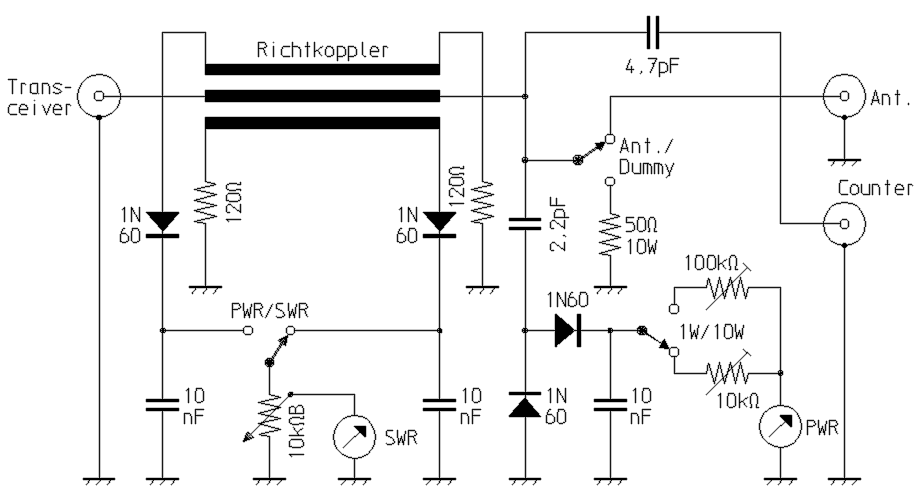
The 50Ω resistor used as a dummy load must be able to dissipate the intended power, i.e., convert it into heat, and therefore must have a corresponding power handling capacity. For measurements on a transmitter with a 10-watt output power, it must have at least this power handling capacity. Furthermore, it must be a low-inductance design. Older designs of high-power resistors are mostly wound wire resistors, which, despite reverse winding, still exhibit a significant self-inductance in the RF range. They are therefore unsuitable for such purposes. Since 50 ohms is not a common standard value for resistors, a combination of multiple resistors is recommended. This value can be achieved, for example, by connecting two 100Ω resistors in parallel. With a power handling capacity of 5 watts each, this results in a total of 10 watts. However, connecting a larger number of individual resistors is even better. If these resistors are connected in a star configuration with a ground plane, the overall inductance is reduced due to the parallel connection. For example, a suitable 10-watt dummy load can be easily created using twenty 1kΩ film or metal-film resistors, each with a power rating of 0.5 watts. Another advantage is that the individual resistors distribute the heat over a larger area.
Furthermore, the presented device features an output jack, which is also rather loosely coupled to the output. With the specified 4.7 pF coupling capacitor, the arrangement works perfectly with an existing frequency counter, which can be connected to it. If the counter has a high input impedance or a low input capacitance, the capacitor can be larger. The cable capacitance should also be taken into account. The additional components for the power indicator and the counter output are connected to the circuit board, switches, and jacks via point-to-point wiring.
Finally, a few notes on the correct use of the device. First, it should be noted that the significance of the standing wave ratio (SWR) in relation to radiated power is generally considerably overestimated. At an SWR of 3, which is where the red zone on the scale usually begins, half of the voltage and current are reflected. Since power is the product of current and voltage, a quarter of the transmitted power does not reach the antenna in this case. Theoretically, 75% of the power is still radiated. However, since an S-unit is generally considered to be 6 dB, for a drop in received signal strength of one S-unit, the radiated power would have to fall to a quarter of the transmitted power, and thus 75% of the power would have to be reflected. Viewed in this light, an SWR of 3 at the receiving location would, at most, affect the displayed S-value by the width of a pointer. In reality, this would only be true if the SWR meter were installed directly at the antenna feed point. In practice, however, such a device is installed at the station between the transceiver and the antenna cable. This is also sensible because many radios have a protection circuit that reduces the transmit power or switches off the transmitter if the SWR is high. With simpler or older devices, there is even a risk of overloading or damaging the transmitter stage. Since this is the main reason why the SWR should be checked at least from time to time, this arrangement serves its purpose. However, the SWR meter installed at this point measures the entire assembly consisting of the cable and antenna, without indicating whether the actual antenna element is actually delivering the intended power. Consequently, the drop in the S-value at an SWR of 3 can be higher in practice.
In general, the best possible SWR should be aimed for, primarily because otherwise the radiation of RF energy via the feed line can interfere with neighboring devices and may even radiate into the microphone input of the transmitter itself. With FM, this often leads to distorted and quieter modulation; with AM, it can also cause low-frequency oscillations ("squealing"). Similar interference can occur with SSB devices, although it is more difficult to pinpoint. However, if the antenna is resonant, it is not always necessary to achieve a zero SWR reading. With some antenna types, this is simply unattainable.
To actually measure at the antenna feed point, the directional coupler board can be housed in a remote enclosure. Since only direct current flows here, the two wires leading to the display via the switch and potentiometer can be made almost arbitrarily long. Only the display unit itself then remains in the station. Incidentally, remote SWR measurement adapters of this type are quite common in professional radio technology.
Regarding the power meter, it should be noted that it is hardly suitable for aligning transmitters. This applies particularly to the harmonic filter at the transmitter output. If cores are unscrewed or coils are bent apart, the increasing sensitivity with frequency can lead to misleading readings that suggest a higher power output. A larger pointer deflection does not mean that the transmit power has increased, and certainly not at the operating frequency. These manipulations merely increase the harmonic content of the transmitted signal, while the power at the operating frequency generally decreases due to the resulting impedance mismatch. Such alignment work should be carried out with a frequency-selective measurement setup or, ideally, with the aid of a spectrum analyzer.