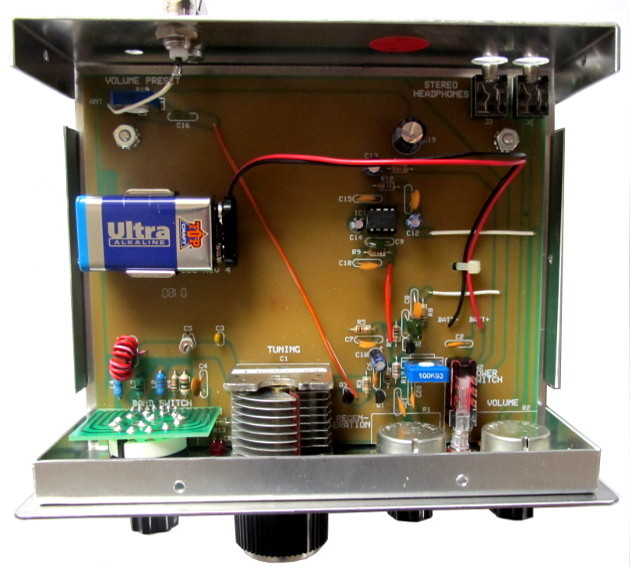
Regenerative receivers from various manufacturers
With minimal circuit complexity, regenerative receivers are known to achieve remarkable results. In the simplest case, such receivers operate with an input amplifier stage that amplifies one half-wave of the high-frequency antenna signal more strongly than the other. Thus, exactly what one seeks to avoid in a hi-fi amplifier occurs: the signal is amplified non-linearly, resulting in distortion. However, this primarily affects the high-frequency (RF) signal. With proper dimensioning, this non-linear operation, in conjunction with a capacitor that shorts the high frequency to ground, effects a low-distortion demodulation of amplitude-modulated (AM) transmissions.
To filter out the desired reception frequency using only a single resonant circuit, the high-frequency signal at the output of the amplifier stage is simultaneously fed back to the input of the circuit. To prevent the circuit from oscillating uncontrollably—as it would then function as an oscillator—this feedback is designed to be adjustable. When set just below the point of oscillation, such a receiver achieves its best selectivity. Due to the use of only one resonant circuit, these regenerative receivers were often referred to as single-circuit receivers. Especially in the era of vacuum tube devices, they were frequently called Audion receivers. Indeed, the historical development of the vacuum tube was directly linked to the Audion circuit.

Even today, much can still be done with such devices. In the medium and long wave bands, most broadcasting stations have unfortunately ceased operations; in the past, countless stations could be heard there with these simple devices. Nowadays, only a few foreign stations can be received—primarily during the evening hours. Many broadcasters have also shut down in the shortwave range. However, due to the greater propagation ranges, numerous stations can still be heard here with a good antenna.
A further specialty of such receivers is that they also allow for the reception of telegraphy (CW) and single-sideband (SSB) stations. For this purpose, the feedback must be increased until oscillations just begin to set in. The non-linear characteristic then allows the stage to function as a self-oscillating product detector, which transposes the high-frequency signal into the audio range, much like a direct-conversion receiver. Consequently, such receivers remain valuable today, particularly as educational objects for amateur radio beginners. Thus, the existence of numerous kit offers for such devices is hardly surprising—from the early days to the present. Some particularly interesting designs of this type are presented below.
0V2 Type V receiver from Teva
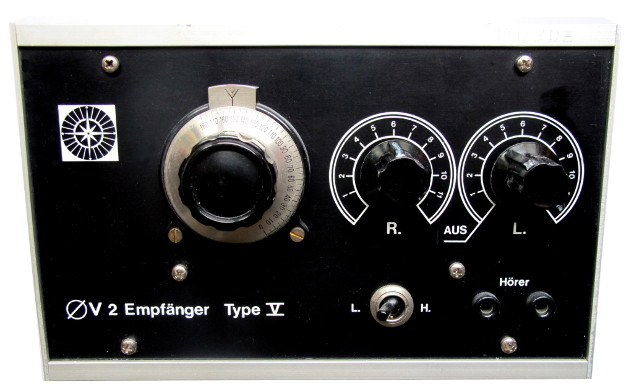
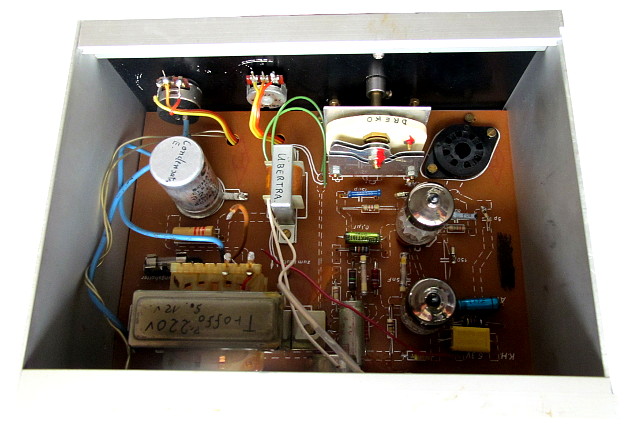
After successfully building my 0V1 receiver with an ECC81 tube, I searched for a suitable template for an even better device. Technik-Versand company from Bremen, had published a number of amateur radio kits under the label Teva, including the Audion receiver presented here. It seemed very suitable for reproduction. In addition, the device was expressly praised by an older OM: He had once possessed such a device. So I set out to build a device in accordance with this circuit template, but without using the kit. I soon found the parts I needed by disassembling old broadcast receivers.
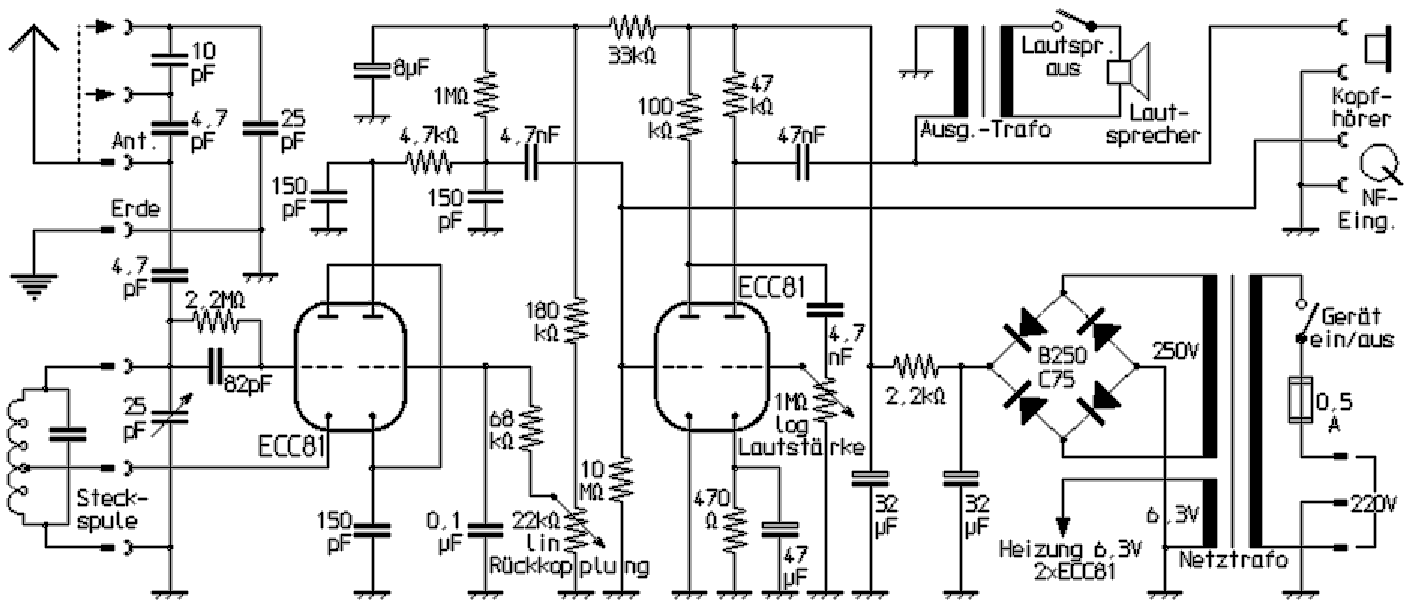
The two-stage audio section with the right-hand ECC81 offered sufficient gain reserves, also for the loudspeaker reception of weaker stations. The left ECC81 was used in a cascode audion formation. The regeneration feedback or respectively the oscillation generation came about in the manner of an ECO oscillator. The feedback adjustment with DC via a bias shift of the system operated in grounded grid circuit resulted in only minor frequency alterations. This receiver proved to be superior to a regenerative circuit using a pentode with adjustable screen grid voltage in my experiments. The regeneration onset was pleasantly soft and the sensitivity was very good. Due to the three antenna connections, the coupling could always be well adapted to the reception situation and to the existing antenna. The upper antenna socket was better for longer antennas, the lowers for shorter ones. The smaller detector level with slacker coupling resulted in less distortion by synchronization in the SSB reception and could be compensated well by higher audio gain, reachable with the two AF stages.
To simplify the replica, here are the winding data for the plug-in coils for receiving the classic SW amateur bands (coil diameter each about 30mm).
- 80m band: abt. 29 turns enamelled copper wire 0,3mm, tapping at 5 turns, parallel C = 33pF
- 40m band: abt. 11 turns enamelled copper wire 0,7mm, tapping at 3 turns, parallel C = 82pF
- 20m band: abt. 5 turns enamelled copper wire 0,7mm, tapping at 2 turns, parallel C = 27pF
- 15m band: abt. 3,5 turns enamelled copper wire 0,7mm, tapping at 1 turn, parallel C = 68pF
- 10m band: abt. 2,5 turns enamelled copper wire 0,7mm, tapping at 1 turn, parallel C = 82pF
'Trabant KM' from Radio RIM
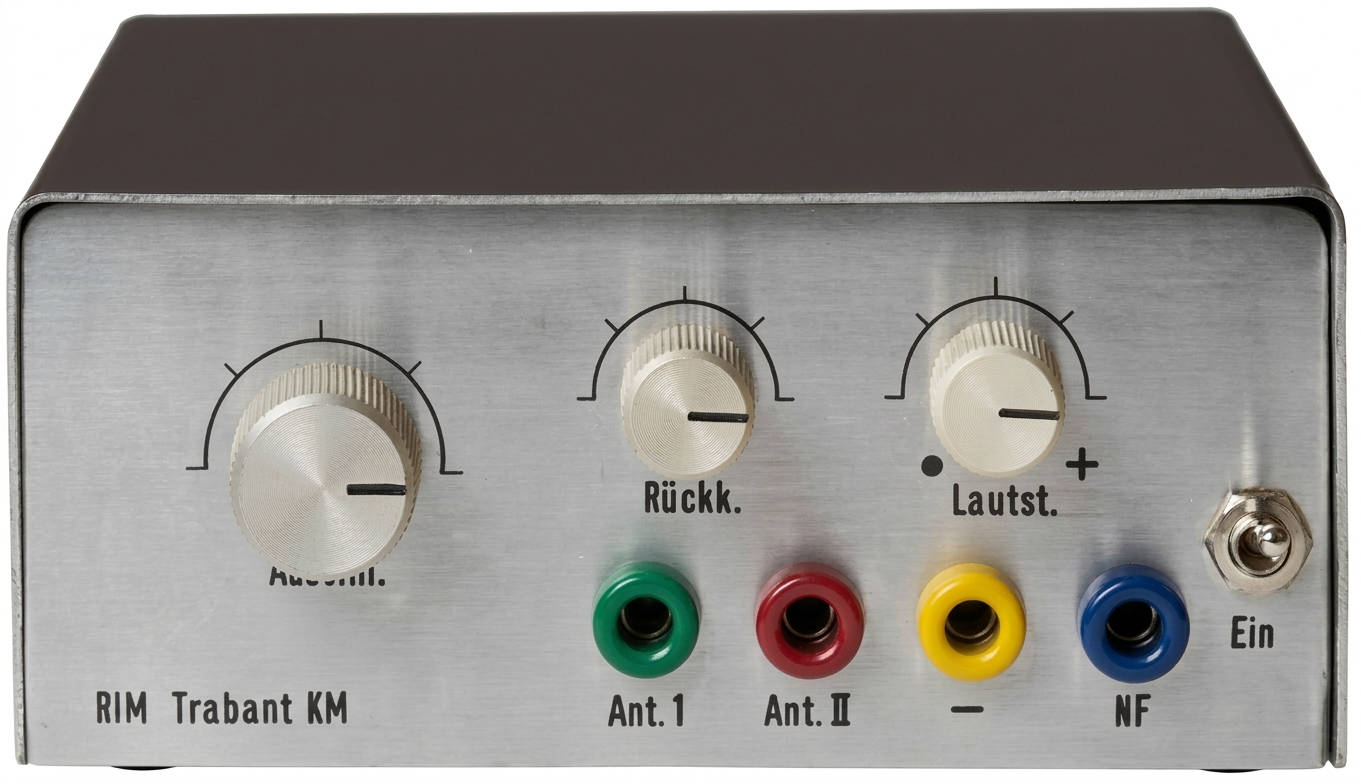
As already mentioned with the one tube receivers, Heinz Richter introduced the circuit of the Trabant KM in one of his books. It was a transistorized SW plug-in coil receiver, which was sold by Radio RIM with printed circuit board and housing from the late 1960s as a kit. I copied that circuit, but in the form of a self-construction on a wood board. This was my first self-made regenerative receiver with transistors that worked decently. With a blocking circuit in the antenna line, which was tuned to the very strong medium-wave local broadcast transmitter, usable reception could be achieved from about 2 MHz. So I could at least listen to it in the lower shortwave area working maritime radio stations (such as Norddeich Radio), which at that time still in AM sent. Medium-wave reception, however, despite blocking circuit due to my short distance to the local medium-wave broadcast station did not succeed, as it penetrated everywhere under 2 MHz. Anyhow could be received on all SW radio bands at that time almost countless radio stations. The regeneration was setting on smoothly and changed the tuning only a little so that the circuit could easily be adjusted for high sensitivity.
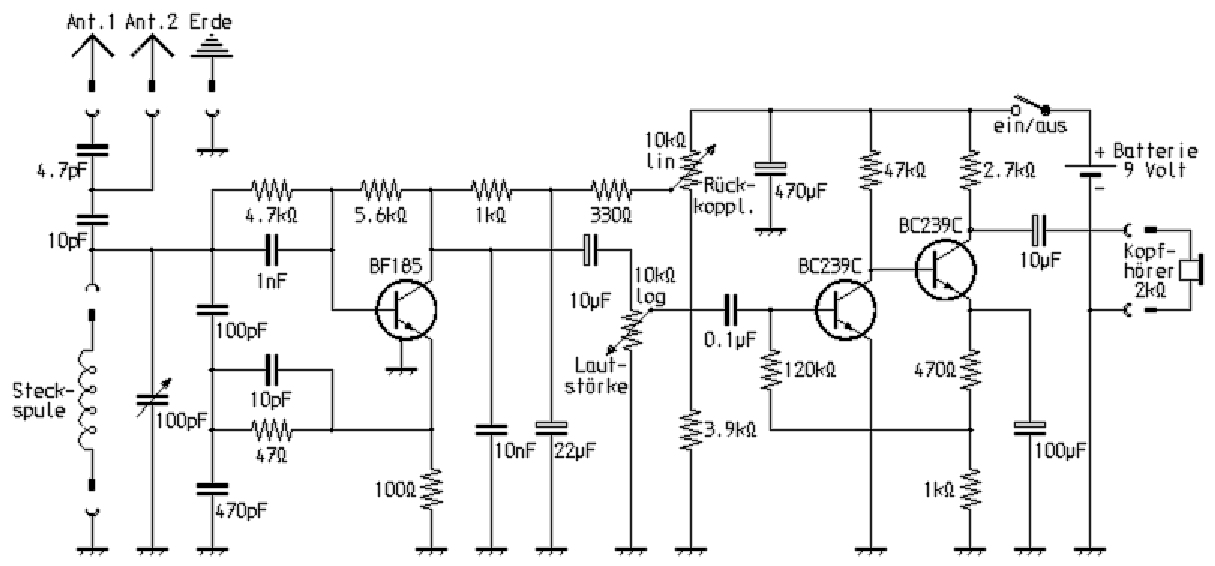
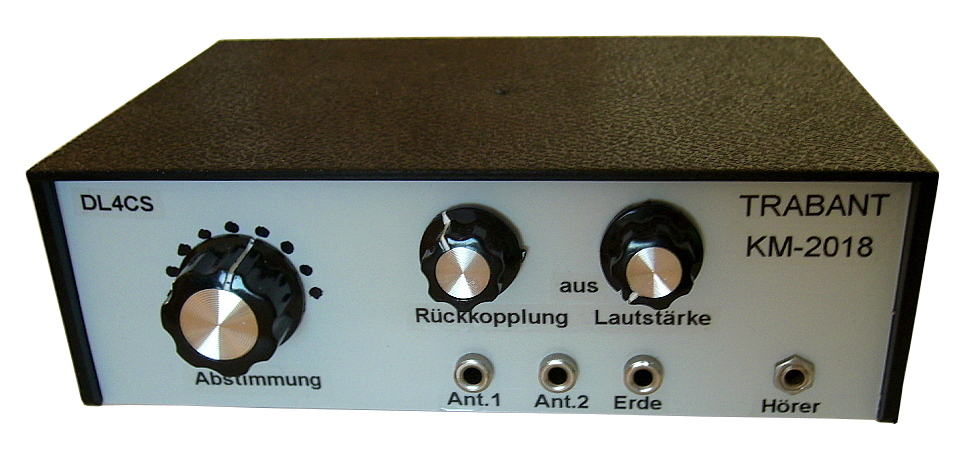
The then good experience with this circuit recently led me to build such a device again. I wanted to be largely based on the original model in order to judge that device from today's perspective. Consciously, I therefore abstained from a ball drive or parallel fine tuning rotary capacitor, as with the original. After I had everything assembled and wired together, the device shown below worked immediately, playing the program of "Radio China International" at a good volume.
A little bit over the beginning of the oscillation turned, the receiver can be used in principle for the reception of telegraphy stations and even for SSB reception. Without fine drive or band spread, however, a clean setting hardly succeeds even with a lot of tact. The damping of the resonant circuit is greater, as in circuits with tubes or field effect transistors and the achievable selectivity is therefore not quite as good. At least, several radio stations in one and the same SW broadcasting radio band can usually be well separated. The selectivity is so good that exact tuning requires a lot of tact even at AM stations. Sometimes individual radio stations become so strong due to the propagation conditions that they can not be separated from neighboring stations. The problem with the breaking in of the local medium-wave broadcast transmitter, on the other hand, is eliminated today, because they have stopped their operation a while ago.
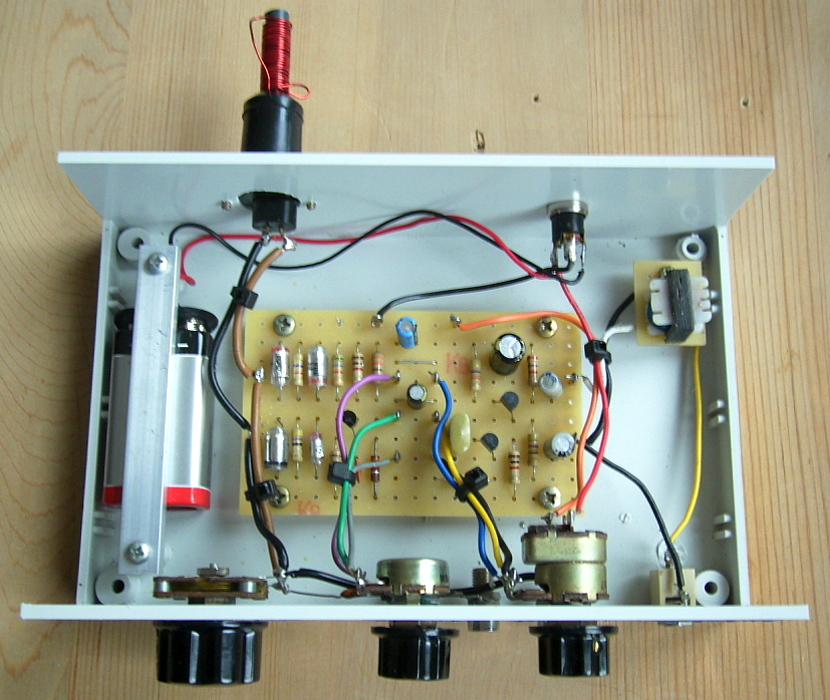
Since the original circuit is designed for high-impedance communication headphones, as you hardly get it today, I have installed a matching transformer. It is a small push-pull driver transformer from an old clock radio, in which the one half of the winding, which was actually intended to drive one of the two output transistors, is connected to the headphone jack. This is wired so that a modern, low-impedance stereo headphones can be connected. The volume achieved in this way is so great that at strong stations, the volume control must be turned back significantly.
The plug-in coils are wound on 6 mm plastic rods, as they are e.g. remain when truncates poti axes. Those are sticked into DIN-plugs and fixed with adhesive. With the shown coil with 30 turns, the range of 7 to 12 MHz can be received with the 200pF variable capacitor I use.
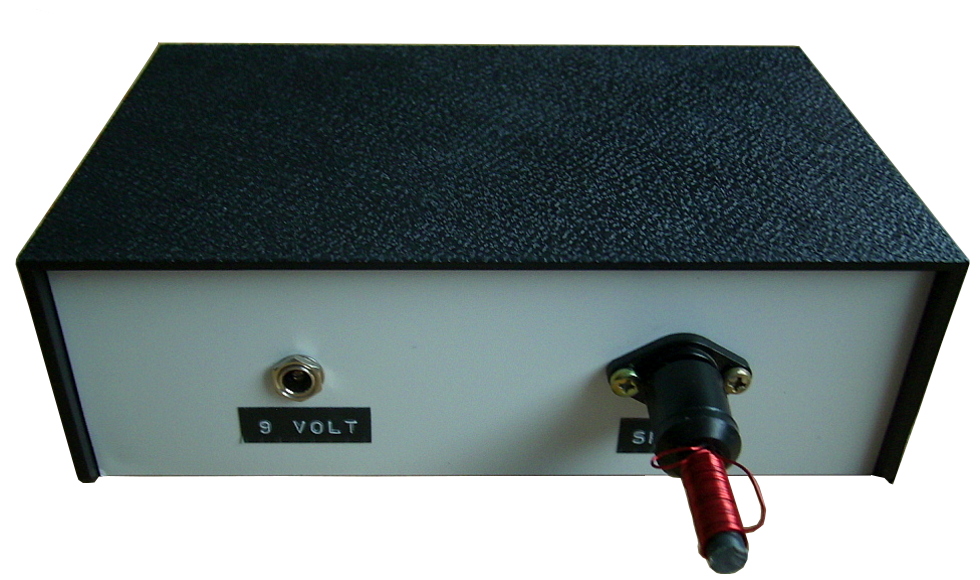
Long before I already had used to improve the circuit and design of the original in various ways. Among others I used a variable capacitor for VHF, whose disk packs I wired in parallel. This gave me a good band spread. As a result of the 1: 3 fine drive contained in the rotary capacitor, SSB stations could still be set with sufficient accuracy up to the 20m band. Usable AM reception was even possible beyond 30 MHz. CB radio stations, as well as radio amateurs, which made at 28.5 MHz AM operation usually with modified CB radio devices, I could receive with a in this way wired device in great quality. In addition, I supplemented the device with a power amplifier, so that also powerful speaker reception was possible. In this way, a complete device, built in a wooden housing, gave me as a schoolboy a lot of fun.
Encouraged by this, another device was created around such a circuit. I had designed this as a monoband receiver for the 80m band and equipped it with an RF preamplifier. As a result, the frequency stability and the recurrence accuracy improved considerably. In addition, I inserted between the receiving unit and its speaker amplifier a preamplifier, which mainly only the voice frequency parts increased in the range of 300 to 3000 Hz. Neighboring SSB and CW stations could be well suppressed with sufficient feedback dosage. One can also regard the SSB demodulation in the oscillating state of the regenerative receiver as a direct conversion receiver with self-oscillating mixing stage. Direct conversion receivers only reach their selection through NF filtering. So quite similar results are achieved for SSB and CW with the regenerative receiver. Similarly, so the unwanted sideband is not suppressed. In contrast to the direct conversion receiver with separate oscillator, however, the circuit of the transistorized regenerative receiver at high signal strengths is very prone to synchronize to the input signals, resulting in distortions. After a adjustment of the operating point of the preamplifier stage led to strong frequency alterations, I added a 5kΩ potentiometer in the antenna line as RF controller. Thus, the received signal could be well dosed in order to avoid synchronization distortions largely.
Taken into the summer vacation to northern Denmark, I listened with this into a wooden box built device to various SSB circles. It was a special experience when I was able to receive a QRP station from the north sea coast of the Netherlands in a legible manner. It was aboard a sailing yacht, transmitting in SSB with only one watt.
The 'Science Fair Globe Patrol' receiver
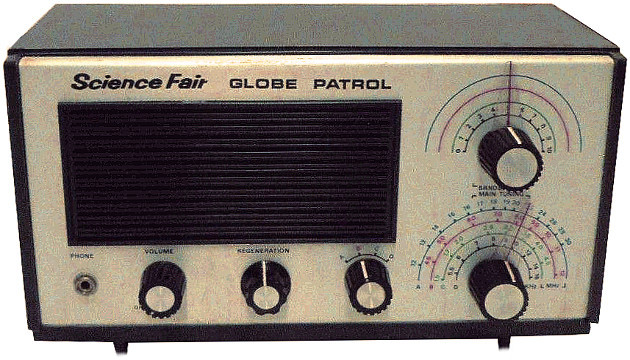
This device is a Japanese-made regenerative receiver that was sold as a kit by the US electronics trading company Radio Shack (Tandy) in the early 1970s. Largely unknown in Europe, as a result it was possible to acquire a useful feedback receiver for receiving short and medium waves at a price of about 20 dollars, which did not burden the pocket money budget of a student too much. The device covers a continous reception range from 550 kHz to 30 MHz over four switchable wavebands. With feedback set shortly before the start of the oscillation, AM stations can be received with a usable selectivity. If the feedback is set so that the circuit begins to oscillate, the device - like all regenerative receivers - works as a kind of self-oscillating direct mixer. Since the device is equipped with main tuning and fine tuning and a mechanical fine drive is available, SSB and telegraph stations can be set to work well, especially on the lower short waves.
For example, advertisements for this device said:
Build yourself a world of excitement! Hear foreign broadcasts, Hams, CB, aviation and marine calls, regular AM stations. Battery powered 'Science Fair' kit gets 'em all. Band spread control, built-in speaker, earphone jack. Instructions include 'Where to Listen' guide. At our store near you. Or postpaid - add applicable post taxes.
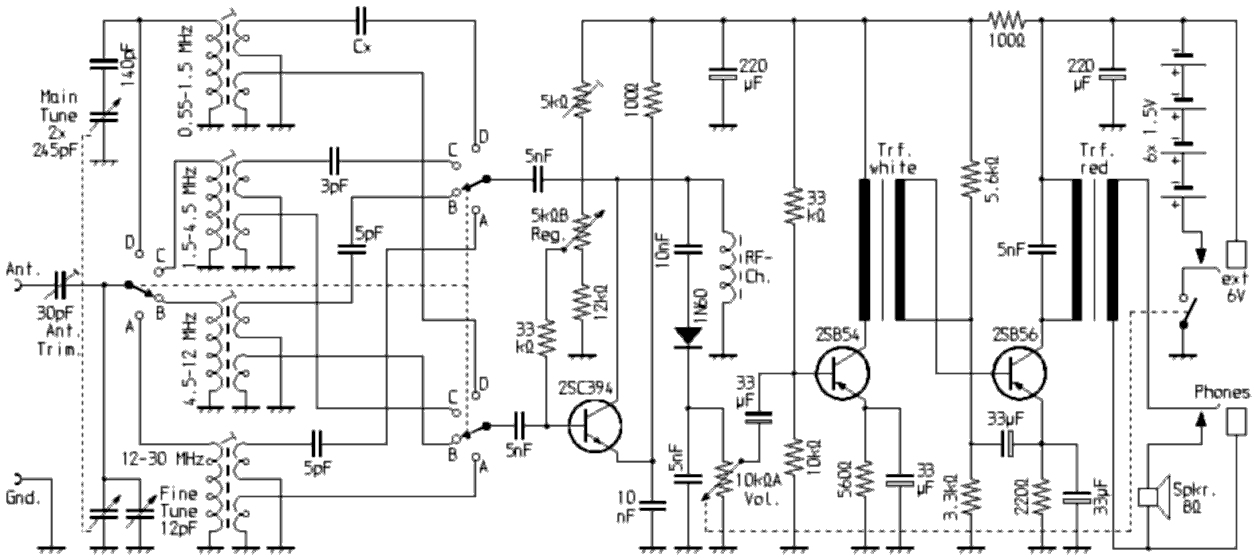
At the time of appearance, the schematic like many Japanese products at the time had a rather conservative design. The germanium transistors in the audio part are particularly noticeable. But the transformer coupling enables the best power adjustment between the stages and to the loudspeaker. With the only two-stage amplifier arrangement, therefore, usable loudspeaker reception is still possible. The demodulation or mixing takes place with a germanium diode. An oscillator circuit with feedback according to Meißner is used for undamping respectively superposition. In the medium wave range, no feedback capacitor is shown in the original circuit diagram. However, since the regeneration regulator also works here, it must ultimately be exist. I assume that the feedback takes place here via the switching capacitance of the lines laid to the wave switch. The unknown capacity is designated here as Cx.
Unfortunately, the design makes the device rather unsuitable for replication without the kit, as the structural design and the nature of the coils and their coupling windings for feedback and adaptation to the transistor input have a decisive influence on the function. Nevertheless, considering the result, this extremely simple circuit is not uninteresting. The coupling to the antenna can be adjusted on the input side with a trimmer capacitor. For the best selectivity and stable SSB-CW reception, the coupling should be chosen so loosely that the required reception volume is just achieved.
TEVA 5001 FET regenerative receiver for 80-10m
The regeneration receiver presented here also was offered in the 1970s by Technik-Versand in Bremen as a kit. It was intended as a beginner device and allowed the reception of the five amateur radio bands in the 80m, 40m, 20m, 15m and 10m range. The circuit diagram is divided into a regenerative detector with a field effect transistor, a two-stage transistorized audio preamp, the LF power amplifier with an IC and the power supply. The range change takes place in this device by a band switch. As you can see, the range switchover takes up the largest space in the schematic.
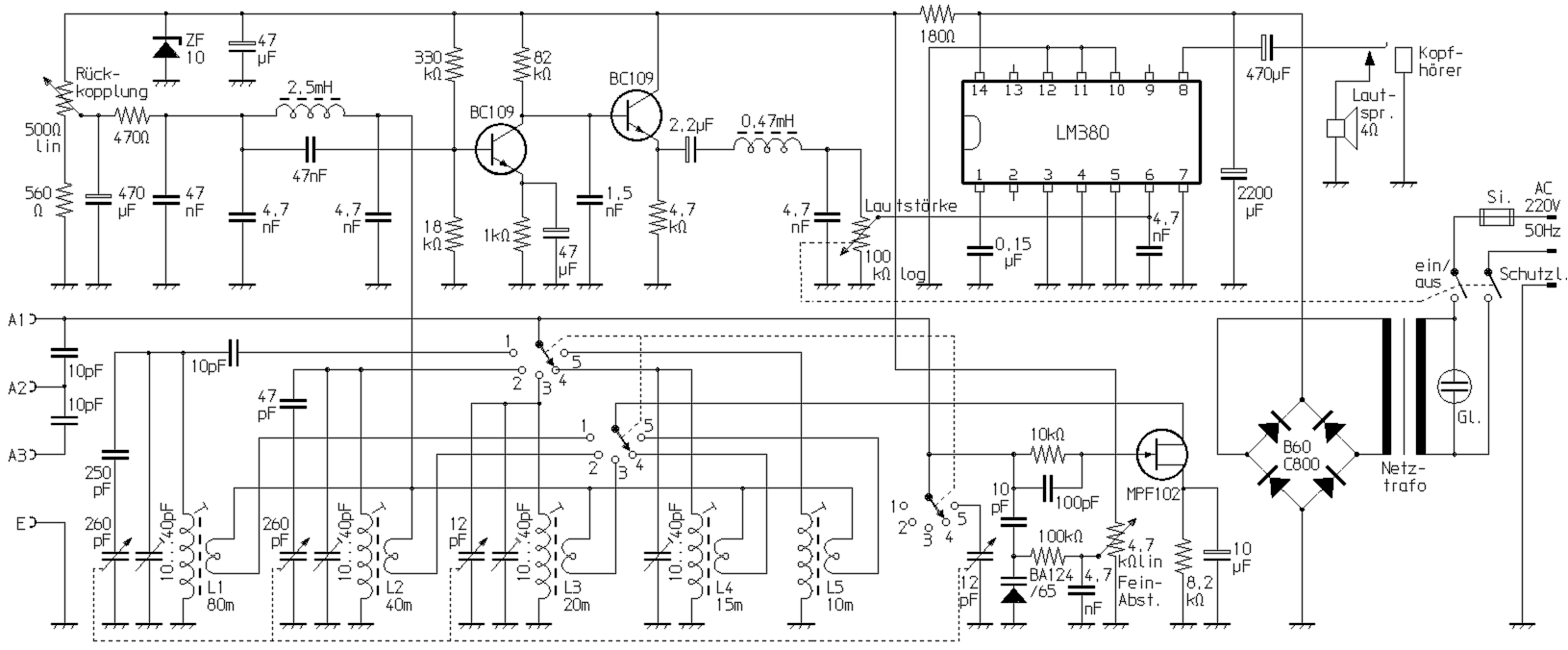
The entire circuit, including the RF coil set and power supply, was built on a printed circuit board, greatly had simplified the wiring and thus the overall design. The fully assembled and mounted board is shown on the next picture. Here, too, shows that the switchable coils for the switchable five wavebands take up quite a lot of space.
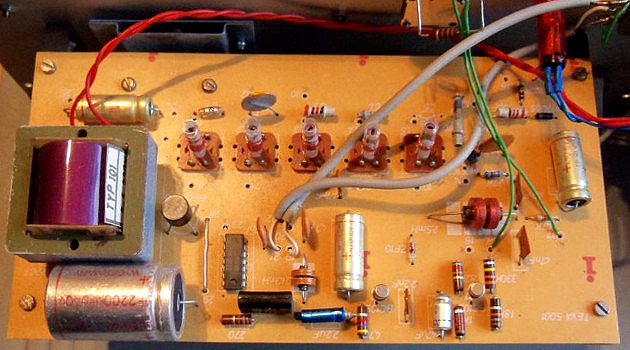
The most difficult and time-consuming thing in construction was the work of coil winding. On the immediately shown photo of the bottom of the board, the switch for the band switching can be seen together with its wiring and the tuning rotary capacitor. The latter is a version, as it was formerly used in transistorized AM-FM-Kofferradios. There, the 12pF segments were intended for VHF tuning. The 260pF segments, on the other hand, served as frequency tuning on the center wave. If available, they were of course also used to vote on short and long waves. The Dreko is connected to the front-side control knob via a planetary gear. This allows a sufficiently sensitive adjustment of SSB and CW stations.
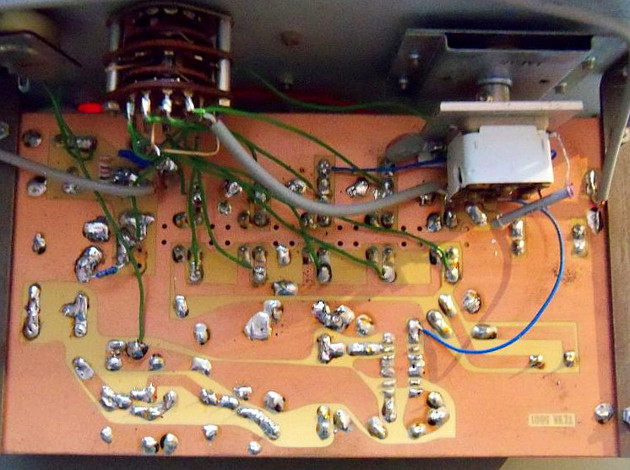
The device is in principle well suited for the replica, especially since hardly any special parts are needed. It is also possible to build on a dot board. Instead of the LM380, you'd probably use an LM386 today. It is important in the replica or in your own experiments with such a circuit, the correct polarity of the feedback windings, otherwise no regeneration can come about. Unfortunately, there are no coil data, so they have to be determined experimentally. Experience has shown that the feedback windings should have about 20 to 25% of the number of turns of the coils.
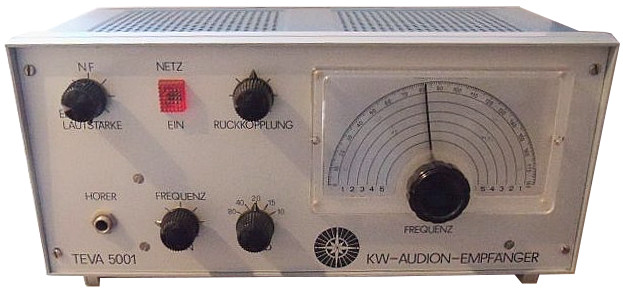
Below, in my opinion, the very appealing exterior of an original device is shown. Many thanks to Joachim Jarling for the giving the photos!
The Regenerative Receiver MFJ-8100
Here's the schematic of the MFJ-8100 regenerative receiver produced by MFJ Enterprises. The circuit offers many suggestions for your own experiments. The RF part works with three field effect transistors (FET) of the type J310, the AF part with the very popular LM386 integrated circuit. Very replica-friendly is the use of pre-wound coils for the lower four frequency ranges. Only for the top area a small toroidal coil with 8 windings has to be wound.
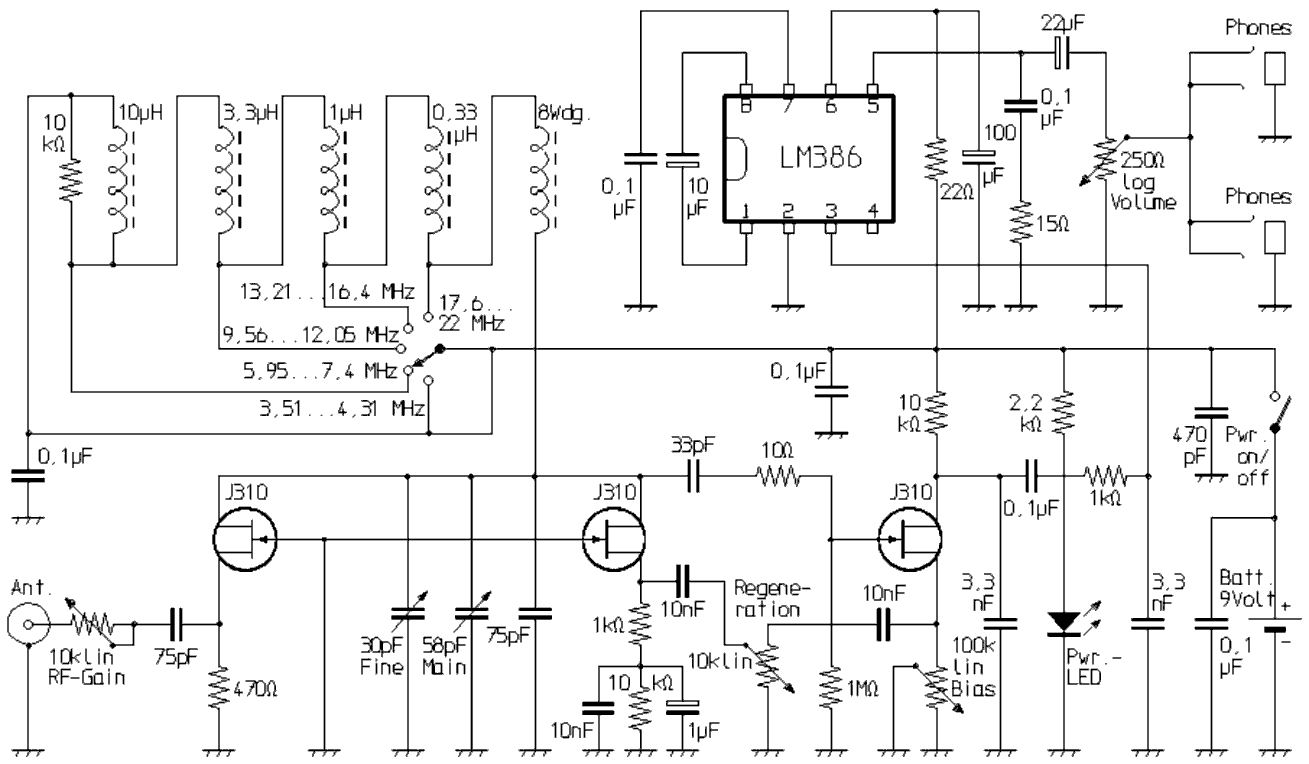
In principle, it is a regeneration receiver in the manner of an audion. In the input there is a RF preamplifier with a FET in gate grounded arrangement. That makes the tuning largely independent of the antenna. The second FET also works in a gate grounded arrangement. It only serves to amplify the voltage in the feedback branch. The third FET works as a kind of an audion detector in source grounded arrangement. For the regeneration, it also works as an RF amplifier in a drain grounded arrangement. With this basic circuit, the voltage gain is always less than one, which would not be sufficient for undamping the resonant circuit. The arrangement with the second FET as a voltage amplifier results in in-phase feedback with sufficient loop gain. This makes it possible to use a simple resonant circuit without taps or coupling windings, which considerably simplifies the wiring of the wave switch and makes the overall structure of the RF part very uncritical.
The regeneration is adjusted in an unusual way by a potentiometer in the signal branch. Although this requires a potentiometer that is sufficiently suitable for RF applications, it has the advantage of a soft oscillation approach and less frequency influencing. The potentiometer in the source conduction of the third FET is used to set the bias point and is adjusted to the best compromise between good amplification and clear sound.
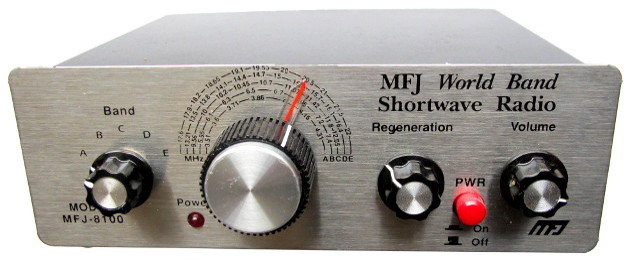
Once the regeneration is set shortly before the approach of the oscillation, the device enables clean reception from AM radio stations without having to constantly readjust the feedback potentiometer. Compared to cheap or older world receivers, as with all direct receivers, the lack of any image frequencies is noticeable very positive. The device is also quite suitable for SSB and telegraphy reception. To do this, the feedback adjuster only needs to be turned a little beyond the start of the oscillation. The circuit then works as a very sensitive direct conversation receiver. However, there is no sideband suppression. In contrast to many other regeneration receivers, the circuit has very little tendency to synchronize, so that the SSB reception also sounds very clean.